Use regional skills data to evaluate in-demand skills in 2026 and get practical insight into stronger program design and approval cases.
Economic Development
Education

By Chmura Economics & Analytics
Published Jul 4, 2026
Key Takeaways
-
Regional skill evidence helps institutions move from broad skill trends to specific curriculum choices tied to local employer needs.
-
Program-to-occupation mapping gives skills context, especially when one program prepares students for several related roles.
-
Stronger approval cases connect skills, occupations, openings, wages, and coursework into a clear workforce narrative.
The strongest program design choices come from regional skill evidence, not national lists of popular abilities. Skills-based hiring has raised the bar for program planning because employers are looking more closely at what graduates can do, while education teams still need to connect those skills to courses, credentials, occupations, wages, and approval cases.
National skill reports can help start the conversation, but they cannot tell you which skills matter most in your labor market. Chmura data also shows why skill planning needs program-to-occupation context: a single program can connect to multiple roles, and each role can carry a different mix of technical, analytical, communication, and management requirements.
Regional skill needs should guide program design choices
Regional skill needs should guide program design because programs are approved, funded, taught, and evaluated in specific labor markets. A skill that looks important nationally can carry less value locally if nearby employers are hiring for a different mix of roles, technologies, credentials, or experience levels.
A college updating a business analytics program, for instance, should not assume that every analytics role requires the same tool set. Local job postings might show frequent requests for SQL, dashboard reporting, market research, and stakeholder communication, while another region emphasizes Python, machine learning, cloud tools, and statistical modeling. Both markets need analytical talent, but the curriculum choices should differ.
This is where skills evidence becomes more useful than a generic list of the most in-demand skills. Program teams need to know which skills appear across related occupations, which ones are tied to stronger wages, and which ones connect to entry-level roles students can realistically pursue after completion. Without that regional filter, curriculum updates can sound current while missing the actual hiring case.
National skill lists miss local employer requirements
National skill lists miss local employer requirements because they flatten differences across industries, regions, and job levels. They can identify broad themes, such as analytical thinking or AI literacy, but they rarely show how those skills appear in local postings or which employers are asking for them.
The World Economic Forum reported that analytical thinking was considered a core skill by nearly 70% of employers in its 2025 skills outlook, which confirms the broad importance of reasoning and problem-solving. That figure helps set context, but it does not tell a nursing dean, CTE director, or workforce board which skills should be added to a local program next.
A regional healthcare market might value patient communication, electronic health record systems, case coordination, and bilingual service skills. A manufacturing region might pair analytical thinking with quality control, maintenance diagnostics, safety procedures, and production scheduling. The broad skill label is useful only after it is translated into the work students will actually do. Regional skill evidence gives curriculum teams that translation step.
Job postings reveal which skills carry regional value
Job postings reveal regional skill value because they show how employers describe current hiring needs in the roles connected to a program. They help institutions see the difference between skills that are nice to mention and skills that appear repeatedly across jobs tied to local employment pathways.
A cybersecurity program offers a clear example. Local postings might show network administration, incident response, identity access management, cloud security, and risk documentation appearing across related roles. If those skills appear across systems administrators, security analysts, network support specialists, and information systems managers, the program has stronger evidence for building a skill sequence rather than adding one isolated course.
Skills-based hiring makes this work more important. Indeed Hiring Lab found that 52% of United States job postings on Indeed did not mention a formal education requirement as of January 2024, up from 48% in 2019. That shift puts more pressure on institutions to show what graduates can do. Degree titles still matter, but the skill story behind each program must be clearer, more specific, and easier for stakeholders to understand.
Occupation linkages show where each skill belongs
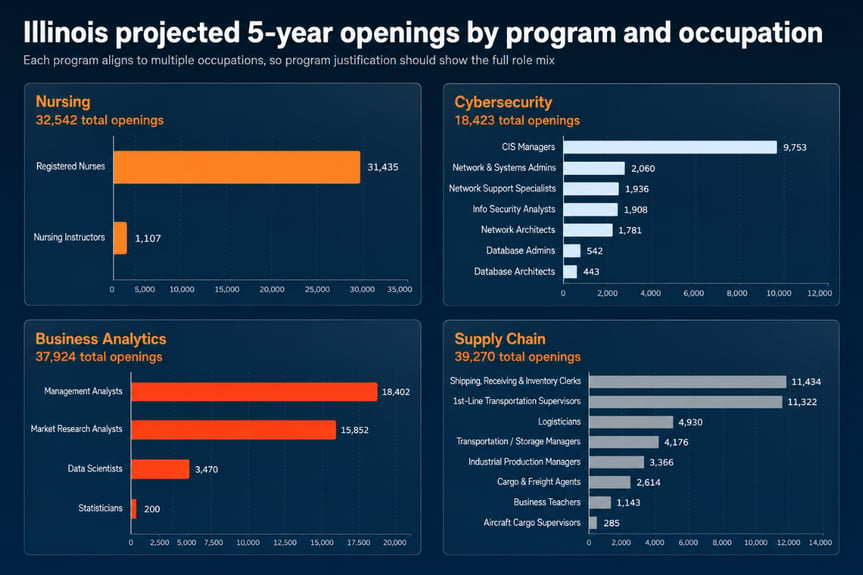
Occupation linkages show where each skill belongs because a program rarely prepares students for only one job title. Skills gain meaning when they are connected to the occupations, career levels, and work settings that graduates are likely to enter after completion.
Chmura’s Illinois example shows the issue clearly. The registered nursing program aligns primarily to registered nurses, with 31,435 projected total openings over 5 years, but it also connects to postsecondary nursing instructors with 1,107 projected total openings over the same period. The program is not just tied to one workforce outcome. It supports a portfolio of related roles with different skill expectations.
That same logic applies to cybersecurity, business analytics, and supply chain programs. A skill like data analysis can support management analysts, market research analysts, data scientists, logisticians, or operations managers, but the level of math, software, communication, and domain knowledge will differ. Program teams should map skills to the right occupation cluster before deciding where they belong in the curriculum.
|
Program planning question |
Stronger skills evidence to review |
|
Which skills should receive the most course time? |
Skills that appear across several related regional occupations deserve more weight than skills tied to a narrow role. |
|
Which skills belong in introductory courses? |
Skills common to entry-level postings should appear early so students can build usable foundations. |
|
Which skills belong in advanced courses? |
Skills tied to higher-wage or leadership roles should appear later as progression markers. |
|
Which skills support funding requests? |
Skills connected to projected openings and regional employer needs make grant narratives easier to defend. |
|
Which skills need employer validation? |
Skills with mixed signals across postings, wages, and occupations should be reviewed with advisory groups. |
“Skills gain meaning when they are connected to the occupations, career levels, and work settings that graduates are likely to enter after completion.”
Program teams need skill clusters before course updates
Program teams need skill clusters before course updates because individual skills can be misleading when viewed alone. A single tool, certification, or software name does not define a program. The stronger planning unit is a cluster of skills that appear together in related roles.
A supply chain program can illustrate the difference. Inventory control, transportation coordination, spreadsheet analysis, vendor communication, warehouse systems, and process improvement each matter, but the program design question is how those skills fit into a pathway. Some belong in an introductory operations course. Others belong in logistics analytics, procurement, or management coursework.
A practical skill cluster review should answer 5 questions before course revisions begin:
- Which skills appear most often across the program’s target occupations?
- Which skills are tied to stronger wages or advancement roles?
- Which skills belong in entry-level work that students can reach soon after completion?
- Which skills require equipment, software, faculty training, or employer partnerships?
- Which skills support credentials, grants, board reports, or advisory committee priorities?
This keeps curriculum planning focused. It also protects teams from overreacting to isolated skill mentions that look urgent but have limited value across the broader employment pathway.
Skills-based hiring raises proof standards for programs

Skills-based hiring raises proof standards because employers, students, funders, and boards want clearer evidence of what a program prepares learners to do. Program claims now need to connect outcomes to specific skills, not just completion counts or broad occupational categories.
A data analytics proposal, for example, will be stronger when it shows how the program prepares students for management analyst, market research analyst, data scientist, and statistician roles. Chmura’s Illinois data shows those related occupations carry different levels of projected openings, from 18,402 management analyst openings over 5 years to 200 statistician openings. That difference should shape the program story.
The practical lesson is not that smaller occupations should be ignored. It means the curriculum narrative should match the regional hiring pattern. Broad analytics skills can anchor the program, while specialized quantitative skills can support advanced tracks, certificates, or elective options. That structure helps institutions make a stronger case without overstating the opportunity.
Wage signals help rank skills with stronger payoff
Wage signals help rank skills because not every skill carries the same labor market value. Postings show what employers ask for, while wage evidence helps institutions understand which skills are associated with roles that offer stronger earnings, advancement, or specialization.
A cybersecurity program might see many postings for help desk support, network administration, and information security analysis. Each role can share technical foundations, but wages and career pathways will differ. If cloud security, risk management, or incident response skills are linked to higher-level roles, those skills deserve careful placement in advanced coursework rather than casual mention across the program.
This matters for student outcomes and funding conversations. Students need a clear view of which skills help them enter the field and which skills support progression. Boards and funders need to see that program design is connected to economic value, not just employer terminology. Wage signals do not replace faculty judgment, but they help teams set priorities when every skill seems important.
Regional skills data strengthens curriculum approval cases
Regional skills data strengthens curriculum approval cases because it turns a broad program idea into a defensible education decision. The strongest cases connect skills, occupations, openings, wages, employer needs, and course design into one clear narrative that stakeholders can follow.
A strong approval case does more than say employers need cybersecurity, nursing, analytics, or supply chain talent. It shows which regional occupations the program supports, which skills appear across those occupations, which courses teach those skills, and which labor market signals justify the investment. That level of detail helps reviewers see the connection between classroom changes and workforce needs.
Chmura’s regional skills data helps institutions make that connection with more discipline because it places skills inside the actual markets, occupations, and program pathways that education leaders need to defend.
"The judgment is simple: skills should not be added because they are popular. They should be added because they strengthen a clear pathway from curriculum to regional opportunity."