Get practical insight into workforce alignment using employer skill data, regional patterns, and faculty review to support curriculum decisions.
Education

By Chmura Economics & Analytics
Published Jul 4, 2026
Key Takeaways
- Curriculum alignment is strongest when program competencies are tested against regional employer skill language before gaps are named.
- Job postings help faculty separate wording mismatches from true curriculum gaps.
- A shared evidence base helps academic affairs, institutional research, and CTE leaders defend program decisions with more confidence.
Curriculum alignment works best when program competencies are tested against the specific skills employers request in regional job postings. That test gives academic affairs, institutional research, and Career Technical Education (CTE) leaders a shared way to discuss workforce alignment without reducing curriculum review to anecdotal employer feedback or broad occupation summaries.
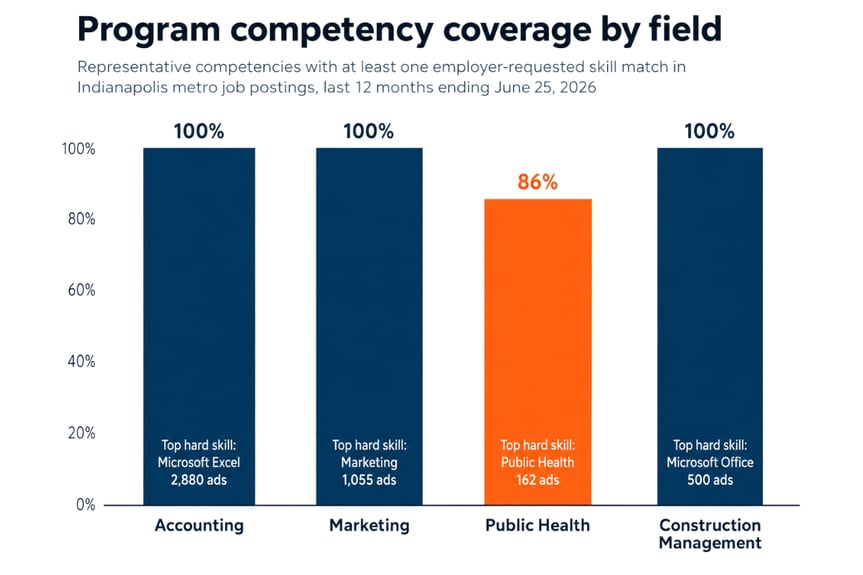
The Indianapolis metro analysis for the last 12 months ending June 25, 2026, shows why that level of detail matters. Accounting, marketing, and construction management each had 7 of 7 representative competencies matched to at least one employer-requested skill, while public health had 6 of 7 matched. That level of coverage suggests strong alignment at the headline level, while still leaving room for faculty review of tools, methods, and compliance language that course outcomes can miss.
Curriculum alignment starts with clear program competencies
Curriculum alignment starts with the skills, behaviors, and applied knowledge a program already expects students to build. Employer skill data becomes useful only after those competencies are clear enough to compare against hiring language, job requirements, and workforce credentials.
An accounting program might list competencies such as preparing financial statements, applying Generally Accepted Accounting Principles (GAAP), using spreadsheets, evaluating internal controls, and communicating financial findings. Those statements are specific enough to compare with job postings that mention Microsoft Excel, financial reporting, accounting software, reconciliation, and public accounting.
The important step is starting with the institution’s own academic intent. Labor data should not rewrite a program before faculty have defined what the program is designed to teach. It should pressure test whether those competencies are visible in the labor market and whether employer language supports the way the program is currently described.
Vague competencies create weak alignment work. Clear competencies give reviewers a defensible starting point because everyone can see what is being matched, what is missing, and what still needs academic judgment.
Employer skill signals help test each competency
Employer skill signals help test whether program competencies show up in the language employers use when they hire. A competency does not need to match a posting phrase perfectly, but it should connect to skills that appear often enough to support a curriculum review discussion.
Chmura’s analysis of Indianapolis metro postings found that communication, teamwork, and detail orientation appeared across all 4 reviewed programs. Program-specific hard skill signals were more varied, including Microsoft Excel for accounting with 2,880 ads, marketing with 1,055 ads, public health with 162 ads, and Microsoft Office for construction management with 500 ads.
That pattern matters because curriculum alignment is rarely about one skill. Shared foundational skills cut across programs, while technical skills show where each program needs a more tailored review. A marketing curriculum that covers research, digital campaigns, and performance analysis should be checked against postings that mention marketing, customer relationship management, digital marketing, sales, and Microsoft Excel.
|
Curriculum review question |
What the labor data helps clarify |
|
Are program competencies visible in employer language? |
Posting skills show whether academic outcomes connect to current hiring requirements. |
|
Which skills are shared across programs? |
Cross-program signals help leaders identify common competencies that deserve institution-wide attention. |
|
Which skills need program-specific review? |
Hard skills help faculty focus on tools, methods, and technical requirements tied to each field. |
|
Where are course titles too broad? |
Skill data can reveal whether a course name hides important employer-requested abilities. |
|
What requires faculty judgment? |
Implied skills need review before leaders call them gaps or curriculum weaknesses. |
“Labor data should not rewrite a program before faculty have defined what the program is designed to teach.”
Job postings show where skill language differs
Job postings show where employer language uses different words than curriculum language. That difference is not automatically a gap. It often means faculty need to translate between academic outcomes and the language employers use in hiring.
A public health competency such as interpreting public health data could connect to epidemiology, health data, program evaluation, or population health language. If a posting says “public health” but the syllabus says “community health assessment,” the match might be valid even when the words are not identical.
This is where curriculum alignment becomes more than a spreadsheet exercise. A direct match is useful, but an implied match needs careful review. Faculty can decide whether a competency already covers the employer skill, whether the course needs clearer language, or whether the curriculum should add more explicit coverage.
The risk is treating every wording mismatch as a program weakness. That can lead to unnecessary curriculum edits and weaker faculty buy-in. A better process separates wording issues from true content gaps.
Workforce credentials need evidence beyond course titles
Workforce credentials need evidence that connects course content to employer skill needs. Course titles alone rarely provide enough detail to support program review, grant applications, advisory board discussion, or workforce alignment claims.
A construction management program might include project planning, cost estimating, safety regulations, team coordination, drawings, quality assurance, and risk management. Job postings connected to that program can help test those areas against skills such as project management, Microsoft Office, Microsoft Excel, supervision, problem solving, organization, and detail orientation.
That evidence matters when a credential is being reviewed for funding or program value. Stakeholders need to see more than a catalog description. They need a clear connection between what students are expected to learn and what employers are requesting in the region.
Strong credential review uses several layers of proof. The program defines competencies. Job postings show employer skill language. Faculty interpret the match. Institutional research can then package the findings into a report that supports the review without overstating what the data proves.
Faculty review should separate gaps from implied skills
Faculty review should separate true gaps from skills that are already present but not named clearly. A posting skill that does not appear word for word in a competency list should be flagged for review before anyone treats it as missing curriculum content.
This distinction is especially important when technical tools, methods, or compliance requirements are implied. An accounting competency about financial reporting could already include spreadsheet use, GAAP, and accounting software, but the curriculum map should show that connection clearly enough for reviewers to defend it.
A practical review process should ask 5 questions:
- Does the competency clearly describe what students will know or do?
- Does employer skill language support the competency?
- Is the skill explicitly taught, assessed, or only implied?
- Does the program need a wording update or a content update?
- Can the match be explained clearly to stakeholders?
Those questions reduce overreaction. They also protect academic quality because faculty are not asked to chase every posting phrase. The goal is to make curriculum decisions with enough evidence to support action, not to turn postings into a checklist.
“Curriculum alignment will never be a simple match score.”
Regional patterns reveal which skills deserve priority

Regional skill patterns help leaders decide which curriculum updates deserve attention first. National skill lists can be useful context, but regional postings show what employers nearby are requesting from graduates and credential earners.
The Indianapolis data shows how different programs require different prioritization. Accounting postings had strong signals for Microsoft Excel, accounting, GAAP, reconciliation, and financial reporting. Marketing postings pointed to marketing, customer relationship management, Microsoft Office, Microsoft Excel, digital marketing, and sales. Construction management postings placed project management among the top soft skill signals while also showing office tools and spreadsheet requirements.
Those differences matter for program planning. A single institution-wide workforce alignment process should still allow each program to make field-specific judgments. Accounting faculty will care about audit, reporting, and software. Marketing faculty will care about campaign execution, research, and customer tools. Construction management faculty will care about planning, estimating, safety, and project coordination.
Regional prioritization also makes stakeholder communication stronger. A curriculum recommendation tied to local employer language will be easier to defend than a generic statement about workforce needs.
A shared evidence base reduces curriculum review friction
A shared evidence base reduces disagreement because academic affairs, institutional research, CTE directors, faculty, and advisory boards can work from the same set of skills and assumptions. The data does not remove debate, but it makes the debate more specific.
A curriculum review meeting can stall when one group brings employer anecdotes, another brings course catalogs, and another brings broad occupational forecasts. A shared alignment file gives the group a common reference point. It shows each competency, the related employer-requested skills, the number of postings, and whether the match is explicit or implied.
This is one reason JobsEQ can fit naturally into the curriculum review workflow. The value is not just finding labor market data. The practical value is helping teams turn program questions into a workforce snapshot that faculty and administrators can discuss with the same evidence in front of them.
Shared evidence also improves repeatability. Once a process is defined, institutions can use it across programs, funding cycles, and advisory board updates. That consistency saves time and makes recommendations easier to explain.
Defensible workflows turn alignment into stakeholder confidence
Defensible workflows make curriculum alignment useful because they connect evidence, academic judgment, and stakeholder communication. The strongest process does not treat labor data as an automatic answer. It uses labor data to focus review, clarify tradeoffs, and support decisions that faculty and leaders can explain.
That discipline matters over time. A program with strong headline alignment can still need better wording, clearer assessment, or more visible coverage of tools and methods. A program with fewer direct matches can still be well designed if faculty can explain how competencies connect to employer needs.
Chmura’s role fits best when curriculum teams need a shared evidence base that makes review faster and easier to defend. The work is strongest when JobsEQ data and expert support help teams move from scattered questions to a clear program alignment analysis that stakeholders can understand.
Curriculum alignment will never be a simple match score. It is a careful review of what a program teaches, what employers ask for, and what the institution can defend. The payoff is a process that respects faculty expertise while giving leaders stronger evidence for program reviews, workforce credentials, funding cases, and stakeholder reporting.