Workforce Pell is more than a financial aid expansion. Learn how the new federal rule could accelerate workforce data modernization, integrated education and labor systems, and demand for labor market intelligence across states.
Workforce
Education

 By Jay Gentry
The U.S. Department of Education’s newly finalized Workforce Pell Grant rule marks one of the most significant shifts in workforce and postsecondary policy in years. Beginning July 2026, eligible students will be able to use Pell Grants for short-term workforce training programs designed to prepare learners for high-skill, high-wage, and in-demand occupations.
Much of the early discussion around Workforce Pell has focused on affordability, access, and the expansion of short-term credential pathways. But beneath the policy headlines lies another major transformation: states are now being asked to build, or significantly modernize, the workforce data infrastructure required to operationalize Workforce Pell at scale.
That may ultimately become the most consequential aspect of the legislation.
Workforce Pell pushes states toward integrated workforce data systems
Under the proposed and emerging final rules, governors and state workforce boards will play a central role in determining which programs qualify for Workforce Pell funding. Programs must demonstrate alignment with:
• High-skill, high-wage, or in-demand occupations
• Employer hiring requirements
• Stackable educational pathways
• Longitudinal learner success metrics
In practice, many states will need to integrate datasets and systems that historically operated independently, including labor market information, postsecondary records, wage records, workforce program participation, credential registries, and occupational taxonomies.
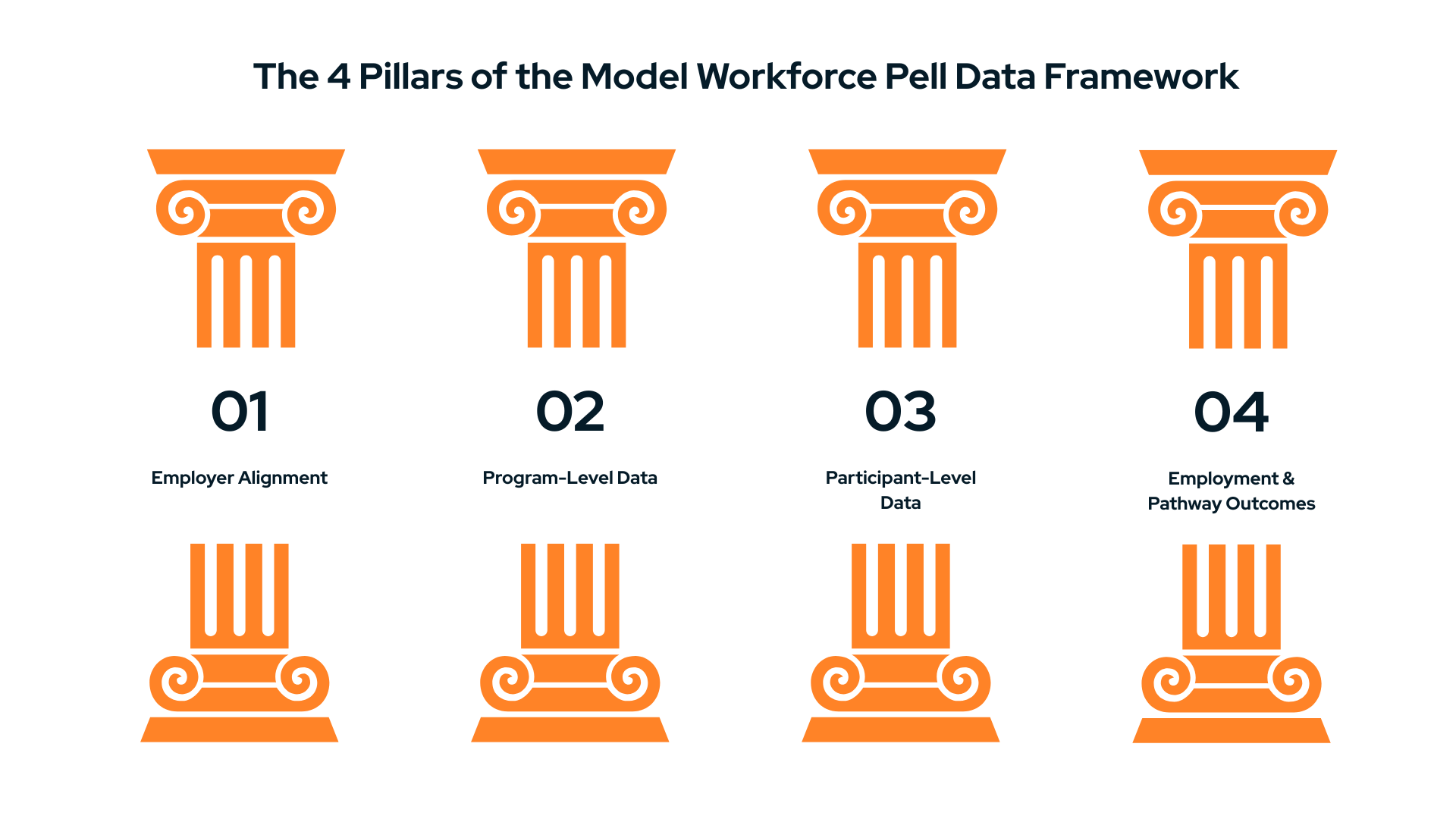
The recently released Model Workforce Pell Data Framework from the Workforce Pell Data Collaborative highlights one prediction of exactly how expansive this effort will be. The framework outlines four interconnected pillars for Workforce Pell implementation:
1. Employer alignment
2. Program-level data
3. Participant-level data
4. Employment & pathway outcomes
The framework also emphasizes that Workforce Pell implementation is intended to support “WIOA alignment, credential transparency, consumer information, and longitudinal outcomes analysis.”
Labor market intelligence becomes foundational infrastructure
What stands out in the framework is how central labor market analytics becomes to the approval and oversight process.
States are expected to maintain methodologies for identifying “high-skill, high-wage, or in-demand” occupations and industries, evaluate employer hiring requirements, map competencies to workforce demand, and monitor employment outcomes over time.
The framework also requires programs to align Classification of Instructional Programs (CIP) codes with Standard Occupational Classification (SOC) codes, a critical interoperability challenge that many states and institutions still struggle to operationalize consistently.
These are precisely the types of workforce intelligence capabilities that state agencies, workforce boards, economic developers, and higher education institutions increasingly rely on JobsEQ to support.
The data questions states must now answer
As Workforce Pell moves from policy to implementation, states will need reliable answers to questions such as:
• Which occupations truly qualify as “in-demand”?
• Which training programs align with employer hiring requirements?
• Are programs producing measurable wage gains?
• How should states benchmark “value-added earnings”?
• Which credentials create stackable pathways into additional education and career advancement?
• How should institutions map instructional programs to occupational outcomes?
• Which regions are experiencing the strongest labor demand shifts?
The framework makes clear that these are not one-time reporting exercises. States will need ongoing, longitudinal, and interoperable workforce analytics capabilities.
The framework explicitly recommends that states use “structured, linked, and interoperable data formats” and publish “aggregate, privacy-protective participant and outcomes information as open data files and interactive resources.”
States with integrated education and workforce systems will move faster
One of the clearest signals emerging from the Workforce Pell framework is that implementation readiness will vary significantly from state to state.
States with more mature longitudinal and interoperable data systems will likely move faster in operationalizing Workforce Pell approval, reporting, and outcomes validation. But “maturity” in this context is not simply about having large amounts of data. It is about how effectively states have integrated their education and workforce ecosystems.
The strongest implementation candidates are likely to be states where Perkins V, WIOA, Pell Grant, and general workforce reporting systems are already connected across education and labor agencies. States that have already aligned their workforce, higher education, and economic development strategies will have a major head start.
In many ways, the federal government is sending a broader message through Workforce Pell implementation requirements: if states want to successfully administer these programs at scale, they must demonstrate the ability to integrate workforce and education planning, reporting, and outcomes measurement across agencies.
That expectation is reflected throughout the Workforce Pell Data Framework, which repeatedly emphasizes linked administrative records, cross-system interoperability, wage record integration, and longitudinal pathway analysis.
The next frontier: Digital wallets and learning & employment records
Some of the most forward-looking states are already moving beyond traditional reporting systems toward learner-owned credential infrastructure and interoperable digital records.
States such as Alabama have emerged as early leaders in adopting digital wallets and Learning & Employment Records (LERs) that allow individuals to carry verified skills, credentials, and employment achievements across education and workforce systems. That direction aligns closely with the Workforce Pell framework’s emphasis on credential transparency, structured competency data, and interoperable records.
The framework specifically references standards such as Credential Transparency Description Language (CTDL), Credential Transparency Identifiers (CTIDs), and machine-readable competency frameworks as best practices for ensuring workforce credentials can be connected, validated, and analyzed across systems.
This matters because Workforce Pell is not simply about funding short-term programs. It is about creating a more connected and measurable workforce ecosystem; one where states can track outcomes longitudinally, institutions can demonstrate value, employers can better understand skills alignment, and learners can carry portable records of achievement throughout their careers.
States already investing in interoperable credential infrastructure, digital wallets, and LER ecosystems may find themselves substantially better positioned for Workforce Pell implementation over the next several years.
Workforce Pell accelerates the need for connected workforce ecosystems
Perhaps the biggest takeaway from the final rule is this: Workforce Pell is not simply a financial aid expansion. It is a catalyst for more connected workforce ecosystems.
The Workforce Pell framework repeatedly references:
• Integrated data systems
• Linked administrative records
• Open data standards
• Longitudinal pathway analysis
• Credential transparency
• Wage record integration
• Interoperable workforce data architecture
That evolution aligns closely with where workforce development has already been heading for years — toward data-informed alignment between education, workforce training, employers, and regional economic strategy.
Where JobsEQ fits
As states begin implementing Workforce Pell requirements, the need for trusted labor market intelligence and workforce analytics infrastructure will only intensify.
JobsEQ already helps organizations across the country:
• Analyze employer demand
• Benchmark wages and outcomes
• Map CIP-to-SOC relationships
• Identify high-demand occupations
• Evaluate regional labor market trends
• Support strategic workforce planning
Those capabilities are becoming foundational requirements within the Workforce Pell ecosystem.
The policy may be new, but the underlying challenge is familiar: connecting workforce demand, educational pathways, and measurable outcomes through integrated labor market intelligence.
Workforce Pell simply raises the stakes and accelerates the timeline.