Learn what drives relocation decisions, which workers are most likely to move, and how employers can use migration trends to build smarter talent attraction strategies.
Workforce

By Mike Chmura
Published May 13, 2026
Talent attraction has never been more competitive.
Americans are relocating less than they have in decades, shrinking the pool of workers willing to move for new opportunities. At the same time, employers and regions continue investing millions into recruitment campaigns, relocation incentives, and workforce attraction initiatives.
The challenge is not just attracting talent. It’s identifying people who are likely to move.
So, what makes someone relocate? Historically, it’s been a combination of career opportunity, personal circumstances, and regional conditions. Understanding these factors can help employers and communities target recruitment efforts more effectively and improve return on investment.
Americans are moving less
Internal migration in the United States has steadily declined for decades. In 2023, only 3.2% of Americans relocated. One of the lowest mobility rates on record.[1]
That is a dramatic decline from the 1980s, when annual migration rates regularly ranged between 6% and 7%. Even though the U.S. population has grown by nearly 100 million people since the mid-1980s, approximately 5.2 million fewer Americans relocated in 2023 than in 1986 (see Figure 1).
Remote work temporarily increased mobility during the COVID-19 pandemic, but the broader trend remains clear: Americans are moving less frequently than in previous generations.
For employers and economic development organizations, this creates a difficult environment. Broad, untargeted recruitment campaigns are becoming less effective because the overall pool of potential movers continues to shrink.
The organizations seeing the greatest success are becoming more targeted, focusing their efforts on workers who are more likely to relocate in the first place.
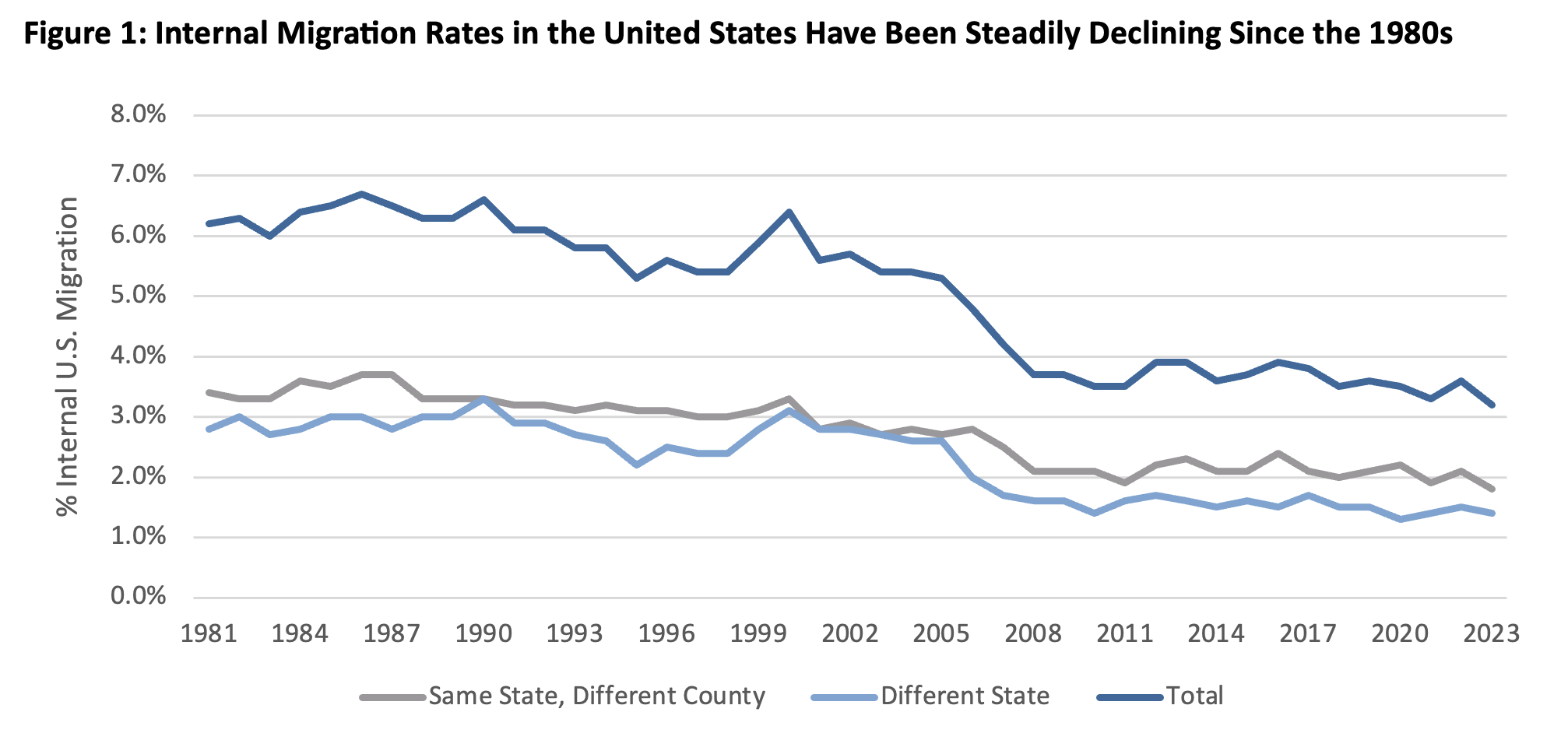 Source: CPS Historical Migration 2023, Chmura
Why people move: A simple framework
Research carried out in the 1970s and 1980s by notable economists, including Jacob Mincer and Michael Greenwood[2],[3] has consistent findings: people move when the perceived benefits outweigh the costs.
Those benefits and costs extend far beyond salary alone.
Potential benefits may include:
-
-
-
-
-
-
• Higher wages
-
-
-
-
-
-
• Better career opportunities
-
• Improved quality of life
-
• Lower housing costs
-
-
• Stronger amenities
-
• Returning closer to family or familiar communities
At the same time, relocation carries substantial financial, social and emotional costs:
-
• Moving expenses
-
• Leaving established social networks
-
• Career disruption for spouses or partners
-
• School changes for children
-
• Uncertainty surrounding a new community
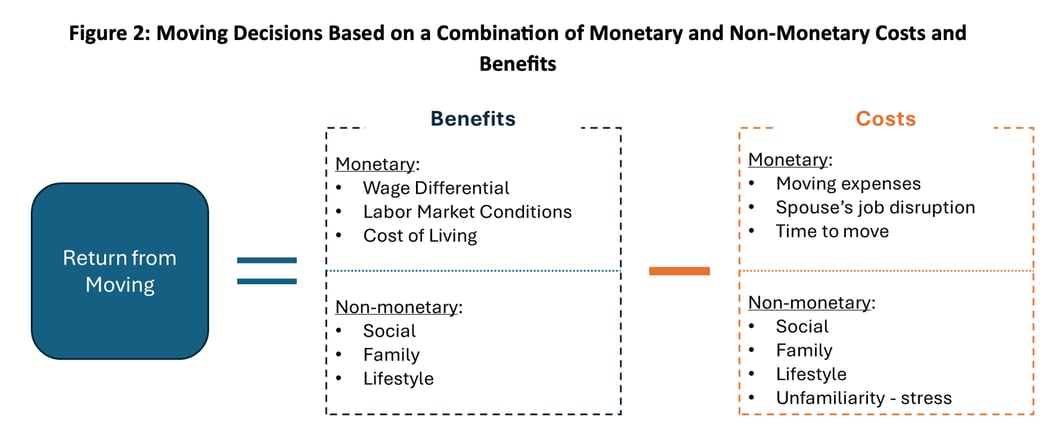 Source: Chmura
Because of this, relocation decisions are deeply personal. The research of Mincer and Greenwood as well as dozens of other economists, identifies several common factors that make some individuals more likely to move than others:
1. Job attractiveness
2. Individual characteristics
3. Regional pull
Job attractiveness still matters most
Career opportunity remains one of the strongest drivers of relocation.
Research consistently shows workers are more willing to move when a new opportunity offers meaningful advancement – whether through higher wages, stronger long-term career prospects, or improved job quality.
Distance still matters, however. The farther a worker must relocate, the greater the financial and social costs become.
One foundational study by economist Larry Sjaastad found that workers historically viewed a 10% wage increase as roughly offsetting the costs associated with a substantial increase in moving distance.[4] While mobility patterns and travel conditions have evolved since that research was conducted, the broader insight still holds today: stronger economic opportunity can overcome relocation friction.
Importantly, “job attractiveness” extends beyond compensation alone. Workers may also evaluate:
-
• Career growth potential
-
• Industry strength
-
• Company reputation
-
• Workplace flexibility
-
• Lifestyle improvements
-
• Long-term economic opportunity
For employers, this reinforces an important point: recruitment messaging should focus not only on open positions, but on the broader opportunity being offered to candidates and their families.
Some workers are more likely to move than others
-
Research shows that demographic and life-stage characteristics strongly influence relocation likelihood.
One of the most extensive studies on migration behavior, conducted by the U.S. Census Bureau’s Center for Economic Studies (CES), identified several characteristics associated with higher migration rates.[5]
Workers more likely to relocate often include:
- • Younger professionals
- • Individuals with higher education attainment
- • Unmarried workers
- • People without school-aged childer
- • Workers who have relocated previously
Education appears to be especially important. Compared to high school graduates, the CES study found:
-
• Individuals with some college education were 7.8 percentage points more likely to move.
-
• College graduates were nearly 12 percentage points more likely to move.
-
• Individuals with advanced degrees were 24 percentage points more likely to relocate.
Life stage also matters significantly. Married individuals were substantially less likely to relocate than unmarried individuals. And each additional child over age five reduced migration likelihood further.
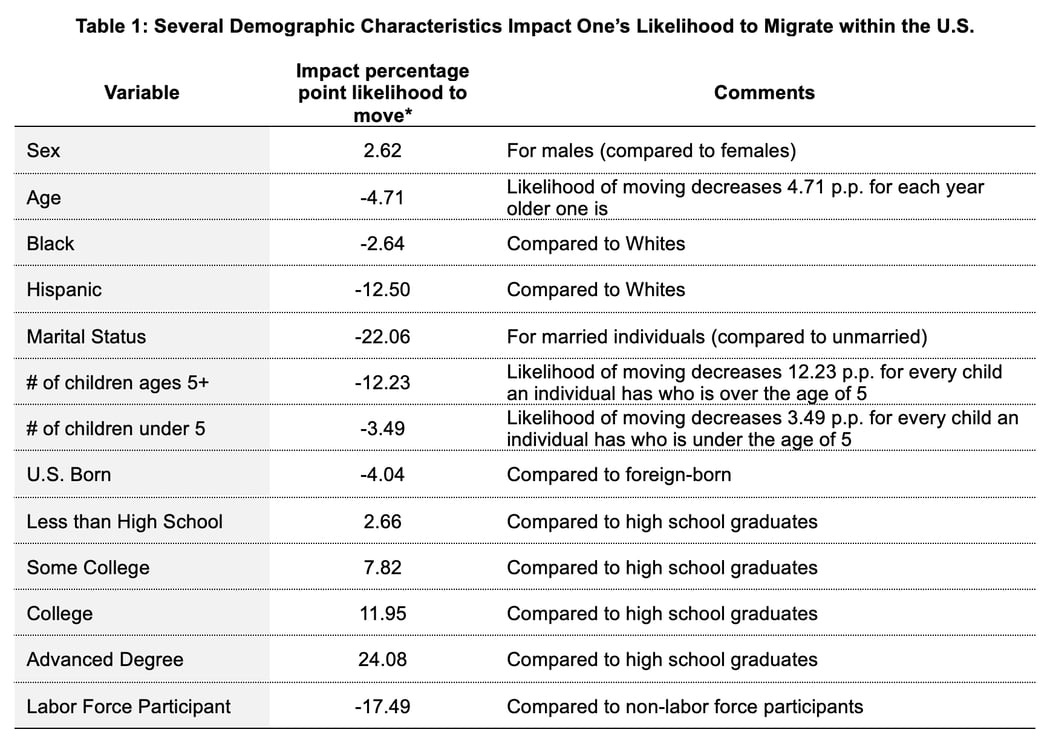
*Note: The CES model uses logistic regression (logit model). Coefficients can be interpreted as the increase or decrease of one’s likelihood of migration to a different county within a year’s timeframe, given that they fall within the demographic category’s definition, holding all else equal. Chmura refers to the CES Table 4 model that included time and region fixed effects. Source: CES, Chmura
-
Repeat movers and “Boomerangs”
-
Research also highlights two especially important groups for talent attraction strategies.
Repeat Movers
People who have relocated before are significantly more likely to relocate again. Historically, “repeat movers” have accounted for 70-75% of all inter-regional movers in the United States.[6],[7]
This suggests that prior relocation behavior can be highly predictive of future mobility.
Boomerang Movers
“Boomerang movers” are individuals returning to a region where they previously lived. According to the Cleveland Fed, approximately 28% of U.S. migration can be classified as “boomerangs.”[8]
For communities and employers, this creates a new opportunity. Former residents already possess:
-
• Personal connections
-
• Familiarity with the region
-
• Emotional attachment to the area
-
• Lower perceived relocation risk
As a result, alumni-focused relocation recruitment and “return home” campaigns may outperform broader attraction strategies.
Life Events Can Trigger Relocation
Certain life events also increase migration likelihood. Spring et al. estimate that migration is 2 times more likely for those who recently lost a job and 1.7 times more likely for those who were “just divorced.”[9]
These moments often create natural periods of reevaluation, making individuals more open to geographic change.
For recruiters and workforce strategists, timing can matter almost as much as targeting.
Regional conditions influence migration decisions
-
People are influenced not only by personal circumstances, but also by conditions in both their current region and potential destinations.
Research consistently shows workers are drawn toward regions with stronger economic conditions and higher perceived quality of life.
Several regional characteristics influence migration patterns, including:
-
• Unemployment levels
-
• Housing affordability
-
• Income levels
-
• Employment growth
-
• Public amenities
-
• Recreation and lifestyle offerings
For example, Foschi et al. found that increases in local unemployment are associated with measurable out-migration after controlling for broader economic conditions.[10]
Similarly, the CES study found that:
-
• Higher housing costs increase migration likelihood
-
• Higher per-capita income reduces out-migration
-
• Greater parks and recreation spending is associated with lower migration away from a region
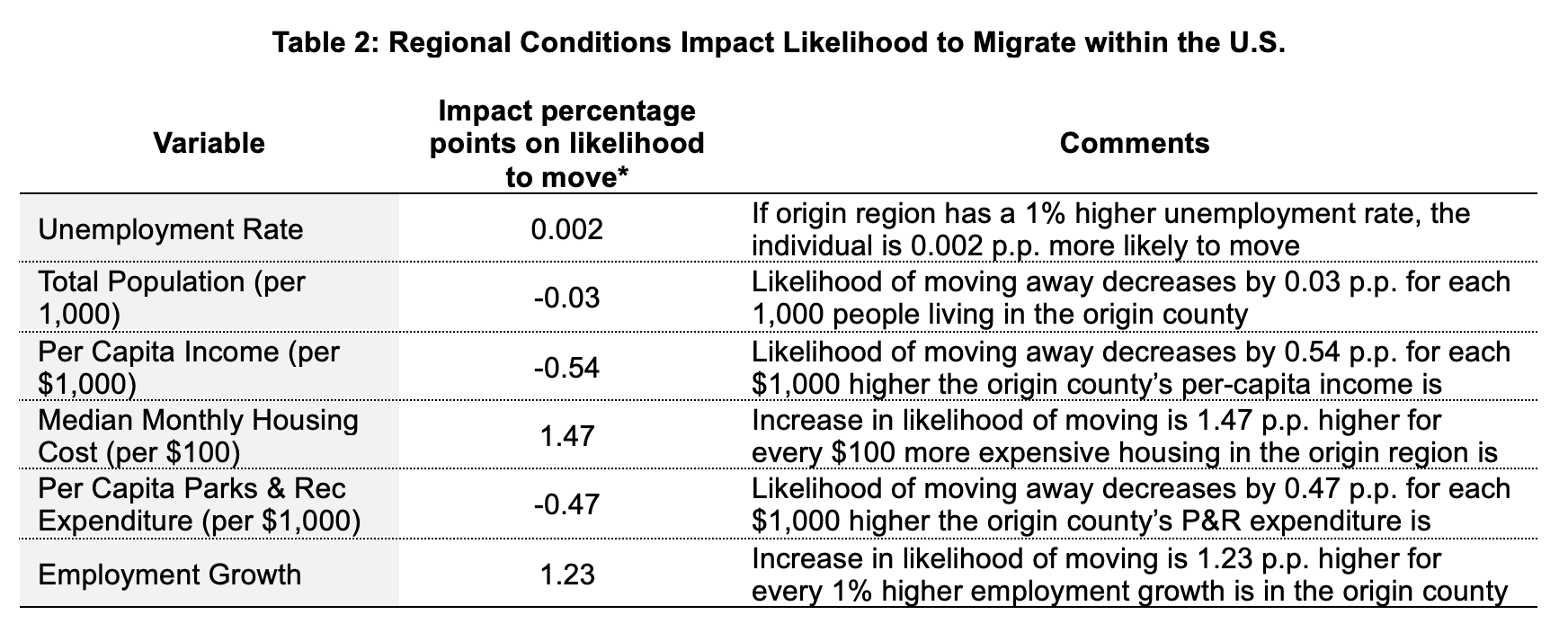
*Note: The CES model uses logistic regression (logit model). Coefficients can be interpreted as the increase or decrease of one’s likelihood of migration to a different county within a year’s timeframe, given they fall within the demographic category’s definition, holding all else equal. Chmura refers to the Table 4 model that included time and region fixed effects.
*Note 2: If the value is positive, this means that if the origin location has a relatively higher value, then migration to the destination location is more likely, and vice versa.
Source: CES, Chmura
Importantly, relocation decisions are often comparative. Workers evaluate opportunities relative to their current situation, not in isolation. This means regional branding and talent attraction strategies are most effective when they clearly communicate a compelling improvement in either career opportunity, affordability, lifestyle, or long-term economic stability.
What this means for talent attraction strategies
-
The decline in U.S. mobility means talent attraction strategies can no longer rely on broad, untargeted outreach.
The most successful organizations will focus on identifying workers who are both qualified and realistically open to relocating.
There are several ways organizations can improve targeting:
-
1. Focus on younger and more mobile demographics
-
2. Prioritize workers with prior relocation history
-
3. Develop “boomerang” recruitment campaigns
-
4. Tailor messaging around career advancement and lifestyle improvements
-
5. Use labor market data to identify regions with stronger relocation potential
-
6. Align recruitment timing with key life and career transition periods
In a lower-mobility environment, precision matters more than volume.
-
Prediction methods
While academic research provides strong directional insights, operationalizing relocation targeting at scale remains challenging.
Most migration studies examine only part of the problem, such as demographics, wage differentials, or regional conditions, individually. Building a predictable framework requires combining many variables simultaneously.
At Chmura, our economists are actively exploring how relocation probability modeling and labor market intelligence can help organizations identify workers who may be more open to relocation opportunities.
Our goal is to transform decades of migration research into practical tools that support smarter workforce strategies.
As competition for talent intensifies, organizations that better understand who moves – and why – will be better positioned to attract the workers they need.
Want to learn more about how labor market intelligence can support your talent attraction efforts? Contact Chmura to start the conversation.
[1] Source: https://www.census.gov/data/tables/time-series/demo/geographic-mobility/historic.html
[2] Source: https://www.jstor.org/stable/1828408
[3] Source: https://www.jstor.org/stable/2722115
[4] Source: https://www.nber.org/system/files/chapters/c13573/c13573.pdf
[5] Source: https://www2.census.gov/library/working-papers/2023/adrm/ces/CES-WP-23-12.pdf
[6] Source: https://www.jstor.org/stable/2060130
[7] Source: https://pure.iiasa.ac.at/id/eprint/1311/1/WP-80-158.pdf
[8] Source: https://www.clevelandfed.org/publications/cleveland-fed-district-data-brief/2025/cfddb-20250219-boomerang-migration
[9] The divorce estimate is specifically for boomerang or “return” migration.
[10] Source: https://www.aeaweb.org/articles?id=10.1257%2Fpandp.20231079