Get practical insight into CIP codes and how validated SOC mappings support stronger program planning and stakeholder-ready evidence.
Education

By Chmura Economics & Analytics
Published Jul 4, 2026
Key Takeaways
-
CIP codes classify programs, but the program case becomes stronger only when each related SOC code is tested for graduate fit.
-
Default crosswalk results can overstate the labor case when teaching roles or catch-all occupations remain in the mapped list.
-
Adjusted mappings help education teams produce clearer program viability analysis for funding, reporting, and stakeholder review.
CIP codes only support strong program planning when they are tested against the occupations a program can credibly prepare students to enter. A crosswalk gives you a starting point, but it does not settle the program case on its own.
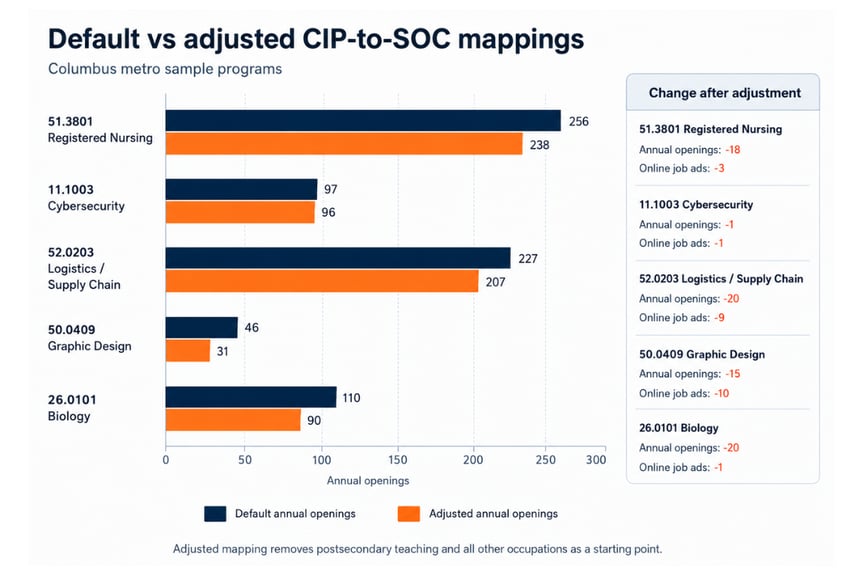
Chmura’s Columbus metro analysis shows why that review matters. For logistics, the default CIP-to-SOC mapping showed 227 total annual openings, while the adjusted mapping showed 207 after removing one postsecondary teaching role. That 20-opening difference can shift how a program case reads to a dean, board, funder, or employer partner.
CIP codes define programs before occupations enter the analysis
CIP codes classify instructional programs, while SOC codes classify occupations. Program planning gets stronger when the CIP code is treated as the education-side starting point, and the SOC code is treated as the labor-side test. The connection between them needs review because a program title and a job title rarely match perfectly.
A college reviewing CIP code 51.3801 for Registered Nursing/Registered Nurse will usually expect a clear occupational link to registered nurses. That mapping is easy to explain because the program prepares students for a direct licensed occupation. Other programs are less direct. A general biology program can connect to several occupations, but some will require added education, credentials, or career steps.
That distinction matters when you’re building a program viability analysis. A CIP code can tell stakeholders what the program is. It cannot prove which jobs graduates will realistically pursue. The planning work starts when you translate the code into occupations and decide which connections are strong enough to support funding, curriculum, and reporting decisions.
Crosswalk results need validation before program planning decisions
A CIP-to-SOC crosswalk should be treated as a working list, not a final answer. It can surface related occupations, but program planners still need to test each mapped SOC against program outcomes, credential level, regional hiring need, wages, and stakeholder expectations. The strongest program cases come from validated mappings.
The Columbus analysis compared default mappings with adjusted mappings that removed postsecondary teaching and catch-all roles as a starting filter. Nursing moved from 256 to 238 total annual openings after nursing instructors were removed. Graphic design moved from 46 to 31 after removing a teaching role and an all-other occupation.
That kind of review protects the credibility of the case. A board packet that includes loosely related roles can look stronger at first glance, but it becomes harder to defend when someone asks which jobs graduates will actually seek.
“Validation gives you a cleaner answer. It helps separate useful program evidence from inflated relatedness.”
|
Crosswalk checkpoint |
Why it matters for program planning |
|
Program code fit |
The CIP code must match the program being reviewed before any occupation mapping can be trusted. |
|
Occupation relevance |
Each SOC should reflect a job students can reasonably pursue after completing the program. |
|
Credential alignment |
The occupation should match the credential level and preparation the program actually provides. |
|
Regional hiring need |
Local openings and postings show whether the mapped occupations support a market case. |
|
Wage evidence |
Median wages help explain the economic value of the program to students and stakeholders. |
|
Mapping adjustments |
Removing weak matches creates a clearer and more defensible program evidence base. |
SOC matches should reflect jobs graduates can pursue
SOC matches should be judged by graduate fit. A strong match connects the program to occupations where the program’s training, credential, and outcomes make sense. A weak match can distort the labor case because it adds roles that are related in name but not realistic for most graduates.
Cybersecurity gives a useful example. CIP code 11.1003 mapped to roles such as information security analysts, network and computer systems administrators, database administrators, and computer and information systems managers. The adjusted mapping removed no occupations, which suggests the default list was already fairly tight for that program group.
Program teams should still ask practical questions before using the list. Does the role require experience beyond the credential? Is it an entry point or a later career step? Will students qualify for the job after completion, or will they need a bachelor’s degree, license, or several years of experience? These questions improve the story you can tell. They turn a crosswalk from a code match into a defensible workforce explanation.
Teaching roles can overstate program-related labor signals

Postsecondary teaching roles can overstate program-related labor signals when the program is meant to prepare students for industry roles. Teaching occupations are related to the field, but they often require advanced degrees and represent a different employment path than the program is designed to support.
The nursing example shows the issue clearly. The default mapping included registered nurses and nursing instructors. The adjusted mapping kept registered nurses and removed nursing instructors, reducing total annual openings from 256 to 238. The removed instructor role had 17 total annual openings and 3 online job ads, while registered nurses had 238 total annual openings and 458 online job ads.
That does not mean teaching roles are always wrong. A graduate program or faculty pipeline analysis could justify them. For most program planning cases, though, they should be reviewed separately. Mixing them into the main occupational case can make the program appear to serve a broader labor need than it does. Clean mapping keeps the central case focused on the jobs students are most likely preparing for.
Catch-all occupations can weaken program viability analysis
Catch-all occupations can make a program case less precise because they group workers whose job duties do not fit cleanly into a single standard occupation. These roles can be useful for labor classification, but they can weaken program planning when they add vague career paths to a decision that needs clear evidence.
Graphic design shows how that can happen. The default mapping included graphic designers, art directors, web and digital interface designers, special effects artists and animators, a teaching role, and artists and related workers, all other. Removing the teaching role and the all-other role reduced total annual openings from 46 to 31 and online job ads from 15 to 5.
That shift matters because vague mappings make stakeholder questions harder to answer. A program director can clearly explain why graphic designers belong in the case. It is harder to explain an all-other category without adding uncertainty. A stronger program viability analysis favors mapped occupations with clear duties, visible postings, and a practical relationship to the curriculum.
Local postings help test each mapped occupation
Local postings help test whether mapped occupations show active hiring activity in the region. Total annual openings are important, but postings add a market signal that can help program teams understand which occupations employers are actively trying to fill and which mappings look weaker under local review.
Logistics, Materials, and Supply Chain Management had 72 online job ads under the default mapping and 63 after removing Business Teachers, Postsecondary. That removed role accounted for 9 postings, while the adjusted list retained roles such as logisticians, shipping and receiving clerks, transportation managers, and industrial production managers.
A practical review should compare mapped occupations across several signals:
- Annual openings that show replacement and growth needs
- Online job ads that show current employer activity
- Employment counts that show the size of the local occupation base
- Wage levels that show student economic value
- Program requirements that show whether graduates can qualify
Postings should not be used alone because they can rise or fall with employer behavior, job board coverage, and recruiting practices. They are most useful when paired with openings, wages, employment, and curriculum fit. The goal is not to pick the biggest number. The goal is to build a program case that holds up under review.
Wage evidence should guide final SOC selection
Wage evidence helps program teams judge whether mapped occupations support the value promised to students. A program aligned to low-wage roles will require a different funding and student outcome story than one aligned to higher-wage occupations. The wage review should sit beside openings and postings, not after them.
The cybersecurity mapping shows why wages add depth. Information security analysts showed a median annual wage of $119,200, database architects showed $125,400, and computer and information systems managers showed $152,100 in the Columbus analysis. Those wages support a different program case than a field where the main mapped roles are lower paid or highly limited locally.
Wages also help identify mismatches. A role with strong pay but limited hiring activity can still matter, but it should not carry the whole case. A role with many openings and modest wages can support access and placement goals, but the economic return should be explained clearly. Strong SOC selection balances opportunity, fit, and outcomes in one view.
Adjusted mappings create stronger stakeholder-ready program evidence
“Use the crosswalk to start the work, then validate the occupations before the numbers shape funding, curriculum, or board decisions.”
Adjusted mappings create stronger program evidence because they force each occupation to earn its place in the case. The best program planning work does not accept every crosswalk result at face value. It reviews the list, removes weak matches, checks local hiring signals, and explains the final mapping in plain English.
That discipline is especially important when the numbers move. Biology’s adjusted mapping reduced total annual openings from 110 to 90 after removing postsecondary teaching and all other science roles. Logistics and biology each shifted by 20 openings after the adjustment. Those differences are large enough to affect how a program case is understood.
Chmura’s program-to-occupation workflow fits this exact problem: it helps teams move from a broad crosswalk to a defensible program viability analysis that stakeholders can review without getting lost in code logic. The judgment is simple.