Get practical insight into Perkins V CLNA requirements and how workforce data supports stronger Perkins grant narratives and funding priorities.
Education

By Chmura Economics & Analytics
Published Jul 4, 2026
Key Takeaways
- A strong Perkins V CLNA connects programs to specific occupations, wages, projected openings, job postings, and education requirements.
- Job postings and projected openings answer different questions, so stronger assessments use both without treating them as the same signal.
- Perkins grant narratives become easier to defend when funding requests are tied to occupation-level evidence and clear workforce measures.
A stronger Perkins V comprehensive local needs assessment connects program choices to specific regional workforce evidence that funders and stakeholders can review with confidence. The strongest Comprehensive Local Needs Assessment (CLNA) work does more than confirm that a career and technical education program serves a broad industry. It shows which occupations are active in the region, where openings are expected, what wages look like, and what education employers are asking for.
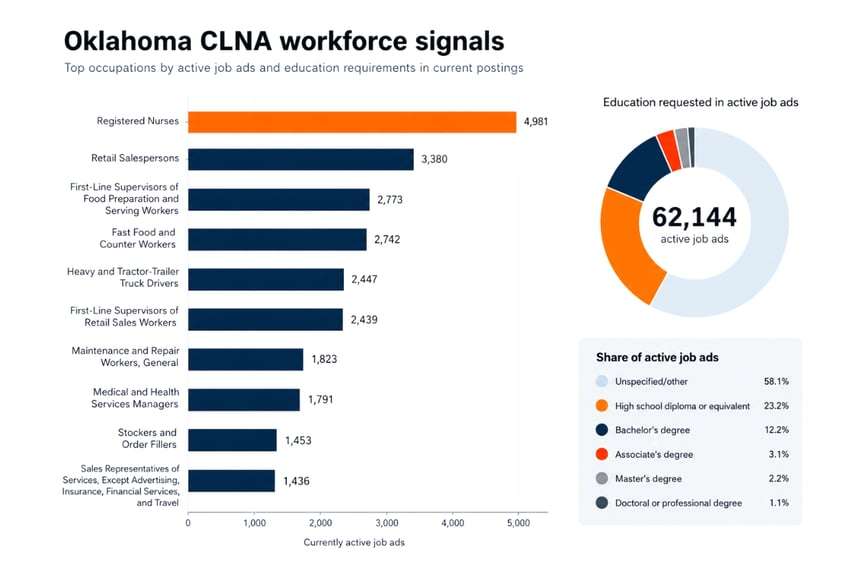
A statewide CLNA workforce dataset for Oklahoma shows 62,144 currently active job ads, with 58.1% listing no clear minimum education requirement and 23.2% asking for a high school diploma or equivalent. That mix matters because Perkins funding decisions need to reflect both current employer signals and longer-term workforce need. A CLNA that treats every job ad as equal will miss the difference between short-term hiring pressure and sustained opportunity.
Perkins V CLNA starts with defensible workforce evidence
A Perkins V CLNA should start with evidence that ties Career and Technical Education (CTE) programs to measurable regional workforce needs. Defensible evidence helps your team explain why a program deserves investment, which occupations it supports, and how the funding request aligns with the labor market students will enter.
A nursing program review offers a useful example. Registered Nurses had 4,981 active job ads in the Oklahoma dataset, a median annual wage of $86,300, and 1,992 projected average annual openings. Those 3 measures tell different parts of the story. Job ads show current employer activity. Wages help assess job quality. Projected openings help your team evaluate longer-term opportunity.
That distinction matters because CLNA work often gets compressed into compliance language. The stronger approach is more direct. Your assessment should show which programs connect to occupations with measurable need, which data supports that claim, and which gaps require action. Defensible evidence also gives staff, boards, employers, and community partners a shared set of facts. Without that shared base, Perkins V priorities can look like internal preferences instead of workforce-backed choices.
- “The stronger approach is more direct. Your assessment should show which programs connect to occupations with measurable need, which data supports that claim, and which gaps require action.”
CLNA requirements connect programs to regional workforce needs
CLNA requirements ask institutions to examine how CTE offerings align with local workforce needs, student outcomes, program quality, and equity. Workforce evidence is the thread that connects those requirements to actual program decisions because it shows where education offerings meet, miss, or partially address regional labor needs.
A practical CLNA review might compare a health sciences pathway against several occupations, including Licensed Practical and Licensed Vocational Nurses, Registered Nurses, Radiologic Technologists and Technicians, and Medical and Health Services Managers. Each role carries different wage levels, openings, posting activity, and education expectations. A single program can support multiple workforce paths, but each path needs its own evidence.
This is where broad industry language falls short. “Health care is hiring” does not explain which roles need workers, which credentials matter, or which programs should be expanded, revised, or better documented. A useful CLNA links each program to specific occupations and then tests that connection against regional evidence. Chmura supports this work by helping education teams connect programs, occupations, wages, postings, and projected openings in a format that can support CLNA narratives and grant documentation.
|
CLNA evidence question |
What the workforce measure helps clarify |
|
Which occupations connect to the program? |
Occupation level mapping shows which jobs the program can reasonably prepare students to enter. |
|
Are employers hiring now? |
Current job ads show recent hiring activity and help identify near-term employer needs. |
|
Will opportunities continue? |
Projected openings show the scale of expected hiring over a longer planning period. |
|
Do jobs support student outcomes? |
Median wages help assess whether aligned occupations offer economic value to students. |
|
What education are employers asking for? |
Posting education requirements show how employers describe minimum credentials in active ads. |
|
Where should funding priorities focus? |
Comparing measures side by side helps teams separate high-visibility roles from stronger program cases. |
Strong assessments separate job postings from long-term openings
Strong CLNA assessments treat job postings and projected openings as separate signals. Job postings show current hiring activity, while projected openings estimate longer-term workforce need. Both are useful, but they answer different questions and should not be combined into one general measure of need.
Retail Salespersons show why the distinction matters. The Oklahoma dataset lists 3,380 active ads and 6,507 projected average annual openings for that occupation, with a median annual wage of $31,200. Fast Food and Counter Workers show 2,742 active ads and 12,294 projected average annual openings, with a median annual wage of $26,100. Those large opening numbers point to worker flow and replacement needs, but they do not automatically create a strong case for every CTE investment.
A CLNA should interpret these signals with care. High postings can reflect immediate employer pressure, while high projected openings can reflect turnover, replacement hiring, or broader occupational scale. Program funding choices should consider both the number of opportunities and the quality of those opportunities. That means pairing openings with wages, education requirements, student goals, and employer input. The better assessment does not chase the largest number. It explains which workforce signal is most relevant to the program decision at hand.
Education requirements help clarify program alignment gaps

Education requirements in job postings help CLNA teams see how employers describe credential expectations in the current labor market. They do not replace program standards or occupational licensing requirements, but they can show where employer language supports, complicates, or weakens the connection between programs and jobs.
The Oklahoma dataset shows that 36,104 active ads, or 58.1%, had no clear minimum education requirement listed. Another 14,436 ads, or 23.2%, asked for a high school diploma or equivalent. Bachelor’s degree requirements appeared in 7,594 ads, while associate’s degree requirements appeared in 1,948 ads. That split is useful because many CTE pathways sit between entry-level work and more advanced credentials.
A CLNA team reviewing a technical program should not assume that every employer posting will name the credential clearly. Many job ads are written for speed, not for education alignment. That creates a documentation challenge. Your assessment should distinguish what employers request in postings from what the program prepares students to do. It should also note when an occupation has licensing, certification, or clinical requirements that postings alone will not capture. Strong alignment work uses posting requirements as one signal, then checks it against occupation details, program outcomes, and employer feedback.
Perkins grant narratives need occupation-level evidence
Perkins grant narratives become stronger when they explain the link between funding requests and occupation-level evidence. Funders need to see more than program interest. They need a clear reason to believe that the program supports student opportunity, regional workforce needs, and measurable outcomes.
A grant narrative for transportation training might reference Heavy and Tractor-Trailer Truck Drivers, which showed 2,447 active ads, a median annual wage of $55,500, and 3,111 projected average annual openings in the Oklahoma dataset. That evidence gives the request a sharper workforce case than a broad statement about logistics hiring. It also helps the institution explain what the funding will support, such as equipment, curriculum updates, instructor capacity, or employer-aligned training.
Strong Perkins grant narratives usually answer 5 practical questions:
- Which occupations does the program prepare students to enter?
- What regional evidence shows current or projected workforce need?
- How do wages support the value of the pathway for students?
- What credential level do employers request in active postings?
- How will the funding improve program quality or access?
These answers make the grant case easier to review. They also reduce the risk of vague claims. Clear occupation evidence helps the reader connect the funding request to the workforce result.
Stakeholder review works better with clear workforce measures
Stakeholder review works better when workforce measures are clear, consistent, and easy to explain. Employers, advisory boards, internal leaders, and public partners will bring different priorities to the CLNA process. Shared measures keep the conversation focused on evidence instead of opinion.
A program advisory group might see strong employer interest in health care, but the data can show important differences across roles. Medical and Health Services Managers had a median annual wage of $105,900 and 1,791 active ads. Nursing Assistants had a median annual wage of $37,000 and 984 active ads. Radiologic Technologists and Technicians had a median annual wage of $73,500 and 835 active ads. Those occupations all relate to health care, but they support very different program and funding discussions.
Clear measures help the group separate urgency from fit. An employer’s immediate hiring need deserves attention, but the CLNA must also consider program capacity, student readiness, wage outcomes, and credential requirements. A simple workforce snapshot can help stakeholders compare occupations without getting lost in raw tables. The goal is not to make the data look final. The goal is to make the tradeoffs visible enough that the team can make a defensible recommendation.
Common CLNA mistakes weaken Perkins funding justification
Common CLNA mistakes weaken funding justification because they make the evidence harder to trust. The most common problems are broad geography, broad occupation categories, overreliance on job ads, missing wage context, and weak program-to-occupation mapping. Each problem makes the funding case less specific.
A common issue appears when a team uses statewide figures for a program that serves a smaller regional labor market. Another appears when a team cites total job ads without asking whether those ads match the program level. Food service occupations can show high openings and posting activity, but a culinary or hospitality program still needs a careful explanation of wages, advancement paths, employer needs, and program purpose. Raw volume alone will not carry the case.
The fix is a more disciplined evidence chain. Start with the program. Connect it to specific occupations. Compare postings, projected openings, wages, and education requirements. Add employer input where it clarifies the data. Then explain what the evidence means for funding. That sequence keeps the CLNA from becoming a collection of unrelated statistics. It also helps reviewers see why a specific investment is justified.
Workforce data helps teams defend Perkins V priorities
Workforce data helps teams defend Perkins V priorities when it is specific, measured, and tied to the actual choices a CLNA must support. The strongest assessments do not simply collect labor market figures. They explain which programs deserve attention and why the evidence supports that judgment.
A well-built CLNA can show that 2 occupations with similar posting activity lead to very different funding discussions because wages, credential needs, openings, and program fit differ. It can also show when a program has a strong employer case but needs better documentation. Those distinctions matter over time because Perkins V priorities shape equipment purchases, staffing, student access, employer partnerships, and program review.
"The best CLNA work gives people a way to agree on the evidence before they debate the decision."
Chmura fits that work when education teams need labor market data, program alignment views, and expert support that turns complex workforce questions into a grant support package or stakeholder-ready report. The discipline is simple, even when the work is detailed: connect each program choice to the clearest available evidence, explain the tradeoffs honestly, and make the funding case easy to defend.