See how workforce data supports career and technical education program proposals and get practical insight into proving program viability.
Education

By Chmura Economics & Analytics
Published May 27, 2026
Key Takeaways
- A degree proposal needs a clear connection between curriculum, occupations, regional openings, and expected graduate volume.
- Job postings, wages, education supply, and employer input should test the workforce case from different angles.
- Consistent geography, occupation mapping, and time periods make program approval and funding recommendations easier to defend.
A strong degree proposal proves that graduates will enter a defined set of occupations with sustained regional hiring activity. Enrollment interest and employer enthusiasm can support the case, but neither establishes program viability alone. Institutions need evidence that connects curriculum, occupations, openings, wages, job postings, and existing education supply.
That evidence gives academic leaders, boards, and funders a clear basis for judging the program. It also helps your team set realistic expectations about program size, student outcomes, and employer participation. The result is a proposal built around a specific workforce need rather than a broad claim about industry growth.
Strong program proposals begin with a defined workforce case
A defined workforce case states which regional problem the proposed program will address. It identifies the occupations graduates will enter, the employers likely to hire them, and the evidence supporting that connection. This gives reviewers a clear claim they can test before approving staff, facilities, equipment, or curriculum work.
A cybersecurity proposal, for instance, should explain more than the general importance of digital security. The case could focus on preparing graduates for information security analyst, network administrator, computer systems analyst, and related roles across the institution’s service area. Each occupation should have a credible connection to the proposed coursework.
The proposal should also establish a practical study area. A statewide total can hide local differences in hiring activity, wages, and employer concentration. A region based on commuting patterns, institutional reach, or employer relationships will produce a more useful program viability analysis.
Start with five questions:
- Which occupations will the program prepare students to enter?
- How many regional openings will those occupations produce?
- What wages will graduates have a reasonable chance to earn?
- Which employers are posting related positions?
- How much similar education capacity already exists nearby?
Clear answers give reviewers a shared standard for judging the proposal. They also prevent later discussions from drifting toward broad claims that cannot support an investment decision.
“A defined workforce case states which regional problem the proposed program will address.”
Map the program to specific occupations before assessing need
Program-to-occupation mapping determines which labor market measures belong in the proposal. Each Classification of Instructional Programs code can connect to several Standard Occupational Classification codes, yet those connections differ in strength. Your team should identify primary occupations first, then treat broader career options as supporting pathways.
A cybersecurity program might connect directly to information security analysts while also preparing some graduates for network administration, computer systems analysis, technical support, or software quality assurance. Including every technology occupation will inflate the apparent opportunity. Limiting the map to one job title will understate the range of roles graduates can pursue.
Curriculum provides the best test. Compare required courses, technical competencies, certifications, and work-based learning activities with the typical responsibilities of each occupation. A role belongs in the primary map when the program prepares graduates for its core work without requiring substantial additional education.
JobsEQ can help education teams compare program codes with occupations and review openings, employment, wages, and postings across a consistent study area. Staff still need to apply academic judgment. The tool supplies the evidence, while faculty and program leaders confirm that the instructional connection is credible.
Regional openings show the scale of employment opportunity
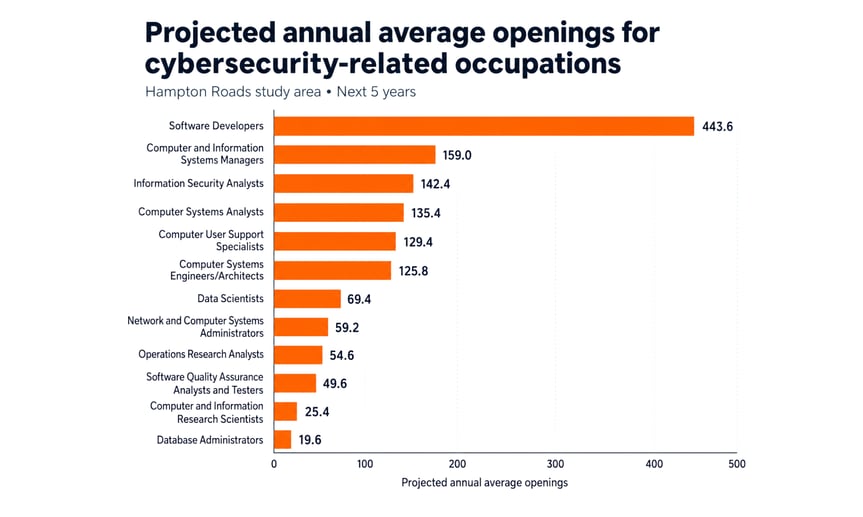
Projected openings estimate how many positions employers will need to fill because of growth and worker replacement. They give institutions a practical measure of opportunity over several years. The most useful proposal compares annual openings with expected graduate counts rather than presenting a large multiyear total without context.
Chmura data for Hampton Roads shows how much opportunity can vary across occupations connected to cybersecurity. Software developers are projected to have an annual average of 443.6 openings over the next five years, followed by computer and information systems managers at 159.0 and information security analysts at 142.4. Network and computer systems administrators are projected to have 59.2 annual openings.
Those figures require careful interpretation. A proposed cybersecurity program will not prepare every graduate to become a software developer or information systems manager at entry. The institution should weight each occupation according to curriculum fit, education requirements, and likely graduate pathways.
Projected openings also need to be compared with planned program size. A cohort of 20 graduates entering several occupations presents a different case from a cohort of 100 entering one narrow role.
“Program scale should reflect the share of regional openings that graduates can reasonably pursue.”
Current job postings verify active employer hiring patterns
Current job postings show where employers are recruiting and which job titles appear in the market now. They add timely evidence to longer-range projections. Postings do not equal hires, so institutions should use them as a validation measure rather than a direct count of available jobs.
The Hampton Roads data recorded 673 new postings for information security analysts during the previous 12 months. Network and computer systems administrators had 570, computer and information systems managers had 335, computer user support specialists had 259, and computer systems engineers or architects had 215. These figures show substantial activity across several related roles.
Posting details can strengthen curriculum planning. Your team can review common certifications, software tools, security frameworks, clearance requirements, experience levels, and soft skills. Repeated requirements will help faculty decide which competencies belong in required courses and which fit better in electives or short credentials.
Posting counts also have limits. Employers can repost the same position, use broad titles, or recruit outside the region. A strong proposal explains those limits and compares postings with projections, employer interviews, and occupation data before reaching a judgment.
|
Evidence checkpoint |
What it tells program reviewers |
|
Program-to-occupation mapping |
The curriculum has a credible connection to the jobs included in the workforce case. |
|
Projected annual openings |
The region is expected to produce enough recurring opportunities for an appropriately sized cohort. |
|
Current job postings |
Employers are actively recruiting for roles related to the proposed program. |
|
Median wages |
The occupations offer earnings that support a clear student value case. |
|
Existing education supply |
Reviewers can see if nearby institutions already produce enough graduates for the same occupations. |
|
Employer validation |
Local employers confirm that the proposed skills and credentials match their hiring needs. |
Wages clarify the program’s potential value for students
Wage data helps institutions assess the economic value students could receive from completing the program. It should reflect the same occupations and geographic area used throughout the proposal. Median wages provide a stable reference point, while entry-level wage estimates can set more realistic expectations for new graduates.
The supplied Hampton Roads data reports a median annual wage of $115,600 for information security analysts. Network and computer systems administrators have a median of $101,200, while computer user support specialists have a median of $61,500. Computer and information systems managers have a median of $179,800, though that role generally reflects experience beyond program completion.
That distinction matters. Presenting a management wage as the likely starting salary will weaken the proposal under review. A stronger explanation separates probable entry roles from occupations graduates could reach after gaining experience.
Wages should also inform program design. Higher earnings do not automatically justify higher tuition, but they help leaders judge student return, equipment costs, internship requirements, and credential value. The proposal becomes more credible when wage claims match realistic career progression.
Existing programs reveal gaps in regional education supply

Existing education supply shows how many similar programs and graduates already serve the region. A new degree has a stronger case when projected openings exceed the flow of qualified completers or when current programs address different occupations, populations, schedules, or credential levels. Program counts alone will not answer that question.
Suppose nearby institutions already graduate 150 students each year from closely related cybersecurity programs. A new 40-student program would need to show unmet hiring need, limited access, a distinct specialization, or employer interest that current programs cannot meet. Distance, delivery format, transfer pathways, and student capacity can also reveal a genuine gap.
Comparisons should use the closest available program codes and review the curriculum behind them. Two programs with similar names can prepare students for different roles. One could emphasize network defense, while another centers on software security or compliance.
Education supply should ultimately be compared with annual openings across the mapped occupations. A low ratio of relevant completers to openings supports expansion more strongly than a raw count of job postings. This step helps institutions avoid duplicating capacity based on temporary recruiting activity.
Employer input tests what workforce data cannot confirm
Employer input confirms how local hiring practices align with the statistical evidence. Employers can explain which roles accept new graduates, which credentials carry weight, and where applicants lack required skills. Their feedback is most useful after the institution has defined the occupation map and reviewed the regional data.
A cybersecurity advisory group could review the proposed curriculum against actual job requirements. Members could clarify that entry-level analysts need stronger networking knowledge, that certain certifications matter more than others, or that many roles require communication skills for incident reporting. Those details turn a broad endorsement into usable program guidance.
Employer input also reveals constraints that occupation totals cannot show. Security clearances, prior experience, shift requirements, and industry-specific rules can reduce the number of roles available to recent graduates. Those barriers should shape internship agreements, admissions guidance, and expected placement outcomes.
Letters of support carry more weight when they include specific commitments. Internship placements, equipment access, faculty participation, mock interviews, and projected hiring needs show direct employer involvement. General statements about the importance of cybersecurity provide far less evidence.
Defensible evidence strengthens program approval and funding cases
Program approval becomes easier to defend when each claim rests on evidence that addresses a specific reviewer concern. Occupation mapping establishes relevance. Openings show scale, postings confirm current activity, wages clarify student value, education supply tests the regional gap, and employer input grounds the proposal in local hiring practice.
The strongest case will still include judgment. Data cannot decide the appropriate cohort size, instructional model, faculty mix, or equipment budget on its own. Academic leaders must connect the evidence to those choices and state the assumptions behind their recommendation.
Consistency matters as much as volume. A proposal loses credibility when it uses one region for openings, another for wages, and national figures for postings. It also becomes harder to defend when the occupation list shifts from section to section. A disciplined program viability analysis keeps the study area, time period, occupation map, and definitions aligned.
Chmura helps education teams bring those measures into a clear workflow and produce workforce evidence that boards, funders, faculty, and employers can review. The final judgment should remain straightforward: approve a program when the mapped occupations show sustained regional opportunity, the education gap is credible, and the proposed curriculum prepares students for the work employers actually need.