Get practical insight into the best majors for remote work in 2026 and how job tasks shape work-from-home career options.
Workforce
Education
Data
Economy
Trends
Analysis

By Chmura Economics & Analytics
Published Jun 24, 2026
Key Takeaways
-
Remote work access depends more on occupation-level tasks than on the name of the degree.
-
The strongest remote-friendly majors lead to jobs with digital work products, clear measures, and enough remote posting evidence.
-
Labor market data helps students, colleges, and workforce teams separate broad assumptions from defensible career guidance.
Remote work is most realistic when your major leads to occupations built around digital tasks, clear outputs, and work that can be reviewed without constant on-site presence. The strongest remote-friendly majors are not simply the ones that sound technical. They are the ones that connect to roles where employers can measure progress through code, analysis, reports, campaigns, models, or documented decisions.
Remote work is also common enough to shape education and career planning. Among people at work in the first quarter of 2024, 22.9% teleworked or worked at home for pay, up from 19.6% one year earlier. That does not mean every degree has equal access. A better question is which occupations each major leads to, how those occupations are performed, and how often remote options appear in job postings.
Remote work potential depends on occupations tied to each major
A college major is a starting point, but remote work depends on the jobs it leads to. The same degree can open paths into highly remote roles, partially remote roles, or roles that require labs, fieldwork, patient care, equipment, or on-site coordination.
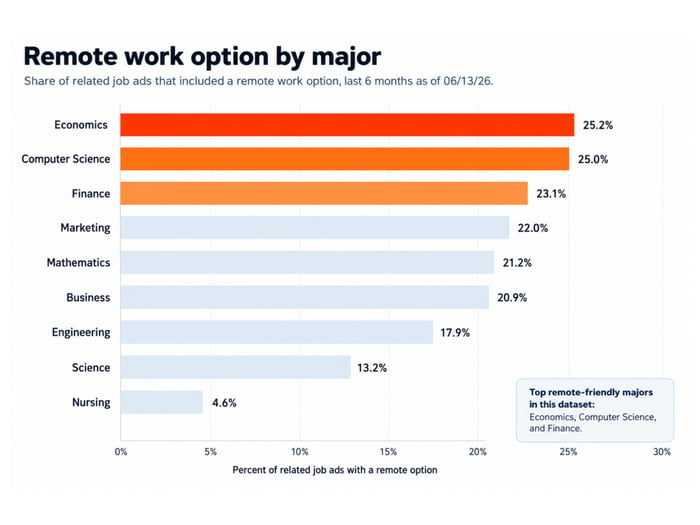
Computer science shows why this distinction matters. A student may picture remote software jobs, but the major can also lead to hardware, systems, support, or security roles with different location needs. Chmura data covering the last 6 months as of June 13, 2026, found that 25% of computer science-related job ads included a remote work option. That is strong, but it also shows that most postings did not indicate remote work.
The practical lesson is to connect majors to occupations before ranking them. Education leaders, workforce planners, and students get clearer answers when they look at job titles, tasks, posting language, and remote indicators. A major is too broad to answer the question on its own.
“Occupation-level analysis gives the answer more weight.”
The best majors pair digital tasks with measurable outputs
The best majors for remote work tend to prepare students for jobs where work can be completed, shared, reviewed, and improved through digital systems. That includes analysis, writing, coding, reporting, campaign management, financial modeling, and structured project work.
A marketing graduate working on paid search campaigns can send weekly reports, adjust budgets, review performance, and coordinate with teammates online. A mathematics graduate working as a data analyst can clean datasets, build dashboards, and explain results through a written brief. Those outputs are easier to manage remotely than work requiring physical presence.
|
What to check before choosing a major |
Why it matters for remote work |
|
The major connects to occupations with digital work products |
Remote roles need outputs that can be reviewed without watching the work happen. |
|
Job ads mention remote options often enough to matter |
Posting language shows how employers are actually structuring roles. |
|
The work has clear measures of completion |
Code, reports, models, and campaigns are easier to assess from a distance. |
|
Entry-level roles exist within the field |
Some majors look remote-friendly only after years of experience. |
|
The role does not rely heavily on physical equipment |
Lab, field, clinical, and production work limit remote access. |
The strongest choices are usually not the broadest degrees. They are the degrees with clear links to occupations where remote work fits the task structure.
Computer science leads when remote access is the main goal

Computer science remains one of the clearest majors for remote career access because many related roles are built around code, systems, testing, documentation, and digital collaboration. Remote work is not automatic, but the work itself often fits distributed teams.
A software developer can submit code, review pull requests, troubleshoot defects, and document changes without sitting in the same office as a manager. A cybersecurity analyst can monitor alerts, investigate risks, and prepare incident notes through secure systems. Those workflows support remote or hybrid setups better than roles tied to a physical site.
The hiring outlook also supports this path. The Bureau of Labor Statistics projects computer and mathematical occupations to grow 10.1% from 2024 to 2034, compared with 3.1% growth for total employment. That broader growth does not guarantee a remote job, but it helps explain why computer science remains a strong option when paired with practical projects, internships, and role-specific skills.
Math and economics offer strong paths into remote analytical roles
Mathematics and economics majors can lead to remote-friendly work when students build applied skills in data, research, modeling, and communication. These majors are strongest when they connect abstract reasoning to decisions employers need to make.
Chmura data found that 21.2% of mathematics-related job ads and 25.2% of economics-related job ads included a remote work option. Economics slightly outpaced computer science in the dataset, which challenges the assumption that only technical computing majors lead to remote work. The reason is practical: many economics roles focus on analysis, forecasting, policy review, pricing, and reporting.
A student with an economics degree can support market research, workforce planning, finance, or public policy analysis. A mathematics student can move toward actuarial work, operations research, analytics, or data science. The degree alone is not enough. Employers need proof that the graduate can work with data, explain findings, and turn numbers into clear recommendations.
Marketing and business create flexible options across many employers
Marketing and business majors can lead to remote work because they prepare students for roles found across many sectors. The opportunity comes from breadth, but the risk is a lack of focus. Students need to shape these majors toward measurable work.
Chmura data found that 22% of marketing-related job ads and 20.9% of business-related job ads included a remote work option. These fields often include roles in digital marketing, account management, operations, sales support, project coordination, and customer success. Some are remote-friendly. Others depend on travel, events, client meetings, or local operations.
The best path is to build a clear work sample before graduation. Strong examples include:
- A campaign report that explains goals, spend, results, and next steps.
- A spreadsheet model that compares cost, volume, and staffing needs.
- A customer research brief based on survey or interview findings.
- A project plan with timelines, owners, risks, and status updates.
- A dashboard that tracks performance across several business measures.
These examples matter because business and marketing job titles can be vague. Work samples help employers see the specific remote-ready tasks you can own.
Finance and engineering require closer review before choosing a path
Finance and engineering can lead to remote roles, but both require more careful review than their reputation suggests. Each field includes desk-based analytical work and site-based work, so remote access depends heavily on the occupation.
Chmura data found that 23.1% of finance-related job ads included a remote work option, higher than business and marketing in the dataset. Finance roles tied to analysis, planning, compliance, reporting, and risk review are often easier to perform remotely. Roles tied to relationship management, branch operations, or on-site controls can be less flexible.
Engineering is more mixed. Overall, 17.9% of engineering-related job ads included a remote option, but specific engineering fields varied. Civil engineering reached 19.5%, computer engineering reached 18%, electrical engineering reached 16.2%, industrial engineering reached 15%, mechanical engineering reached 12.4%, and chemical engineering reached 12.1%. That spread matters. A student choosing engineering for remote work should evaluate the specific discipline and the types of employers tied to it.
Healthcare and science majors need occupation-level checks for fit
Healthcare and science majors can be strong career choices, but they often have lower remote work access because many roles require labs, clinics, equipment, specimens, patients, or regulated work settings. Remote options exist, but they cluster in specific roles rather than across the entire field.
Chmura data found that 13.2% of science-related job ads and 4.6% of nursing-related job ads included a remote work option. That gap makes sense. A biology graduate working in a lab usually needs equipment and controlled procedures. A nurse delivering direct patient care usually needs to be where the patient is. Remote work becomes more realistic in care coordination, case review, research administration, health data, insurance review, and education support.
This does not make these majors poor choices. It means remote work should not be the main assumption. A student who wants healthcare plus flexibility should compare occupations early, not after graduation. The right question is which healthcare or science roles can be done through documentation, review, analysis, or coordination.
Use labor market data before treating any major as remote-friendly
“Remote-friendly should be a tested claim, not a label attached to a degree.”
A major deserves that label only when its related occupations show clear task fit, enough remote postings, and practical paths for entry-level workers.
The most useful review starts with job postings and occupation data. A college program team can compare remote indicators, wages, openings, skills, and related job titles before advising students or updating a program. JobsEQ can support that work by tying programs to occupations and showing how labor market evidence changes the answer from a broad guess to a defensible finding.
The judgment is simple: choose the major that gives you both career access and a work style that matches how the job is actually done. Computer science, economics, mathematics, marketing, business, finance, and parts of engineering can all support remote careers. Chmura data shows why the strongest answer is not a single major. It is the ability to compare degrees through occupations, tasks, and post evidence before making the call.