Get practical insight into CTE advisory committee evidence that connects programs to occupations, wages, postings, and employer needs.
Education

By Chmura Economics & Analytics
Published Jul 4, 2026
Key Takeaways
- Strong CTE advisory board evidence connects programs to specific occupations, regional openings, wages, current postings, and employer names.
- Hard-to-fill signals help boards focus employer engagement on roles where local worker supply appears tight.
- Board input carries more weight when it is documented against clear labor market evidence and tied to program action.
CTE directors build stronger advisory board cases when employer input is paired with specific labor market proof. A strong board packet answers the questions local employers will ask first: which occupations the program supports, how many workers the region needs, what wages look like, who is hiring, and where hiring friction is already visible.
“Program approval gets harder when evidence stays broad.”
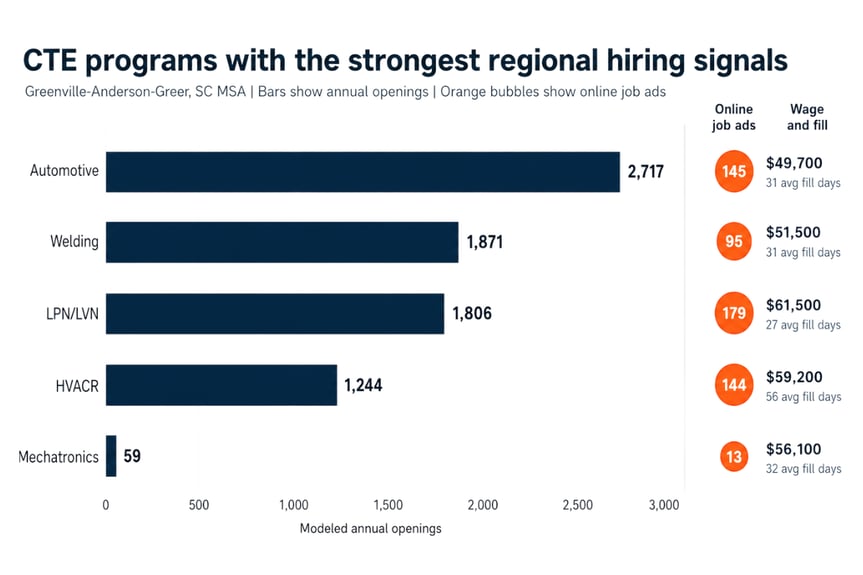
A regional snapshot gives the CTE advisory committee a shared baseline before members debate equipment, curriculum, internships, and program capacity. Chmura’s Greenville-Anderson-Greer analysis shows why that matters: automotive service technicians and mechanics had 2,717 modeled annual openings, while licensed practical and vocational nurses had 179 online job ads in the same regional brief.
8 ways CTE directors prove employer need with board evidence
Board evidence works best when each metric answers a specific employer or stakeholder question. Openings show labor need, wages show student value, postings show active recruiting, employer names make the case concrete, and hard-to-fill signals help the board decide where to focus discussion.
|
Proof point |
Main takeaway |
|
Match each program to specific regional occupations |
Program evidence gets clearer when each credential is tied to the jobs students are preparing to enter. |
|
Use annual openings to size workforce need |
Openings help boards understand the yearly worker pipeline needed from growth and replacement. |
|
Add wage signals to show student value |
Wage evidence connects program conversations to career value and student outcomes. |
|
Validate hiring activity with current postings |
Current postings help confirm that employers are recruiting for roles tied to the program. |
|
Bring employer names into advisory board meetings |
Recognizable employer names make board conversations more practical and easier to act on. |
|
Flag hard to fill roles using jobseeker signals |
Tight labor signals help boards focus on programs where local pipelines need attention. |
|
Turn meeting input into documented program proof |
Board comments become more useful when they are connected to evidence and recorded clearly. |
|
Package findings into a board ready brief |
A concise brief helps CTE leaders carry the same case into funding and approval discussions. |
1. Match each program to specific regional occupations
A CTE advisory board needs to see how a program connects to the jobs students will pursue. Broad program names will cause confusion when employers discuss different roles, credentials, tools, and work settings. A stronger case connects each program to the occupation most closely tied to its employment pathway.
Welding Technology/Welder can be tied to welders, cutters, solderers, and brazers. HVACR Maintenance Technology/Technician can be tied to heating, air conditioning, and refrigeration mechanics and installers. That mapping gives the board a cleaner way to discuss curriculum fit, equipment needs, work-based learning, and graduate readiness.
This step also protects the program case from overreach. Some programs support more than one occupation, but advisory board proof should start with the clearest fit. Once that foundation is set, the board can discuss adjacent roles without losing the main workforce question.
2. Use annual openings to size workforce need
Annual openings help a CTE advisory committee understand how many workers the region needs each year. The number includes growth and replacement needs, so it gives a better view than job counts alone. It helps the board discuss whether local program capacity matches the scale of employer need.
Automotive service technicians and mechanics showed 2,717 modeled annual openings in the Greenville-Anderson-Greer analysis. Welders, cutters, solderers, and brazers showed 1,871 openings, while licensed practical and vocational nurses showed 1,806. Those figures give the board a practical starting point for capacity and recruitment discussions.
Openings should still be used with care. They are modeled estimates, so they work best when paired with postings, wages, and employer input. A high openings figure supports the case for attention, but it does not replace direct board feedback about skills, certifications, schedules, and hiring standards.
3. Add wage signals to show student value
Wage signals help board members connect program need to student outcomes. Employers can confirm hiring needs, but students and families also need to see that a credential leads to a viable career path. Median wages give the board a simple way to discuss value without relying on anecdotes.
The Greenville-Anderson-Greer brief showed median annual wages of $61,500 for licensed practical and vocational nurses, $59,200 for HVACR mechanics and installers, and $51,500 for welders, cutters, solderers, and brazers. Those numbers help CTE leaders show how programs support both regional employers and student economic mobility.
Wage evidence also improves program prioritization. A program with strong openings but weak wages will require a different board conversation than a program with strong openings and higher pay. The right question becomes sharper: what support does the program need to produce graduates who can access stable, well-paying roles?

4. Validate hiring activity with current postings
Current job postings show where employers are actively recruiting. They do not equal hires, and they can include reposts, but they help board members see which roles are showing up in the current hiring market. Used correctly, postings add a timely layer to modeled openings.
In the Greenville-Anderson-Greer region, licensed practical and vocational nurses had 179 online job ads. Automotive service technicians and mechanics had 145, while HVACR mechanics and installers had 144. Those signals help a CTE advisory board compare program areas through a current recruiting lens.
Postings work best as a validation tool, not a single proof point. A board should ask which employers are posting, which job titles are most common, and which requirements appear often. That discussion can reveal curriculum gaps, certification needs, or work-based learning opportunities that annual openings alone cannot show.
5. Bring employer names into advisory board meetings
Employer names make a CTE advisory board discussion more grounded. A chart with postings is useful, but a board packet that names recognizable employers makes the conversation more concrete. It helps members confirm which companies are hiring and which partnerships deserve follow-up.
The Greenville-Anderson-Greer brief listed employers tied to program keyword sets, including Prisma Health for licensed practical and vocational nursing, Vertiv and Trane Technologies for HVACR, and GE Vernova and Michelin for mechatronics. Those names help the board move from general labor need to targeted employer engagement.
Chmura data can support this step by connecting postings, occupations, and employer names in a format CTE leaders can use in board packets. The value is practical: the director can ask specific employers about skill expectations, internship capacity, hiring timelines, and barriers to filling roles.
6. Flag hard-to-fill roles using jobseeker signals
Hard-to-fill signals help board members see where hiring pressure is most likely to strain employers. Useful indicators include low occupation unemployment, postings per unemployed worker, and average posting duration. These signals do not prove a shortage alone, but they help identify where the board should ask harder questions.
Mechatronics technologists and technicians showed 13 postings per unemployed worker in the Greenville-Anderson-Greer analysis. HVACR mechanics and installers showed an average posting duration of about 56 days. Those figures point to different types of hiring friction that deserve board discussion.
The implication is practical. A role with a high postings-per-unemployed ratio can require stronger recruitment and awareness building. A role with long posting duration can require deeper discussion about credentials, experience requirements, scheduling, wages, or employer expectations. Advisory boards work better when these issues are visible before the meeting.
7. Turn meeting input into documented program proof
Employer comments become stronger evidence when they are documented against the data reviewed in the meeting. A board member saying “we need more technicians” is useful, but it becomes more defensible when tied to openings, postings, wages, and specific skill gaps. Good documentation turns a conversation into program support.
A CTE director can record which employers confirmed hiring needs, which roles they named, what credentials they expect, and which barriers they see in applicants. That record can support program approval, grant narratives, Perkins V documentation, and internal budget requests.
The key is discipline. Meeting notes should avoid vague statements and capture specific employer input. If an HVAC employer says applicants lack troubleshooting experience, that comment should connect to curriculum review or lab planning. If a healthcare employer flags clinical placement capacity, that issue should shape the next board agenda.
8. Package findings into a board-ready brief
A board-ready brief helps CTE leaders put the full case in one place. It should include aligned occupations, openings, wages, postings, employer names, and hard-to-fill signals. The goal is a short, credible packet that helps board members discuss the same evidence during the meeting.
The strongest briefs also include plain-English caveats. Postings do not equal hires. Openings are modeled estimates. Employer lists from keyword-associated postings can include adjacent roles. Those notes make the evidence more credible because they show the director understands what each metric can and cannot prove.
A good brief should also give the board something to do. It can frame questions about work-based learning, equipment, certifications, employer outreach, and program capacity. That turns the CTE advisory board from a passive review group into a practical source of program direction.
How CTE directors turn board evidence into action
“Strong evidence turns a meeting into a better program decision.”
Board evidence creates value when it shapes decisions after the meeting. The strongest CTE directors use the same proof set for employer follow-up, program approval, grant support, and stakeholder reporting. The work becomes easier to defend because each recommendation ties back to a clear workforce question.
That discipline matters. Local industry boards do not need a stack of disconnected charts. They need a concise case that shows which programs connect to which jobs, where employers are hiring, how wages support students, and where hiring friction needs attention. Chmura helps CTE teams build that kind of board-ready workforce evidence, but the real payoff comes from how the director uses it.