Review CTE funding sources for 2026, including Perkins V, WIOA, Workforce Pell, state programs, and rural funding, and get practical guidance.
Education

By Chmura Economics & Analytics
Published Jul 28, 2026
Key Takeaways
- Strong CTE funding cases connect occupations, credentials, employers, costs, and student outcomes through regional evidence.
- Perkins V, WIOA, Workforce Pell, state programs, and philanthropic funds serve different roles within one coordinated financing plan.
- Rural and regional partnerships can expand access when individual institutions lack enough staff, equipment, employers, or participants to support a pathway alone.
Career and Technical Education (CTE) funding in 2026 will favor programs that connect public investment to specific occupations, credentials, employers, and student outcomes. Education leaders will build stronger funding cases when they treat workforce evidence as part of program design rather than a final attachment to an application.
The strongest opportunities sit across several connected channels. Perkins V remains the base; Workforce Innovation and Opportunity Act partnerships expand training capacity; Workforce Pell expands access to eligible short-term programs; and state or philanthropic funds can address local gaps. A disciplined funding plan links each source to a defined pathway, cost, participant group, and measurable result.
CTE funding in 2026 rewards clear workforce alignment
Funding requests need a direct line from regional workforce needs to program design. Reviewers want to see which occupations the program serves, which credentials students will earn, which employers will participate, and how completion will lead to work or further education.
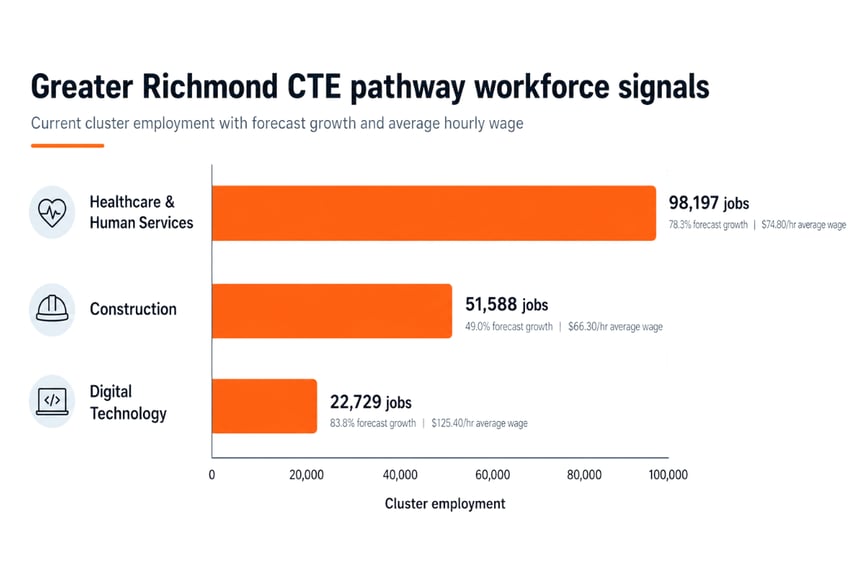
Greater Richmond data provides a practical model. Healthcare and Human Services represents 98,197 jobs, while Construction represents 51,588 and Digital Technology represents 22,729. Employer postings also reference credentials such as Basic Life Support, Registered Nurse, CPR, OSHA 30, OSHA 10, Forklift Certified, and CISSP. Those details give an institution concrete evidence for equipment purchases, work-based learning, faculty capacity, and credential testing.
A strong application names the occupation, documents the regional need, identifies the credential, explains the training sequence, and sets measurable completion and placement goals.
“Broad claims about workforce shortages carry less weight than a specific pathway supported by clear local evidence.”
Perkins V remains the foundation for local CTE funding
Perkins V remains the most stable federal base for secondary and postsecondary CTE programs. Congress provides roughly $1.3 billion each year through Title I state formula grants, with states distributing funds under approved plans and local rules.
Local leaders should start with their Comprehensive Local Needs Assessment and state priorities. A construction program could connect Perkins spending to updated electrical labs, OSHA preparation, instructor training, or employer-supervised work experience. The request should explain how each cost addresses an identified performance or access gap.
Perkins funds work best as part of a larger financing plan. An institution can use Perkins for program quality, WIOA resources for eligible participant services, and employer support for equipment or paid placements. This structure reduces reliance on a single source and gives each funder a defined role.
|
Funding channel |
Best use in a CTE funding plan |
Evidence reviewers will expect |
|
Perkins V |
Supports program quality, equipment, access, and approved local priorities. |
Connect spending to the local needs assessment and state plan. |
|
WIOA |
Supports eligible participants, workforce partnerships, and training tied to regional priorities. |
Show workforce board coordination and participant eligibility. |
|
Workforce Pell |
Helps eligible students pay for approved short-term workforce programs. |
Document program approval, outcomes, hours, and state certification. |
|
State programs |
Addresses state priorities, sector needs, and capacity gaps. |
Match the proposal to current state rules and budget periods. |
|
Philanthropic funds |
Supports pilots, student services, equipment, and community goals. |
State the measurable benefit and the plan for continued support. |
|
Rural programs |
Builds career pathways where distance and limited capacity create barriers. |
Prove regional need, partner roles, and access across the service area. |
WIOA supports employer-linked training through regional partnerships
The Workforce Innovation and Opportunity Act (WIOA) supports training through state and local workforce systems, so education providers usually access its value through coordination rather than a stand-alone campus request. Strong proposals begin with the local workforce board, eligible training rules, participant criteria, and regional sector priorities.
A community college developing a nursing assistant pathway could pair classroom instruction with workforce board referrals, supportive services, and clinical placements. The college provides instruction, the workforce board supports eligible participants, and healthcare partners help define schedules and work experience.
Coordination requires clear ownership. Before submitting a request, document:
- The participant group each funding source can support.
- The program costs assigned to each partner.
- The employer commitments already secured.
- The outcomes each partner will report.
- The staff member responsible for compliance.
Federal guidance issued in 2026 also encourages closer alignment between WIOA and Perkins activities. That gives local teams a stronger basis for shared planning, but each source still keeps its own eligibility and reporting rules.
Workforce Pell expands funding for short-term credential programs
Workforce Pell became available on July 1, 2026, for approved short-term programs that meet federal and state requirements. Students can receive Pell support for eligible workforce programs, but institutions must complete the approval process and document required performance standards.
This creates a meaningful opening for programs built around recognized credentials and clear employment routes. A short healthcare certificate tied to Basic Life Support or CPR requirements could fit the funding logic when its length, outcomes, and approval status meet the rules. A construction certificate linked to OSHA preparation offers another practical case.
Workforce Pell is student aid rather than a broad institutional award. Leaders still need separate resources for equipment, faculty, outreach, and student supports. The best financing plan pairs Pell eligibility with Perkins, state funds, employer contributions, or philanthropy so tuition access and program capacity grow at the same pace.
State programs can fill gaps in federal funding
State CTE offices, workforce agencies, and economic development programs can fund priorities that federal formulas do not fully cover. These opportunities often support sector partnerships, equipment, apprenticeship expansion, credential attainment, or programs tied to state industry goals.
Virginia institutions, for instance, can scan state CTE opportunities and workforce initiatives alongside federal channels. A Digital Technology program could seek support for a cybersecurity lab or certification preparation when employer postings show a clear need for CISSP-related skills. The supplied Greater Richmond analysis identifies Digital Technology as a sizable regional pathway with strong projected growth and high wages.
State funding requires close attention to timing and eligibility. Budget cycles, match rules, allowable costs, and applicant types differ across programs. Maintain a grant tracker that records opening dates, required partners, reporting terms, and approval steps. That discipline prevents a promising program from missing an opportunity because the team started too late.
Philanthropic funders favor measurable community workforce outcomes
Foundations and employer giving programs usually support a defined community result rather than routine operating costs. Strong requests connect funding to a specific barrier such as transportation, testing fees, tools, childcare, instructor capacity, or access for underserved students.
A rural healthcare pathway could ask a community foundation to cover clinical travel and credential fees while Perkins supports instruction and Workforce Pell supports eligible tuition. An employer foundation could fund simulation equipment or paid placements tied to nursing assistant preparation. Each contribution solves a different constraint.
Philanthropic support also gives institutions room to test a program before seeking recurring public funds. The proposal should still explain what happens after the initial award. Reviewers will expect a realistic continuation plan based on enrollment, employer participation, public funding, or institutional support. Clear measures such as credential completion, placement, persistence, and wage progression make the case more credible.
Rural CTE programs need stronger regional funding partnerships

Rural workforce development depends on regional partnerships because a single institution or county often lacks enough students, instructors, employers, or equipment to carry a specialized pathway alone. Funding cases become stronger when partners share facilities, instruction, transportation, recruitment, and placement responsibilities.
Federal rural programs reflect this regional approach. The 2026 Rural Postsecondary and Economic Development program supports career pathways aligned with high-skill and high-wage occupations. The Workforce Opportunity for Rural Communities program anticipated about $49.2 million for its seventh round, with possible added funds.
A multi-county skilled trades program could place lab instruction at one campus, provide mobile training at partner schools, and coordinate apprenticeships across several employers. The funding request should show why the shared model is more practical than separate small programs. It should also address travel, broadband, equipment access, instructor availability, and service coverage with specific costs and partner commitments.
Regional workforce evidence should guide every funding request
“Regional evidence should determine which programs receive attention, which credentials belong in the curriculum, and which funding source fits each cost.”
A funding calendar alone cannot answer those questions. Institutions need a repeatable process that connects occupations, wages, projected openings, employer postings, credentials, student access, and partner capacity.
The Greater Richmond findings show how this works. Healthcare, construction, and digital technology each present different job volumes, wages, occupations, and credential signals. Chmura’s JobsEQ can help education teams turn those signals into a workforce snapshot, program viability analysis, or grant support package, while expert analysis can address complex regional questions.
Good execution is disciplined rather than complicated. Start with the regional need, define the pathway, assign each cost to an eligible source, confirm every rule, and document the outcomes reviewers will assess. That approach gives funders a clearer reason to invest and gives your institution a defensible basis for choosing which CTE programs deserve scarce time and resources.