Get practical insight into workforce grants and how labor market data supports stronger Perkins, WIOA, and Title III applications.
Education

By Chmura Economics & Analytics
Published Jul 4, 2026
Key Takeaways
-
Stronger workforce grant applications connect the funding request to specific occupations, wages, openings, employer activity, and measurable outcomes.
-
Perkins, WIOA, and Title III applications each use workforce evidence differently, so the same data should be framed around the grant’s purpose.
-
Grant narratives become more defensible when data shapes the request rather than being added after the funding case is already written.
Strong data does more than prove that jobs exist. It shows why a program, pathway, training model, or institutional investment deserves support now, in the specific community the grant will serve.
Federal workforce grants reward clarity. Perkins funding asks education providers to connect CTE programs to labor market alignment and local needs; WIOA funding is tied to workforce system performance and services for job seekers and employers, and Title III supports institutional capacity for eligible colleges serving low-income students. Each program has different rules, but the strongest applications share one trait: they make the case with defensible workforce evidence that reviewers can follow.
“Grant applications get stronger when workforce evidence connects the proposed activity to a clear funding purpose, a defined population, and a measurable regional need.”
Grant reviewers need workforce evidence tied to fundable outcomes
Grant reviewers need workforce evidence demonstrating that the proposed activity aligns with the grant’s purpose, regional workforce needs, and the outcomes the applicant promises to improve. A stronger case connects occupations, wages, openings, employer signals, target learners, and measurable outcomes into a clear line of reasoning.
A weak application might state that a community needs more technical workers. A stronger application shows which occupations need workers, what those jobs pay, which employers are posting for related roles, and how the proposed training will prepare participants for those opportunities. That evidence gives reviewers a practical way to judge fit.
The main risk is treating workforce data as background support rather than as the structure of the funding case. Grant narratives become harder to defend when they rely on broad claims, national averages, or generic labor trends. Reviewers need to see how the proposed use of funds will address a documented gap. The grant story should move from regional need to funded activity to measurable outcome without making the reviewer connect the dots.
|
Grant evidence area |
What the evidence needs to prove |
|
Regional occupation fit |
The proposed program connects to specific jobs in the service area rather than broad career categories. |
|
Worker pathway value |
Participants will be prepared for roles with openings, wages, and advancement potential. |
|
Employer signal strength |
Job postings, employer names, and hiring patterns support the need described in the request. |
|
Program alignment |
The curriculum or training model matches the skills and occupations tied to the funding purpose. |
|
Outcome credibility |
The proposed results are measurable and grounded in actual labor market conditions. |
Strong applications start with regional occupation fit
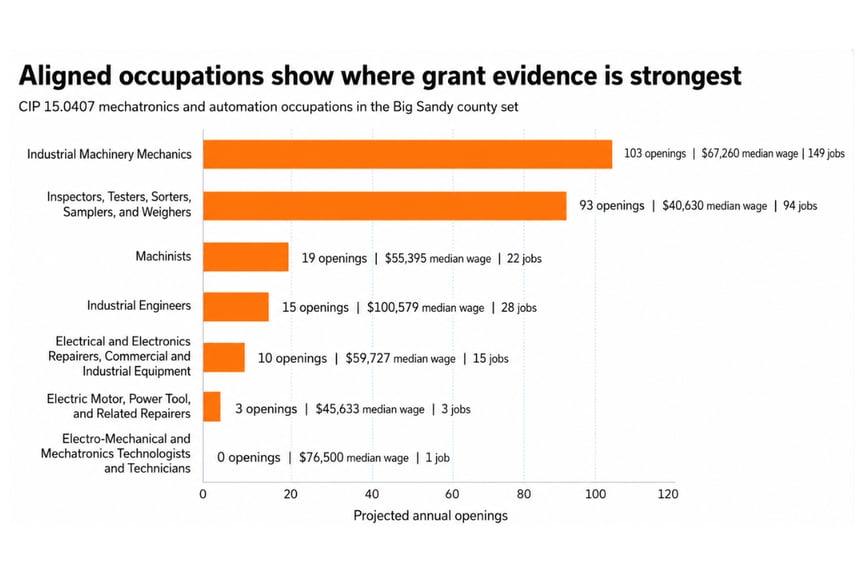
Regional occupation fit shows reviewers that the proposed program is tied to jobs available in the applicant’s actual service area. This matters because workforce grants are not scored only on broad economic need. They also depend on whether the proposed activity fits the local labor market and the people it will serve.
A community college proposing a mechatronics certificate, for instance, should connect the program to roles such as industrial machinery mechanics, machinists, and electro-mechanical technicians. Chmura’s analysis of a Big Sandy Area Development District example found 312 jobs across aligned mechatronics and automation occupations, with 243 projected annual openings across the selected occupation set. That gives the application a more concrete foundation than a general statement about manufacturing needs.
The best use of occupation fit is not to inflate the opportunity. It is to define it accurately. Some aligned occupations will have more openings, some will pay better, and some will represent smaller but strategic skill needs. That distinction helps applicants avoid overstating the case while still showing why the funded program matters. A credible grant narrative will explain which occupations are the strongest fit and which ones serve as supporting pathways.
Perkins applications require program evidence linked to local need
Perkins applications require evidence that CTE investments match local education and workforce needs. Labor market alignment is part of the Comprehensive Local Needs Assessment process, and eligible recipients use that assessment to guide local Perkins applications and program planning.
A Perkins request for equipment, curriculum updates, or instructor capacity should connect the program to occupations, regional openings, and wages. A robotics or automation program should not rely only on student interest or employer anecdotes. It should show how the program maps to specific technical roles and why those roles matter for the region’s workforce goals.
Strong Perkins evidence usually answers 5 practical questions:
- Which occupations does the program prepare learners to enter?
- How many regional openings support the need for training?
- What wages show the pathway has value for students?
- Which employers or industries signal a need for these skills?
- How will the funded activity improve program quality or access?
Perkins narratives are strongest when they treat data as a program planning tool. The evidence should help the applicant decide what to fund, not simply justify a choice already made. That distinction matters because reviewers need confidence that the request is tied to real labor conditions and a clear plan for learner outcomes.
WIOA funding cases need proof of worker pathway value

WIOA funding cases need evidence that training will help participants move toward employment, wage gains, or stronger career pathways. The workforce system is built around outcomes for job seekers and employers, and performance data is used by workforce boards, partners, stakeholders, and the public to assess program activity and results.
A workforce board supporting a short-term training program should show more than job counts. The case should explain the worker pathway. That means connecting the target population to occupations with openings, wages that justify training, and skills that employers request. It also means showing why the selected pathway is realistic for the participants served.
A practical WIOA grant narrative might compare entry-level roles, training time, wage outcomes, and advancement options within a regional labor market. If a proposed program prepares dislocated workers for industrial maintenance roles, the application should show openings, wages, related postings, and the role’s fit within local employers’ operations. This turns workforce investment from a general training expense into a defensible pathway strategy. Reviewers need to see that participants will have a reasonable route from service to employment.
Title III proposals benefit from clearer labor market alignment
Title III proposals benefit from workforce evidence when the requested activity supports academic quality, institutional capacity, student success, or long-term fiscal stability. The Strengthening Institutions Program helps eligible institutions become more self-sufficient and expand capacity to serve low-income students.
A Title III proposal might request support for advising redesign, program planning, career pathways, data systems, or student success infrastructure. Workforce data strengthens those requests when it shows how institutional investments connect to programs that lead to regional employment opportunities. That connection is especially useful when the institution must explain why capacity-building work will matter beyond internal operations.
A college seeking funds to improve program pathways could use labor market evidence to prioritize programs with stronger regional fit. The grant narrative can connect academic planning to occupations, wages, transfer or credential pathways, and employer needs. That does not mean Title III should be written like a workforce grant. It means labor market data can help prove that institutional capacity investments are tied to student opportunity and program relevance. Reviewers get a clearer view of why the proposed capacity work deserves funding.
Employer signals make training requests easier to defend
Employer signals make training requests easier to defend because they show current market activity rather than only long-term projections. Job postings, employer names, requested skills, and hiring frequency help applicants explain which roles are active, which skills appear in real hiring language, and which industries are most connected to the proposed training.
Chmura data for the Big Sandy Area Development District example found 56 active job ads referencing the selected education program code during the July 2025 to June 2026 period. That kind of signal will not replace occupation projections, but it adds a valuable layer. It shows that employer activity can be tied to a specific program discussion instead of staying at the level of broad labor trends.
Employer signals also help writers avoid vague claims about business support. A letter from an employer is useful, but a stronger application connects that letter to postings, skill requirements, and regional occupation data. That combination gives reviewers both human context and market evidence. It also helps applicants decide which employer partnerships are most relevant to the funded work.
Projected openings help reviewers judge long-term need
Projected openings help reviewers judge whether a proposed activity addresses a sustained regional need. They combine expected growth and replacement needs, which matters because many workforce gaps come from turnover, retirements, and role churn rather than job growth alone.
A training program tied to industrial machinery mechanics might look modest if the application only discusses current employment. The same program can look more relevant when projected openings and wages are included. Chmura’s Big Sandy example shows industrial machinery mechanics with 149 current jobs, 103 projected annual openings, and an approximate median annual wage of $67,260. That combination supports a stronger case for pathway value.
Projected openings should still be handled carefully. A high number does not automatically prove that a program should expand, and a smaller number does not automatically make a pathway weak. The right interpretation depends on wages, training requirements, employer concentration, and the role’s importance to regional industries.
“Strong applications do not use more data than necessary. They use the right data in the right order.”
Common grant gaps weaken otherwise strong workforce narratives
Common grant gaps usually come from weak connections between the data, the proposed activity, and the promised outcome. A grant narrative can include accurate data and still feel unconvincing if the evidence does not explain why the requested funds are needed, why the timing makes sense, and how the results will be measured.
The most common mistake is using labor market data as a decorative proof point. A sentence about regional job growth will not carry much weight if the application never connects that growth to curriculum, equipment, participant services, employer partnerships, or expected outcomes. Reviewers need a complete chain of logic.
Disciplined grant writing makes every data point earn its place. The evidence should clarify the decision, sharpen the funding request, and make the proposed outcomes easier to evaluate. Chmura supports that work when teams need to connect programs, occupations, wages, openings, and employer activity into a grant support package that stakeholders can understand. Strong applications do not use more data than necessary. They use the right data in the right order.