Use higher education program review data to assess enrollment, workforce fit, wages, openings, and program viability with practical insight.
Education

By Chmura Economics & Analytics
Published Jul 28, 2026
Key Takeaways
- Enrollment is useful, but program review needs regional workforce evidence to judge program fit, scale, and student opportunity.
- Program-to-occupation mapping gives review teams a clearer way to connect academic offerings to openings, wages, and employer need.
- Completion ratios are most useful as a screening tool that points reviewers toward deeper questions, rather than a final judgment.
Program review becomes more useful when enrollment is tested against regional workforce need, not treated as the final answer. A program with strong headcount can still raise hard questions if related jobs are limited, wages are weak, or nearby completions already exceed openings. A smaller program can deserve continued support if it connects to strong local hiring need and clear student opportunity.
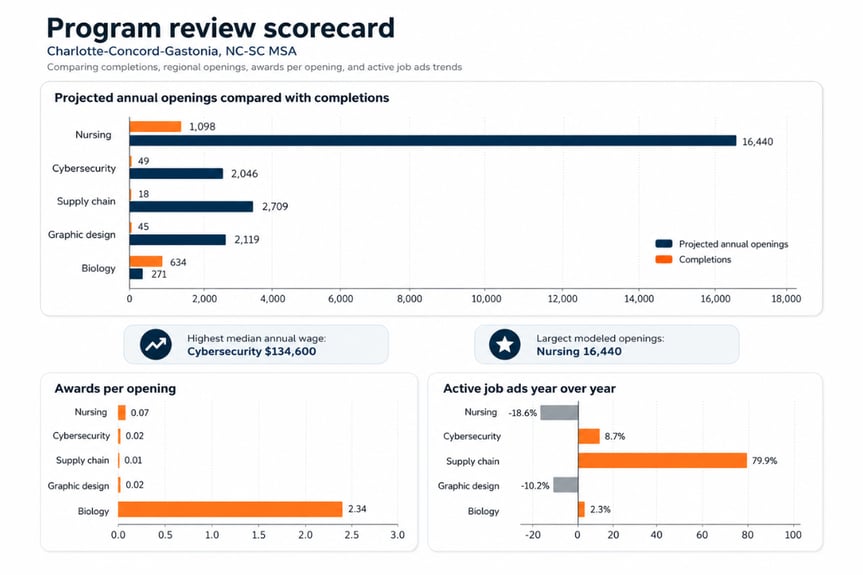
A recent Chmura program review scorecard for the Charlotte-Concord-Gastonia, NC-SC MSA shows why enrollment is only one part of the review process. For example, registered nursing had 1,098 regional completions, but the related focus occupation had 16,440 projected annual openings. Logistics showed an even sharper gap, with only 18 completions compared with 2,709 projected annual openings.
That means both programs may be connected to strong labor market demand, but they raise different planning questions. Nursing may need capacity, faculty, clinical placement, or retention strategies. Logistics may need stronger program visibility, employer partnerships, or pathway development. Enrollment alone would not show those differences.
Enrollment signals need support from labor market evidence
Enrollment shows student interest and institutional capacity, but it does not prove program viability on its own. A stronger program review connects student activity to regional openings, wages, employer need, and related completions. That broader evidence helps academic affairs and institutional research teams separate popularity from workforce fit.
A program with steady enrollment can still lead to weak outcomes if graduates face limited regional job options. A program with modest enrollment can be worth protecting if it serves a field with strong hiring need, limited local supply, and wages that support student mobility. Review teams need both sides of the picture.
The scorecard makes that tension visible. One useful measure is the awards-per-opening ratio, which compares how many local completions exist for each projected annual job opening tied to the selected focus occupation. A ratio below 1.0 may suggest that regional demand is larger than the local talent pipeline. A ratio above 1.0 may suggest that local completions exceed projected openings for that occupation, but it does not automatically mean the program is weak.
Biology had 634 awards and only 271 projected annual openings for the selected focus occupation, which produced an awards-per-opening ratio of 2.34. That ratio should not be read as a simple pass-or-fail score. Instead, it should prompt better review questions: Where do graduates actually go? Which occupations do they enter? Does the program mainly support transfer, graduate study, healthcare pathways, research roles, or applied career options beyond the focus occupation?
A defensible review process treats enrollment as an input. It should never become the whole case. Strong program review asks if the program is attracting students, preparing them for specific options, and matching a regional workforce need that stakeholders can understand.
“Enrollment shows student interest and institutional capacity, but it does not prove program viability on its own.”
Program to occupation mapping frames the review correctly
Program-to-occupation mapping gives program review a clear structure. It connects an academic program to the jobs students will likely pursue, then tests that connection with labor market evidence. Without that mapping step, review teams risk comparing enrollment counts to broad job categories that do not reflect actual career pathways.
A cybersecurity program should be reviewed against information security roles, not the full technology sector. A nursing program should be tied to registered nurses, licensed practical nurses, clinical pathways, and related healthcare roles where appropriate. The goal is to make the employment link explicit enough for deans, boards, and faculty committees to evaluate.
This is also where methodology matters. Some programs lead to one clear occupation. Others lead to several. A biology program can support healthcare preparation, lab roles, education, environmental work, graduate study, and research pathways. Treating it as a single-job pipeline will distort the review.
The best program evaluation framework makes those limits visible. It should show the focus occupation, explain why it was selected, and note when the program feeds a wider set of outcomes. That transparency makes the review more credible because stakeholders can see the logic behind the comparison.
|
Review question |
Stronger evidence to include |
What it helps stakeholders decide |
|
Is the program attracting students? |
Enrollment trends and recent completions |
This shows student interest and current production, but it does not prove labor market fit. |
|
Do graduates connect to clear occupations? |
Program-to-occupation mapping |
This shows which jobs should be included in the review and which should be excluded. |
|
Is the region likely to absorb graduates? |
Projected annual openings and employment levels |
This helps reviewers assess whether completion volume fits local workforce need. |
|
Do students see economic value? |
Median wages and posting wage signals |
This helps explain the payoff tied to the program and related occupations. |
|
Is employer need current? |
Active job ads and year-over-year posting movement |
This adds a timely signal to the longer-term projections used in the review. |
Regional openings show where program capacity may fit
Regional openings help review teams judge whether program completions are aligned with local workforce need. They do not replace academic judgment, but they give stakeholders a clearer way to assess program scale. The key question is whether the region has enough related job opportunities to support the number of graduates being produced.
One way to interpret that relationship is through the awards-per-opening ratio, which compares local completions with projected annual job openings for a related focus occupation. A ratio below 1.0 means projected openings are larger than local completions, which may point to unmet regional demand. A ratio near 1.0 suggests completions and openings are more closely balanced. A ratio above 1.0 means completions exceed projected openings for that focus occupation, which should prompt a closer look at graduate pathways, transfer patterns, related occupations, and demand outside the selected occupation.
Nursing shows how openings can reframe a program with high completions. The Charlotte scorecard lists 1,098 nursing awards, which could look large in isolation. Placed next to 16,440 projected annual openings for registered nurses, that produces an awards-per-opening ratio of 0.07. In practical terms, that means there are far more projected openings than local completions tied to the focus occupation, suggesting the program is connected to a large regional workforce need.
Logistics shows a similar capacity question from a smaller program base. With 18 awards and 2,709 projected annual openings for logisticians, the awards-per-opening ratio is 0.01. That very low ratio does not automatically mean the institution should expand the program, but it does suggest the review committee should ask whether stronger employer partnerships, clearer student pathways, or fewer participation barriers could help the program better match regional opportunity.
Openings should still be used carefully. They are modeled estimates tied to a focus occupation, and many programs connect to multiple roles. The strongest review process uses openings as a signal to frame discussion, then tests that signal against job postings, wages, employer feedback, completions, and student outcomes.
Current job postings reveal employer needs sooner
Current job postings give program review a nearer-term view of employer activity. Projections help estimate longer-term workforce need, while postings show what employers are asking for now. Used well, postings can help colleges spot shifts in skills, hiring volume, credentials, and wage language before older datasets reflect them.
The logistics program in the Charlotte scorecard shows why this matters. Active job ads tied to the supply chain program tag grew 79.9% year over year, the fastest increase in the scorecard. That near-term signal adds weight to the low awards-per-opening ratio and points to a program review discussion about expansion, employer input, and curriculum fit.
Nursing shows why postings need interpretation. The scorecard shows a 18.6% year-over-year decline in active job ads tied to the nursing program tag, even though modeled annual openings remain very high for registered nurses. A short-term posting decline does not erase a large labor need, but it should prompt questions about hiring cycles, clinical capacity, credential mix, and local employer behavior.
Good review teams avoid treating postings as a hiring count. Job ads can include repeated postings, hard-to-fill roles, and employer sourcing activity. Their value is strongest when paired with projections, wages, and completions.
Wages help explain program value for stakeholders

Wages help reviewers connect program evaluation to student value. They show whether related occupations offer a return that supports career mobility, family-sustaining income, and funding conversations. A program review that omits wages can overstate the value of high-volume programs or understate the value of smaller programs tied to strong earnings.
Information security stands out in the Charlotte scorecard. The cybersecurity-related program had 49 awards, 2,046 projected annual openings for information security analysts, and the highest median annual wage among the focus occupations at $134,600. That combination gives reviewers a strong reason to examine capacity, curriculum alignment, and employer connections.
Graphic design raises a different type of question. The selected focus occupation had a median annual wage of $54,100, with 45 awards and 2,119 projected annual openings. The review should not stop at wage rank. It should ask which industries hire graduates, which skills raise earnings, and how portfolios, internships, and applied work shape outcomes.
Wage evidence also helps academic leaders communicate with non-technical stakeholders. Boards and funders need to understand more than enrollment totals. They need to see which programs connect to strong economic outcomes and where institutional action will improve student opportunity.
Completion ratios can screen program supply risk
Completion ratios help program review teams screen where regional supply appears high or low compared to related openings. Awards per opening is not a verdict. It is a quick signal that tells reviewers where to ask better questions about scale, student pathways, employer need, and local program mix.
The Charlotte scorecard shows clear variation across programs:
- Nursing had 0.07 awards per opening, which suggests large workforce need relative to regional completions.
- Cybersecurity had 0.02 awards per opening, which points to possible capacity questions for a high-wage field.
- Logistics had 0.01 awards per opening, which raises a clear undersupply flag for the selected occupation.
- Graphic design had 0.02 awards per opening, which calls for closer review of skill fit and employer channels.
- Biology had 2.34 awards per opening, which requires careful pathway analysis before any program judgment.
That final point matters most. Biology’s ratio looks high because the scorecard ties it to one focus occupation. Many biology graduates pursue graduate study, health programs, lab roles, teaching, or careers outside the selected occupation. A simplistic ratio would miss that complexity.
Completion ratios work best as a triage tool. They help review teams decide where to spend deeper analytic time, which programs need employer validation, and which cases require a more detailed program viability analysis.
Program viability requires evidence stakeholders can defend
“Good program review is not about defending every program or cutting programs from a spreadsheet.”
Program viability should be judged through a disciplined evidence chain, not a single metric. Enrollment, completions, occupation mapping, openings, postings, wages, and ratios each answer a different question. The review becomes stronger when those signals are combined and explained in plain English.
That is where Chmura’s program-occupation alignment workflows fit the work. JobsEQ helps teams connect programs to occupations, compare completions with regional workforce need, review wage signals, and produce evidence that can support program evaluations, board discussions, grant narratives, and academic planning. The value is not just finding a number. It is getting to an answer stakeholders can follow.
The strongest reviews also acknowledge uncertainty. A program can serve transfer pathways, local employers, graduate study, or community priorities that do not appear fully in one occupation match. A program can also have strong enrollment while still needing curriculum updates, employer input, or clearer student outcomes evidence.
Good program review is not about defending every program or cutting programs from a spreadsheet. It is about asking better questions with evidence that is specific, transparent, and tied to the decisions colleges actually need to make.