Explore how construction labor shortages affect data center development, workforce capacity, site selection, project costs, and timelines.
Economic Development
Economic Impact
By Ibrahim YazdanPanah
Published Aug 11, 2026
Data centers have become one of the fastest-growing construction sectors in America
The scale of this shift is increasingly visible in construction spending. In April 2026, private data center construction reached a seasonally adjusted annual rate of approximately $50.7 billion, surpassing the $43.8 billion spent on general office construction. Data centers had therefore become the largest individual segment within private office construction.[1]
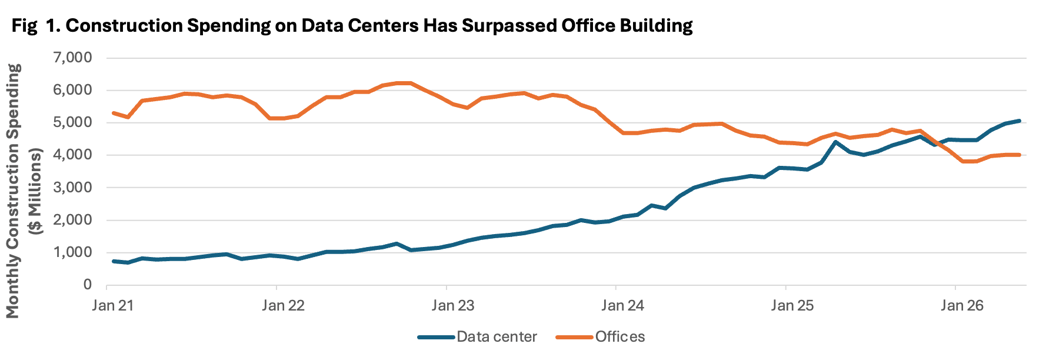 Source: U.S. Census Bureau
The expansion has also created concerns about local electric-grid capacity, potential costs to utility customers, and water consumption. The U.S. Department of Energy reports that data center electricity demand has tripled over the past decade and could double or triple again by 2028.
Another frequent criticism is that data centers create relatively few permanent jobs compared with the enormous capital investments and physical footprints, creating only 50-300 jobs dependent on the size of the data center.[2]
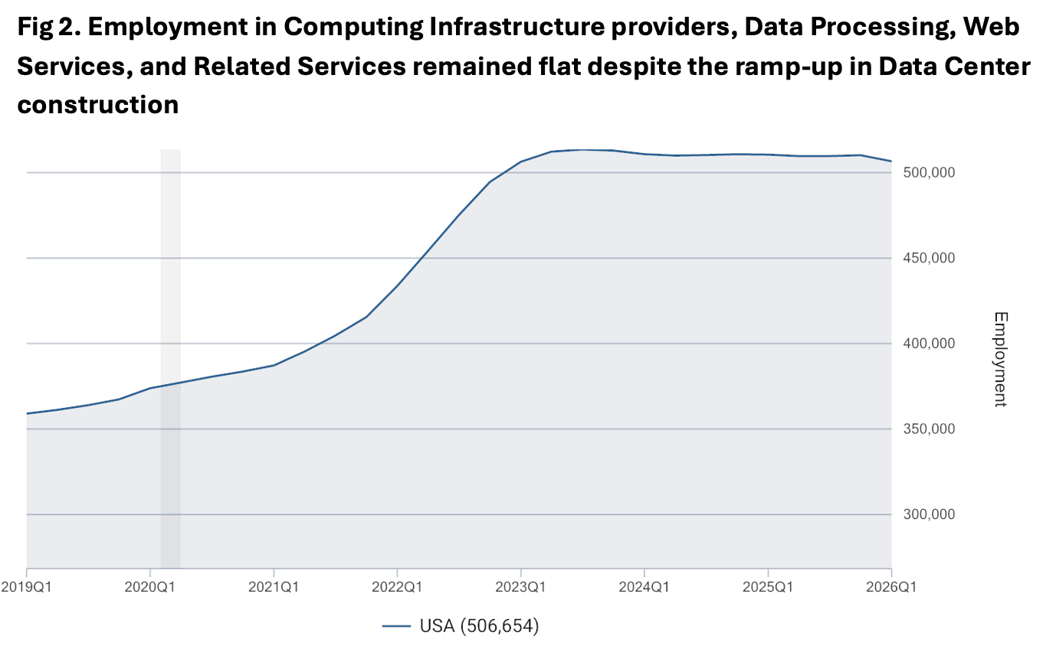 Source: JobsEQ Labor & Wage Trends, Data as of 2026Q1
While that criticism is valid, it overlooks another workforce challenge that can have a much greater impact on whether a project succeeds: finding enough skilled workers to build the facility in the first place.
The greatest workforce challenge happens before the data center opens
Although data centers create relatively small numbers of permanent jobs, building them requires a large construction workforce and specialized skilled trades.
Not every data center is the same.[3] Data centers vary in purpose, capacity, location, and size.
| Edge Data Center | Colocation Data Center | Hyperscale Data Center | |
| Primary Purpose | Low-latency computing close to users | Lease infrastructure to many customers | Massive cloud and AI computing |
| Capacity | 1-10 MW | 20-80 MW | 40-100+ MW |
| Location | Near population centers | Near business hubs | Near inexpensive land and abundant power |
| Typical Size | 5,000-100,000 sf | 50,000-600,000 sf | 300,000 - 500,000 sf |
One recent workforce study estimates that direct peak construction employment generally ranges from approximately 0.7 to 2.0 workers per megawatt, depending on the type of data center, with construction periods typically lasting 18 and 36 months per building.[4] Large campuses, which comprise multiple data center buildings, can require decades to build and thousands of workers simultaneously.
This demand comes at a particularly difficult time. The broader construction industry is already experiencing a major workforce shortage. Associated Builders and Contractors estimates that the industry must attract approximately 349,000 net new workers in 2026 simply to keep labor supply and demand in balance.[1] Meanwhile, a nationwide survey by the Associated General Contractors of America found that 92% of construction firms that were hiring had difficulty finding qualified workers. Forty-five percent reported that shortages among their own workforce or their subcontractors had delayed projects.[5]
What exacerbates the labor shortage for data center construction is that due to the large parcel of land required, data centers are often located in less-populated areas where land is plentiful. That also means labor required for data center construction may have to come from other areas, increasing the labor cost.
For developers and economic development organizations, this raises an important question: Can a region support the surge in construction labor required to build a major data center?
Looking beyond average employment tells a different story
Using JobsEQ’s What-if Analytic, Chmura examined whether the construction workforce in a representative Midwestern labor shed could support a typical hyperscale data center.[6]
The analysis used two workforce scenarios:
⋅ An average workforce of approximately 300 workers, representing the full-time-equivalent workforce sustained across the overall construction period.⋅ A peak workforce of approximately 750 workers, representing the maximum number of workers who may need to be onsite simultaneously during the most labor-intensive stage of construction.
This distinction is important because a region may appear capable of supporting a project’s average employment needs while still lacking the workers required during periods of peak construction activity.
Under the 300-worker average scenario, the surrounding labor market initially appeared capable of supporting most of the project’s needs. Only structural iron and steel workers and mechanical insulation workers fell below the benchmark of 50 potential candidates per job opening, the golden rule used by site selectors and expanding firms to identify sufficient labor availability.
.png?width=1408&height=1056&name=Data%20Center%20Chart%20(1).png)
Peak workforce demand changes the picture
When the analysis applied a stress test for peak labor demand of 750[XS1] workers, the results changed significantly.
The heightened labor demand placed substantial pressure on several specialized occupations, particularly:
⋅ Electricians⋅ Plumbers, pipefitters, and steamfitters
⋅ Sheet metal workers
⋅ Structural iron and steel workers
⋅ Telecommunications installers
⋅ Security and fire alarm systems installers
⋅ Mechanical insulation workers
⋅ Millwrights
⋅ Electrical and electronic engineering technicians
⋅ Construction-trade helpers
The findings demonstrate that workforce availability isn’t simply about having enough workers overall. It’s about having enough specialized workers available at the same time, when construction demand is at its highest.
Why workforce capacity should be part of every site selection decision
The analysis indicates that labor shortages among specialized construction occupations can create significant challenges for developers. Contractors may need to recruit workers from outside the region, offer higher wages or additional incentives, modify construction schedules, or invest in apprenticeship and training programs.
Each of these responses can increase project costs, delay construction, or both. Importing a large temporary workforce may also create additional demand for housing, transportation, and other local services.
For developers, labor availability should be evaluated alongside electricity, water, land, telecommunications infrastructure, and permitting.
An analysis based only on total employment, or average construction employment, may overlook the point at which a project places the most pressure on the local workforce.
Companies planning new data centers should evaluate:
⋅ Peak workforce requirements by occupation
⋅ The timing of each construction phase
⋅ Existing local employment and unemployment
⋅ Potential candidates and annual job openings
⋅ Competing construction projects in the region
⋅ Wage levels and commuting patterns
⋅ The ability to recruit workers from surrounding markets
⋅ Local training and apprenticeship pipelines
Workforce readiness can become a competitive advantage
JobsEQ allows developers and economic development organizations to assess these conditions before construction begins. By identifying occupations with the greatest potential shortages, companies can make better-informed site-selection decisions, develop realistic construction schedules, and establish workforce partnerships before labor constraints become project delays.
As data center investment continues to accelerate, conversations will continue to focus on power, water, and infrastructure. But workforce capacity deserves equal attention. The regions best positioned to attract and deliver these projects won’t simply have the necessary land and utilities; they’ll also have the skilled workforce needed to build them successfully.
[1] U.S. Census Bureau, “Monthly Construction Spending, May 2026,” July 1, 2026; “Data Centers Become Largest Segment of US Office Construction,” Data Center Knowledge, June 2026.
[2] U.S. Department of Energy, “DOE Releases New Report Evaluating Increase in Electricity Demand from Data Centers,” December 20, 2024; U.S. Government Accountability Office, Artificial Intelligence: Generative AI’s Environmental and Human Effects, GAO-25-107172 (Washington, DC, 2025).
[3] https://datacenternews.org/hyperscale-vs-colocation-vs-edge/
[4] Associated Builders and Contractors, “ABC: Construction Industry Must Attract 349,000 Workers in 2026 Despite Macroeconomic Headwinds,” January 15, 2026.
[5] Associated General Contractors of America, “Construction Workforce Shortages Are Leading Cause of Project Delays as Immigration Enforcement Affects Nearly 1/3 of Firms,” August 28, 2025.
[6] The construction staffing matrix is a planning-level estimate for one 64 MW, approximately 500,000-square-foot hyperscale data center. Total labor demand was assumed to be 1.1 million direct construction hours over a 20-month schedule, based on published industry benchmarks for a 60 MW facility. These hours were distributed across major construction packages and mapped to six-digit SOC occupations using BLS occupational definitions, producing an average workforce of approximately 317 full-time-equivalent workers. Peak staffing was estimated at approximately 750 onsite workers during the most labor-intensive construction stage using occupation-specific peak factors. The occupation-level figures are analytical estimates.