See which World Cup jobs appeared across host cities and why sports event management jobs outweighed hospitality roles. Get practical insight into hiring.
Economic Impact

By Chmura Economics & Analytics
Published Jul 28, 2026
Key Takeaways
- More than half of directly identified World Cup postings were concentrated in management, business, and financial occupations.
- Food service and sales represented fewer than 15% of postings, so hospitality hiring did not dominate the occupation mix.
- Event employment claims become more useful when they include occupations, wages, timing, duration, and local hiring patterns.
The 2026 World Cup created a narrower and more specialized hiring pattern than the broad hospitality surge many host communities expected. Chmura’s analysis found that management, business, and financial occupations represented more than half of postings that explicitly mentioned FIFA or the World Cup, while food service and sales accounted for fewer than 15%.
That occupation mix changes how local leaders should judge sporting event jobs. A headline job estimate cannot show who employers hired, what those positions paid, or which host cities received the activity. Clear evaluation starts with postings, occupations, wages, timing, and place.
What jobs did the 2026 World Cup actually create?
World Cup jobs were concentrated in planning, administration, finance, media, information technology, and event operations. The postings did not point to a broad wave of restaurant, hotel, and retail hiring across host-city labor markets. They showed targeted employer needs tied to preparing, coordinating, promoting, and operating a major tournament.
A finance manager supporting event budgets and a meeting planner coordinating venues both count as tournament-related hires, yet neither fits the typical image of a temporary hospitality worker. Communications specialists, project managers, analysts, producers, and technical staff can also support an event months before a match begins.
The distinction matters because sports event management jobs often sit inside regular business functions. Their connection to the tournament appears in the work assignment or posting language rather than the occupation title alone. Looking only at traditional event occupations will miss part of the hiring activity and give local leaders an incomplete account of what appeared.
Business roles accounted for most World Cup job postings
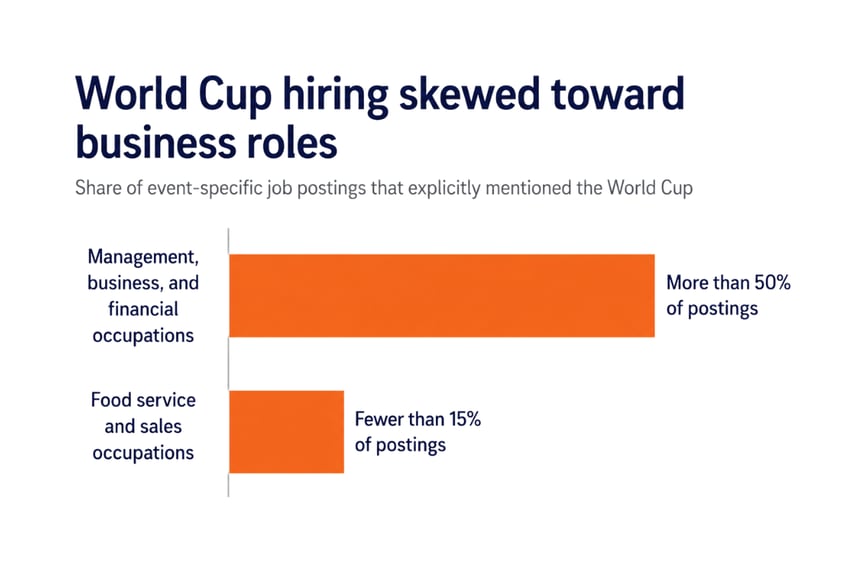
Management, business, and financial occupations made up more than 50% of the postings in Chmura’s analysis. This was the largest occupation group linked directly to the tournament, showing that employer preparation relied heavily on coordination, budgeting, contracting, staffing oversight, communications, and other professional functions.
Consider a host-city employer recruiting an operations manager to coordinate vendors, schedules, and venue requirements. Another employer could seek a financial analyst to track event spending or a project manager to manage deadlines across several departments.
“Those positions support tournament delivery even when their titles never mention sports.”
This pattern gives local leaders a clearer basis for action. Employer outreach should include professional services firms, media organizations, event contractors, and corporate operations teams alongside hotels and restaurants. JobsEQ can help teams review postings by occupation, employer, and custom region so a workforce snapshot reflects the actual mix of work rather than a preset assumption.
Hospitality roles represented a smaller share of event hiring
Food service and sales occupations represented fewer than 15% of postings that named FIFA or the World Cup. Hospitality work still supported visitors and match-day activity, but the directly identified postings did not make it the primary source of tournament-related recruitment.
A restaurant near a stadium could add servers without mentioning the tournament in its job advertisement. A hotel could increase employee hours instead of opening new positions. A retailer could use existing staff, seasonal workers, or a third-party contractor. These choices create activity that keyword-based posting analysis will not fully capture.
The finding should be read with that limit in mind. It shows the occupation mix among postings that explicitly cited the event, rather than every job influenced by visitor spending. Even with that limit, the result challenges the assumption that sports hospitality jobs will dominate formal hiring. Leaders need several measures, including postings, hours worked, payroll, and employer interviews, before making a complete local assessment.
|
Hiring signal |
What it tells local leaders |
|
Event-specific postings |
These ads identify positions employers are directly connected to tournament work. |
|
Management and business share |
A large share signals substantial planning, coordination, and administrative needs. |
|
Food service and sales share |
A smaller share shows that direct recruitment extended well beyond visitor-facing work. |
|
Wage information |
Pay levels help distinguish job volume from the economic value of the positions. |
|
Host-city distribution |
Local posting counts show where employers placed the clearest hiring activity. |
|
Posting timing |
Recruitment dates indicate when preparation work began and how long it continued. |
Wage differences reveal the quality of World Cup jobs
The wage gap between occupation groups means the value of World Cup hiring cannot be judged from job counts alone. Management, business, and financial roles generally pay substantially more than food service and sales positions, so a smaller number of professional openings can carry greater earnings value.
Suppose two host cities each record 100 event-linked postings. One city’s openings center on project management, finance, and media production, while the other city’s openings center on food preparation and retail sales. Equal posting totals would conceal major differences in pay, skill requirements, career access, and local household income.
A useful review should ask five questions:
- Which occupation groups received the postings?
- What wages are typical for those occupations locally?
- Did the roles require specialized experience or credentials?
- How long were the positions expected to last?
- Could local workers access the openings before the event ended?
These questions help workforce boards and education partners judge who benefits. They also reveal where short training, employer referrals, or targeted recruitment could connect residents to higher-paying event work.
Occupation data explains why total job counts mislead
Total job estimates combine positions with very different duties, wages, durations, and links to the event. Occupation-level evidence shows the type of work behind the number, which makes the final assessment more useful for workforce planning, funding discussions, and public reporting.
A forecast of 10,000 jobs could include full-time professional roles, short assignments, contractor work, added shifts, and positions supported indirectly through spending. Treating each category as equivalent will overstate some benefits and hide others. A posting count also measures employer recruitment, rather than every person employed or every hour added.
Local leaders should match each claim to the correct measure. Job postings show where employers recruited and which skills they sought. Employment records show filled jobs. Payroll and wage data show earnings. Employer interviews can explain staffing choices that the numbers cannot reveal.
“A defensible report will state these differences clearly instead of allowing one total to carry more meaning than the evidence supports.”
Host cities experienced distinct hiring patterns across occupations

World Cup hiring was uneven across the 11 United States host cities, with New York and Miami recording the largest numbers of event-specific postings in Chmura’s analysis. National totals cannot explain what happened in each local labor market.
New York’s larger corporate, media, tourism, and professional-services base gives employers more channels for event-related recruitment. Miami also combines tourism activity with international business, media, and event operations. Another host city could rely on existing staff, contractors, or regional firms posting elsewhere.
City comparisons should account for the number of event-specific postings, the occupation mix, the employers recruiting, the timing and duration of roles, and local wage levels. The same tournament can produce a different workforce result in every host market. A peer-region comparison will help leaders separate event effects from normal local hiring patterns and explain why one city recorded more activity than another.
Temporary postings need context before estimating local employment
Temporary postings are evidence of recruitment, yet they do not equal permanent employment or a net increase in local jobs. Some positions replace normal hiring, some last only through event operations, and some recruit workers who already live outside the host city.
A six-month event coordinator role creates income and experience, but its local effect depends on who fills it, where that person lives, and what happens after the contract ends. A staffing firm could also post several openings for the same assignment, while an employer could fill multiple positions through one advertisement.
Analysts should record posting duration, employer identity, work location, contract terms, and occupation before translating ads into employment claims. They should also check for duplicate postings and distinguish new roles from replacement hiring. These controls keep estimates conservative. They also help officials explain temporary benefits without dismissing the skills, wages, and connections that short assignments provide.
Better event forecasts require detailed occupational hiring evidence
A credible event forecast should specify which occupations will gain, when recruitment will occur, what the roles will pay, and how results will be tested. Broad employment totals are easier to announce, but they give workforce teams little help with training, employer outreach, or resident access.
The 2026 findings offer a practical judgment. Tournament hiring existed, yet its clearest postings favored management, business, and financial work over hospitality and sales. That result does not erase visitor-facing activity. It shows that major events depend on substantial professional work that forecasts can overlook when they begin with familiar assumptions.
Chmura’s approach connects posting evidence, occupation data, wages, and local comparisons so leaders can move from a public claim to an answer they can defend. Disciplined measurement will not make every event promise accurate. It will show which jobs appeared, who had a realistic path to them, and what the hiring activity meant for each host community.