Review the economic impact of hosting the World Cup and get practical insight into why national job projections overstated local hiring.
Economic Impact

By Chmura Economics & Analytics
Published Jul 28, 2026
Key Takeaways
- National employment projections cannot show how many positions appeared within each host city.
- Similar posting patterns across host and non-host markets weakened claims of a distinct tournament hiring surge.
- Local job claims require evidence tied to specific cities, occupations, employers, time periods, and employment types.
The 2026 FIFA World Cup produced visible visitor activity without a distinct hiring surge across U.S. host cities. Chmura’s analysis found that local job postings moved much like postings in comparable non-host markets, which weakens claims that the tournament created a broad employment boost.
Economic impact estimates can measure spending and supported labor across a large area, but they do not automatically show how many people local employers hired. A credible review must compare forecasts with employer activity, hotel use, visitor behavior, and the types of roles that appeared.
“Attendance, spending, revenue, supported jobs, job postings, and permanent hires describe different outcomes.”
Host city hiring showed little lift during FIFA 2026
Host cities did not record a clear increase in job postings that separated them from comparable non-host labor markets. The tournament still required workers and created business activity, but the available hiring evidence does not show a broad host city employment surge.
Event organizers, stadium vendors, hotels, restaurants, and transportation providers can handle temporary peaks without advertising many new positions. Employers can adjust schedules, offer overtime, use contractors, or rely on workers hired months before the event. Those responses support event operations without producing a sharp rise in local postings.
That distinction matters for economic development leaders evaluating the economic impact of hosting the World Cup. Attendance, spending, revenue, supported jobs, job postings, and permanent hires describe different outcomes. Treating them as interchangeable will make an event’s employment effect appear larger than the available evidence supports.
5 Reasons FIFA 2026 job forecasts missed actual hiring
The gap between projected FIFA World Cup jobs and observed hiring came from the scope of the forecast, local comparison data, hotel performance, visitor behavior, and occupation patterns. Each factor shows why national economic estimates require local validation.
|
What shaped the result |
Main takeaway |
|
National projections obscured local hiring patterns |
A national employment estimate could not show how many positions appeared within individual host cities. |
|
Host cities tracked closely with non-host labor markets |
Similar posting trends suggest broader labor conditions shaped hiring more than the tournament. |
|
Hotel revenue gains masked uneven guest activity |
Higher room prices did not produce steady occupancy or sustained staffing needs. |
|
Short domestic trips limited local visitor spending |
Brief stays reduced the number of hotel nights, meals, and purchases supporting local work. |
|
Postings favored professional roles over service hiring |
Tournament-related postings appeared more concentrated in specialized work than expected service roles. |
1. National projections obscured local hiring patterns
The widely cited FIFA and World Trade Organization estimate of 185,000 jobs described a national economic contribution. It did not represent 185,000 new hires within the 11 U.S. host cities or 185,000 publicly advertised positions.
National models can include direct, indirect, and induced effects across transportation, broadcasting, merchandise, suppliers, and other industries. Some supported activity can occur far from a stadium. Full-time-equivalent jobs can also combine hours worked across several temporary or part-time positions, so the total does not equal a headcount of individual workers.
A useful local forecast must define its geography, measurement period, baseline, and meaning of “job.” Without those details, a large national figure can create expectations that city-level hiring data cannot confirm. Economic development teams should separate national supported employment from local postings, payroll jobs, temporary assignments, and retained positions before presenting projections to stakeholders.
2. Host cities tracked closely with non-host labor markets
Host city job postings followed a pattern similar to postings in non-host comparison markets. That parity weakens the case that the tournament caused a distinct increase in local hiring.
A rise in hospitality postings during the summer can look like an event effect when viewed alone. The interpretation changes if similar cities without matches record the same increase. Seasonal travel, economic conditions, school schedules, and normal employer turnover can affect both groups at the same time.
Comparison markets provide the baseline needed to separate ordinary movement from tournament-related activity. Analysts should compare similar regions before, during, and after an event rather than relying on a host city’s change alone. This method will not capture every temporary assignment or contractor, but it prevents normal hiring patterns from being credited entirely to the event.
3. Hotel revenue gains masked uneven guest activity
Revenue per available room increased, but stronger revenue did not mean hotels consistently filled more rooms. Higher room prices around match dates can raise revenue even when occupancy remains weak on surrounding nights.
A hotel can charge significantly more on the night before a match while serving roughly the same number of guests it handles during another busy period. That produces a financial gain without creating enough added housekeeping, front desk, or food service work to support permanent hiring. Lower occupancy on non-game nights further limits the total workload across the tournament period.
Hotel labor needs follow occupied rooms, guest services, and sustained operating volume more closely than room prices alone. Forecasts that apply peak-night activity across an entire week or month will overstate staffing requirements. A stronger assessment reviews room rates and occupancy separately, then measures how many nights experienced activity above the normal baseline.
4. Short domestic trips limited local visitor spending
Many domestic attendees treated the tournament as a short trip rather than an extended stay. Brief visits reduced the number of hotel nights, restaurant meals, transportation purchases, and attraction visits available to support local employment.
A fan who drives into a host city on match day and leaves the following morning produces a smaller local effect than an international visitor who stays for several nights. Both can appear in attendance totals, but their spending patterns differ. Ticket sales alone cannot show how much activity reached businesses outside the stadium.
Trip origin and length should be central inputs in an economic impact study. Analysts also need to account for visitors who would have traveled to the city during the same period without the event. Accurate estimates separate added spending from spending that was shifted across dates, neighborhoods, or businesses.
5. Job postings favored professional roles over service hiring
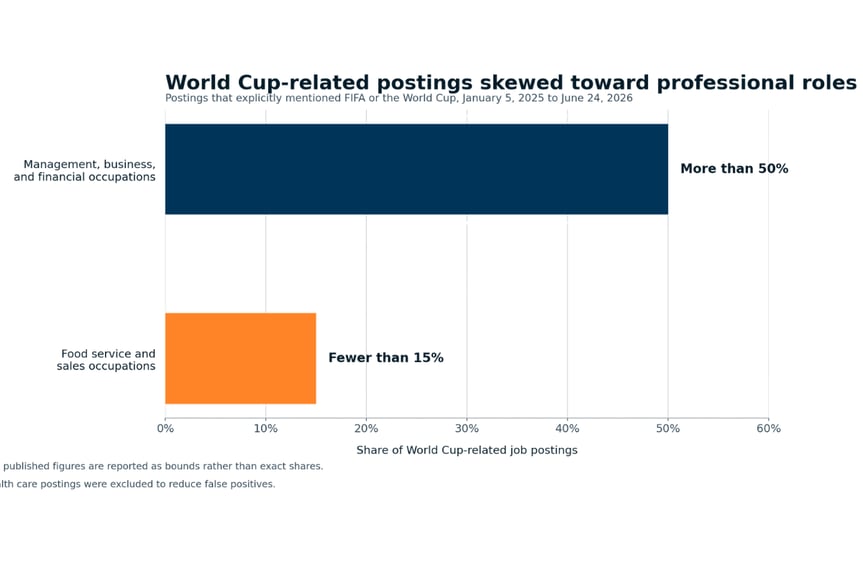
World Cup-related postings leaned more heavily toward management, business, and financial occupations than toward the broad service hiring often associated with major sporting events. Chmura’s analysis found that professional occupations represented more than 50% of relevant postings, while food service and sales represented fewer than 15%.
Planning, marketing, sponsorship, media, finance, and event management roles are more likely to appear online months before kickoff. Temporary concession, cleaning, or event-day positions can be filled through vendors, staffing agencies, existing employee pools, or informal recruiting methods. Those differences affect what appears in posting data.
“The occupation mix shows where visible hiring activity occurred.”
Analysts should review job titles, employers, industries, posting dates, and employment arrangements rather than assuming every role connected to the tournament was a new local service job.
How to measure event hiring with defensible evidence
Event hiring should be assessed against a defined baseline using several measures that answer different questions. Job postings show employer recruitment activity, while payroll records, hours worked, occupancy, tax receipts, visitor surveys, and business interviews provide evidence about employment and spending that postings cannot capture alone.
A credible review compares host cities with similar non-host markets and separates the periods before, during, and after the event. It also distinguishes projections from observed results and keeps full-time-equivalent jobs, individual hires, temporary assignments, and advertised positions in separate categories.
Chmura applies local labor data and economic impact methods to help teams explain those distinctions in stakeholder-ready reports. The lesson from FIFA 2026 is straightforward: large events can generate revenue and temporary activity, but local job claims should be supported with evidence tied to specific cities, occupations, employers, and dates.