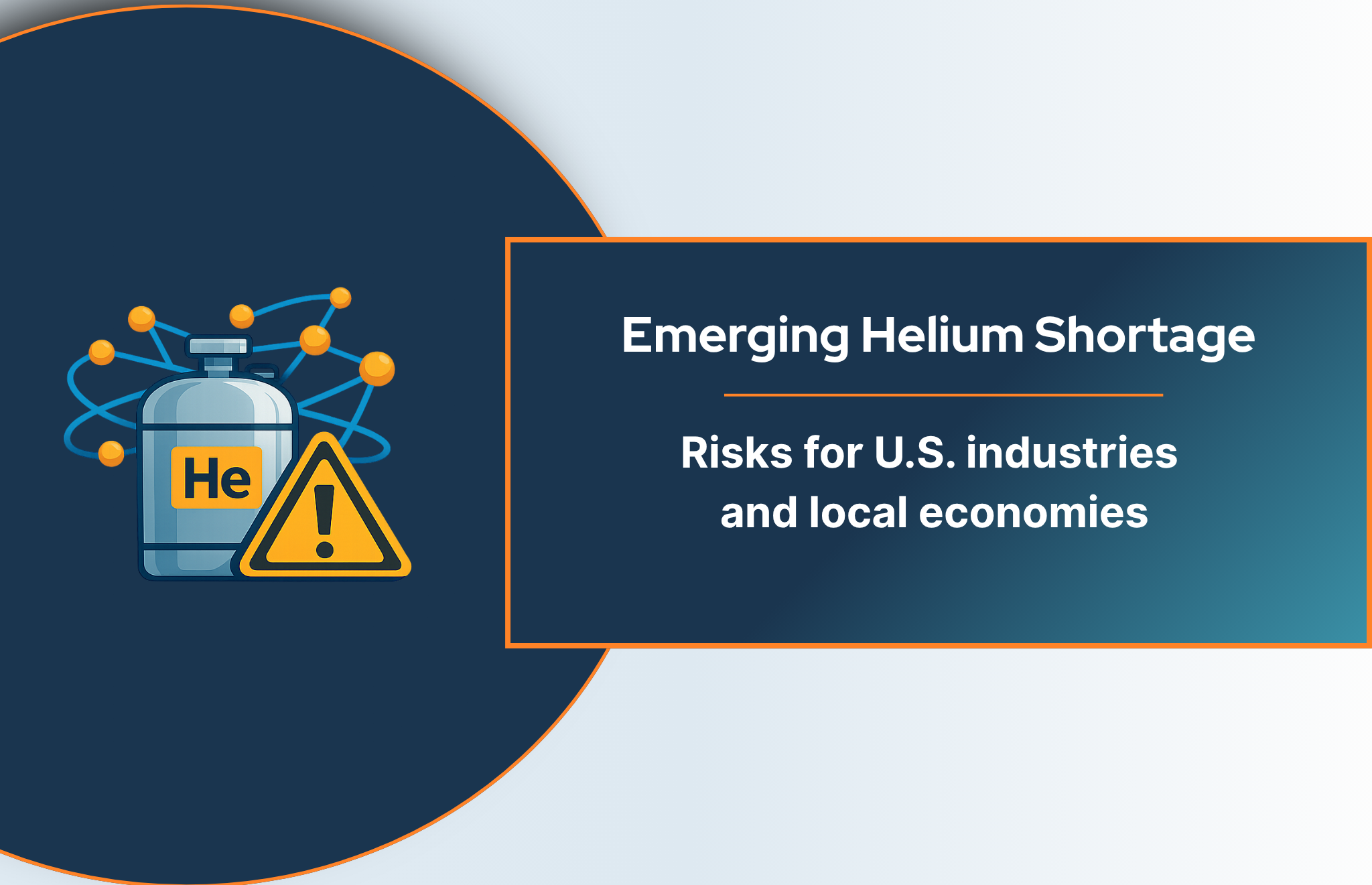
As the war in Iran continues to shock the energy supply chain, a global helium shortage is emerging as an unforeseen consequence. Helium, a byproduct of natural gas processing, is an important input to such end uses as semiconductor production, aerospace manufacturing, welding, machining, cryogenics, and MRI machines.[1]
The United States is the largest helium producer in the world and a net helium exporter; however, the U.S. still imports helium to bridge gaps caused by increased domestic demand or decreased domestic production. The second largest producer of helium, Qatar, has been marred by the closure of the Strait of Hormuz and Iranian strikes on natural gas facilities. Qatar’s importance in global helium markets cannot be understated. It produces a third of the global helium supply, it is the largest source of helium for the manufacturing centers of Asia, and it is the second largest exporter of helium to the United States[FR1] , accounting for 28% of U.S. helium imports[CC2] .[2] Taking Qatar out of the global helium supply chain, in part or in full will drive up global helium prices as helium consuming sectors around the world compete for the limited supply.
Although spot helium pricing is not as transparent as that of other commodities, there is increasing anecdotal evidence that helium prices on the global market are soaring.[3], [4] With the specter of helium shortages hanging over important sectors ranging from medical imaging to semiconductor production to aerospace, different parts of the United Sates may be more or less susceptible to disruptions in the helium market. As high-paying industries, impacts due to helium disruption may ripple through communities with a high concentration of helium-impacted firms.
Chmura used JobsEQ to compile a custom industry that includes sectors most at risk from helium shortages, including semiconductor processing, diagnostic imaging, aerospace manufacturing, R&D services, and other advanced manufacturing sectors[CC3] .[5] We then use a location quotient (LQ) to determine where employment in helium-related industries are most concentrated. The map below shows the LQ for helium-related industries across the country.
1. Idaho Falls, Idaho MSA
The Idaho Falls, Idaho metropolitan statistical area (MSA) has the highest concentration of workers employed in helium-using industries, with an LQ of 8.62. Over 8% of workers in Idaho Falls work in research and development in the physical, engineering, and life sciences, likely due to its proximity to the Department of Energy Idaho National Laboratory.
2. Wichita, Kansas MSA
Wichita, Kansas is also highly concentrated in helium-consuming industries, with an LQ of 8.20. Over 7% of the workers in Wichita work in aircraft manufacturing, such as in the nearby Boeing plant; and the industry is supported by a high concentration of machine shop and plate work manufacturing workers.
3. Palm Bay-Melbourne-Titusville, Florida MSA
The Palm Bay-Melbourne-Titusville, Florida MSA, due its proximity to Cape Canaveral, is highly concentrated in both space vehicle manufacturing and semiconductor manufacturing—two helium-intensive sectors. Diagnostic imaging centers are also more concentrated here than in the U.S. as a whole. Overall, the LQ for employment in helium-using industries in the Palm Bay-Melbourne-Titusville, Florida MSA is 6.36.
4. San Jose-Sunnyvale-Santa Clara, CA MSA
The San Jose-Sunnyvale-Santa Clara, CA MSA is at the heart of Silicon Valley, and with high concentrations of semiconductor manufacturing (31,371 employees) and R&D in the physical, engineering, and life sciences (22,035 employees), it is at risk of disruptions due to helium shortages.
5. Savannah, Georgia MSA
Savannah, Georgia has the fifth highest concentration of helium-intensive industries of all MSAs in the country, with an LQ of 5.75. With Gulfstream Aerospace Corporation headquartered in Savannah, over 11,000 workers are employed in Aerospace Manufacturing.
[1] https://www.reuters.com/world/asia-pacific/helium-shortage-has-started-impacting-tech-supply-chains-execs-say-2026-03-26/
[2] https://pubs.usgs.gov/periodicals/mcs2026/mcs2026-helium.pdf
[3] https://www.chemanalyst.com/NewsAndDeals/NewsDetails/semicon-china-begins-amid-uncertainty-over-global-helium-41581
[4] https://radiologybusiness.com/topics/medical-imaging/magnetic-resonance-imaging-mri/helium-prices-spike-war-rages-should-mri-providers-be-worried
[5] Helium impacted industries include Natural Gas Extraction, Industrial Gas Manufacturing, Plate Work Manufacturing, Machine Shops, Semiconductor and Related Device Manufacturing, Analytical Laboratory Instrument Manufacturing, Aircraft Manufacturing, Guided Missile and Space Vehicle Manufacturing, Research and Development in the Physical, Engineering, and Life Sciences (except Nanotechnology and Biotechnology, and Diagnostic Imaging Centers.
 By Colin Emberland