Explore how shifting workforce trends are impacting small businesses and economic development in 2026—and what it means for your region.
Economic Development

By Chmura Economics & Analytics
Published May 5, 2026
Introduction
As the International Economic Development Council (IEDC) marks 100 years of leadership in economic development, the challenge facing communities today looks very different than it did even a few years ago.
Economic Development Week 2026 also coincides with National Small Business Week, bringing into focus a critical relationship: small business growth depends on workforce realities.
And those realities have changed.
For the past several years, economic developers and small businesses alike have been operating in a labor market defined by extreme tightness. Hiring was not just difficult. It was often the primary constraint on growth.
Today, the data tells a more nuanced story.
The labor market isn’t as tight as it was, but it hasn’t returned to normal. It has reset.
Small business hiring has shifted from crisis to constraint
2023 reflects the peak of worker availability constraints—small businesses were competing in an environment where available workers were scarce, and hiring demand was historically high.
That environment changed, but not in a way that fully relieves the pressure.
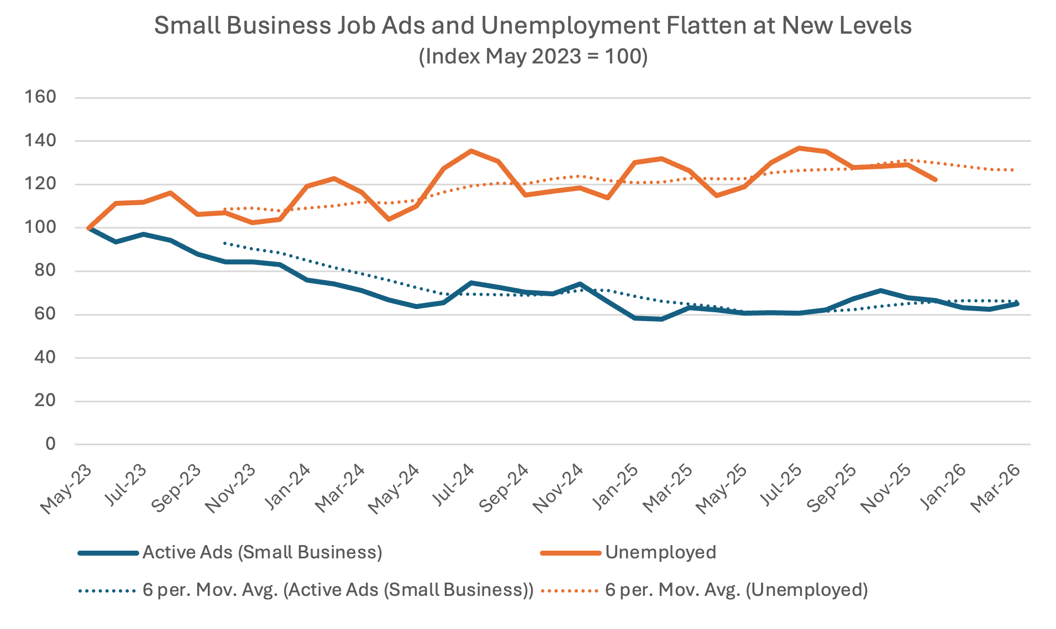
As of December 2025, the latest available data, there are approximately 1.6 small business jobs per 100 unemployed workers, down from 1.7 in 2024 and from 2.9 in 2023. Higher ratios reflect more potential work opportunities for jobseekers but more difficult hiring conditions for businesses as they compete for a smaller pool of workers.
At the same time, small business job ads have declined by roughly 35% from 2023.*
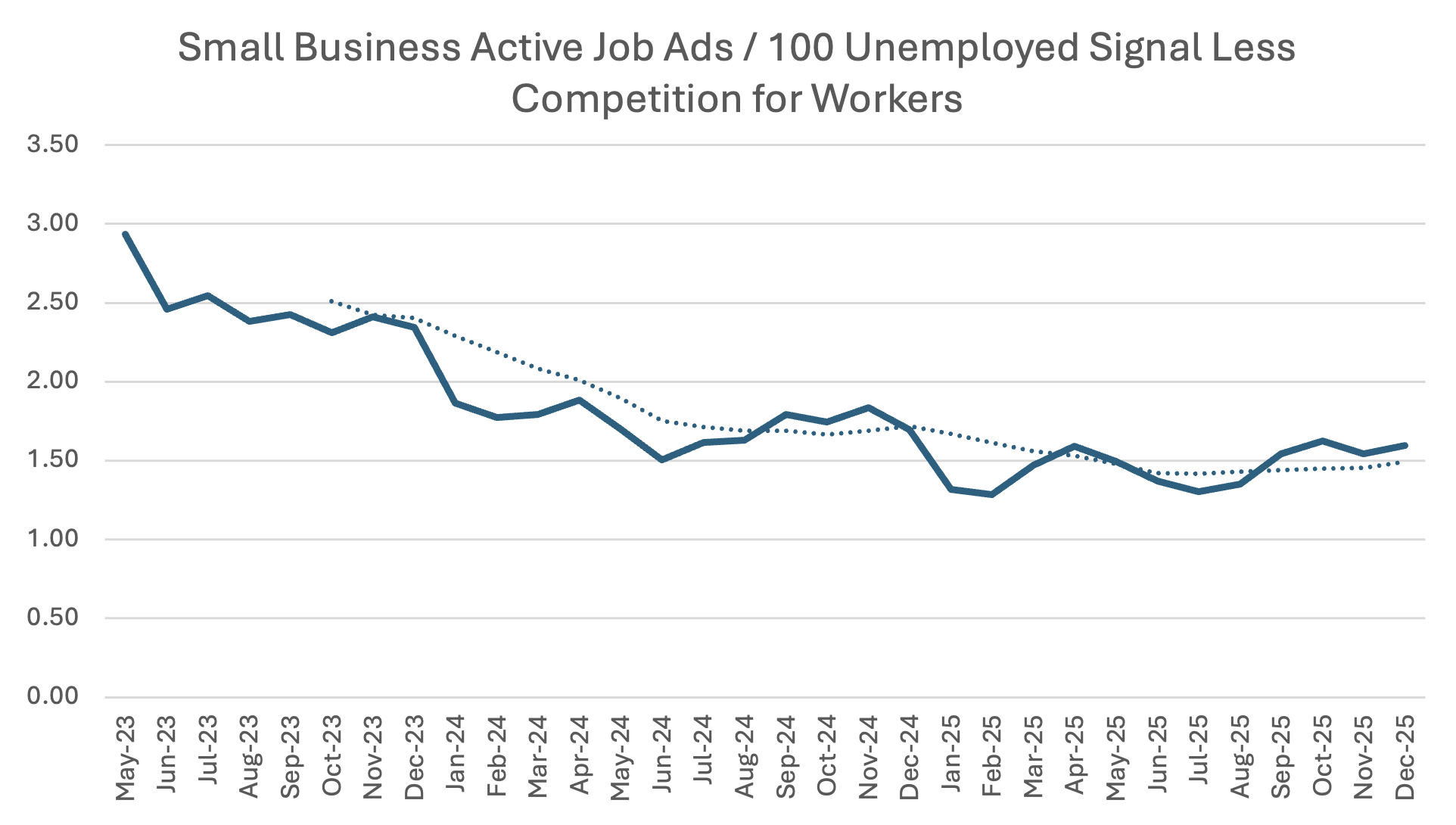 Source: JobsEQ® by Chmura. Small business defined as firms with 11-200 employees. October 2025 unemployment data are imputed.
This is a meaningful shift. Hiring conditions are no longer at crisis levels. But for many small businesses, they are still far from easy.
Recent trends show both job ads and unemployment leveling off, suggesting the labor market may be settling into a new equilibrium rather than continuing to loosen.
For economic developers, this creates a different kind of challenge.
Hiring may be more predictable than it was in 2022 and 2023, but it is still a limiting factor for growth in many regions.
A market rebalancing, but not a full recovery
What is driving this shift? Not one, but two factors:
-
1. Hiring demand has cooled
- 2. Labor supply has increased
Together, these forces are gradually bringing the labor market into better balance.
As shown in the indexed trends, both job postings and the number of unemployed have leveled off.
Source: JobsEQ® by Chmura. Small business defined as firms with 11-200 employees. October 2025 unemployment data are imputed.
This leveling off is important. It suggests that the labor market is no longer rapidly changing but instead stabilizing at a new baseline.
For small businesses, this means:
- • Hiring is still competitive
- • Talent is still constrained
- • But conditions are no longer deteriorating
- • From attracting jobs to sustaining businesses
- • From incentives to insights
- • From growth alone to alignment
For economic developers, the implication is clear. The focus is shifting from reacting to volatility to planning within a new, persistent constraint.
Wage pressure is easing, but that doesn't mean relief
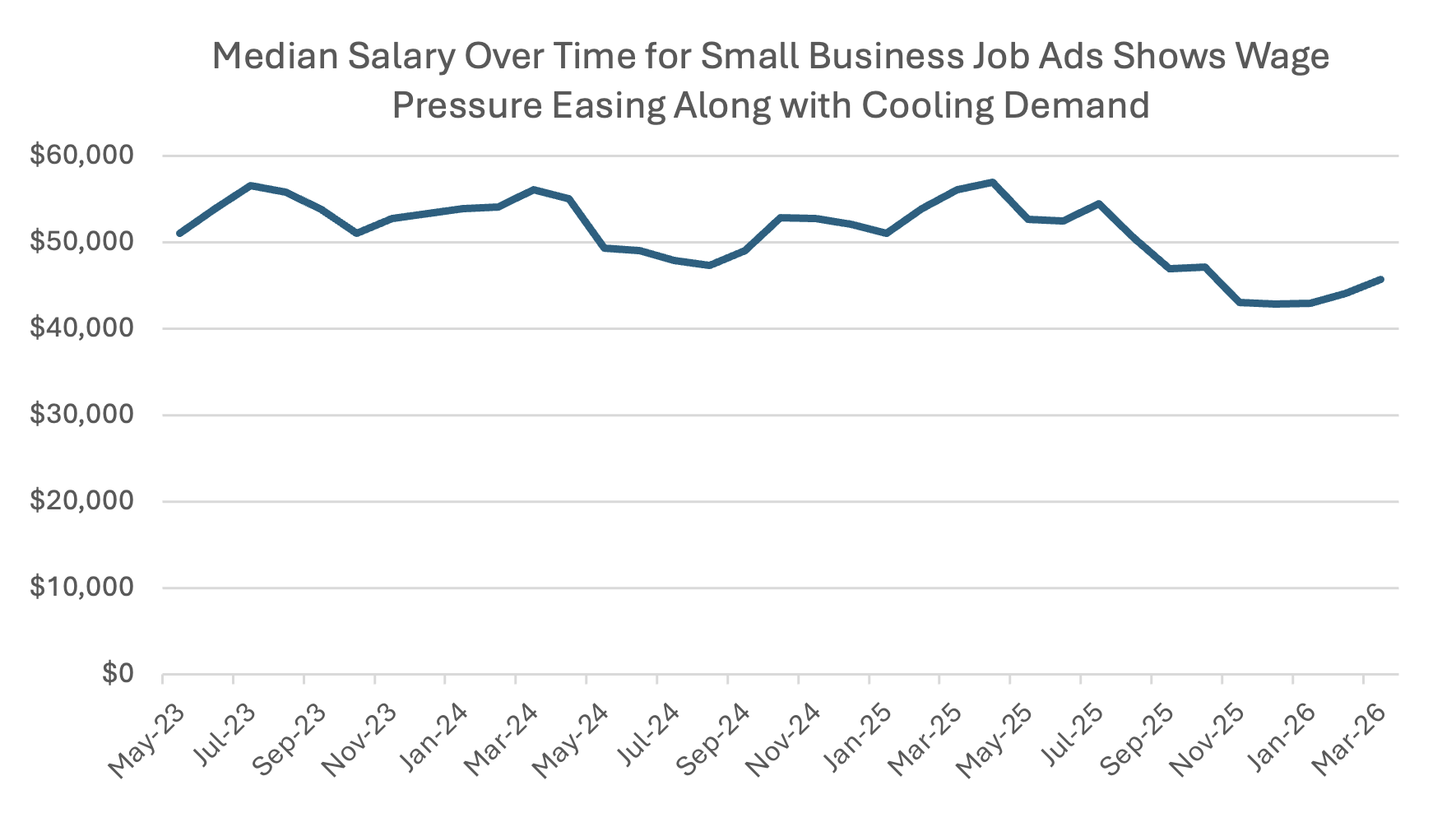
During the height of labor shortages, rising wages were one of the clearest signs of competition for workers. Small businesses were forced to increase compensation to remain competitive. This pressure is now beginning to ease in the nation as a whole.
 Source: JobsEQ® by Chmura. Small business defined as firms with 11-200 employees.
As median salaries for small business job ads begin to steady, the data reflect a less aggressive hiring environment.
This shift should be interpreted carefully. Easing wage pressure does not necessarily signal relief. It reflects a broader cooling in hiring demand.
For small businesses, this creates a mixed reality where wage growth is leveling out, but margins remain tight, and compensation for talent hasn’t disappeared.
For economic developers, this reinforces a critical point. Workforce challenges don’t disappear when the market cools. They evolve.
Local labor markets tell a more uneven story
While national trends suggest a cooling labor market, local conditions remain highly uneven.
As shown in the map, some regions continue to experience relatively tight labor markets, while others have loosened considerably.
This variation is the result of differences in labor force participation, industry mix, population growth, and migration. The effect is a fragmented landscape.
There is no single “labor market condition” in the U.S. today.
For small businesses, this means hiring challenges and opportunities that are highly location-dependent. For economic developers, it raises a more strategic question: How competitive is your region’s workforce environment, really?
Because in this new equilibrium, local dynamics matter more than national averages.
What this means for economic developers
The shift from labor market crisis to constraint has important implications for how economic development strategies are designed and executed.
In this environment:
-
• Workforce analysis must guide strategy
-
• Supporting small businesses means supporting workforce alignment
-
• Regional competitiveness depends on understanding local labor market dynamics
The traditional focus on job creation alone is no longer sufficient. In many regions, the limiting factor is not the availability of jobs. It’s the availability of workers.
That shift changes how economic developers must think about business attraction, industry targeting, and workforce development partnerships.
The question is no longer just “How do we create jobs?”
It is “How do we ensure the workforce exists to sustain them?”
The next 100 years of economic development
As the IEDC celebrates a century of impact, the next 100 years will be shaped by a different set of challenges.
The role of economic development is evolving:
Small businesses will remain at the center of local economies. But their success will increasingly depend on how well regions understand and respond to workforce realities.
The labor market has reset, and for economic developers, adapting to that new reality will define the next era of impact.
Want to understand how these trends are shaping your region? Explore workforce and economic data with JobsEQ by Chmura.
* Job openings are obtained from Chmura Economics & Analytics’ JobsEQ technology platform, and small businesses are defined as firms with 11-200 employees.