Talent mobility works best when career paths reflect regional hiring pressure, skill gaps, and retention risk. Get practical insight into program design.
Corporate

By Chmura Economics & Analytics
Published Jun 11, 2026
Key Takeaways
-
- Internal career paths gain practical value when planners test them against regional job options and recruiting pressure.
- Priority should go to roles where high outside opportunity meets high replacement risk and clear business importance.
- Program rules and outcome measures determine if internal mobility produces lasting retention value.
Talent mobility works best when corporate planners weigh internal career options against the outside opportunities employees can realistically pursue. A career path that looks strong on an organizational chart can still fail to retain talent if another employer can offer a faster move, stronger pay, or a clearer next step.
That is where many talent mobility programs fall short. They focus on internal openings and skills without accounting for how regional labor conditions affect retention pressure. Stronger planning connects career progression, skill readiness, pay, and local hiring activity so teams can decide which roles need attention first and how quickly an internal path must move.
“A stronger approach treats each pathway as a retention choice with a time limit.”
Talent mobility connects internal careers to external opportunity
Talent mobility is the movement of employees across roles, functions, or locations through planned career paths. A useful program links those paths to outside job options. It shows where an internal move can retain a valued employee. It also shows where a weak path leaves the employee exposed.
Consider a software developer who can progress toward data science, database architecture, or systems analysis. The internal options look promising because the roles share technical foundations. Yet the employee will compare that path with current openings, pay, and employer activity nearby. A two-year internal path will feel weak when another employer can offer a related role now.
Corporate planners often treat mobility as a catalog of openings. A stronger approach treats each pathway as a retention choice with a time limit. That shift turns career architecture into a practical response to outside opportunity rather than an internal administrative exercise.
Regional labor conditions shape employee retention pressure
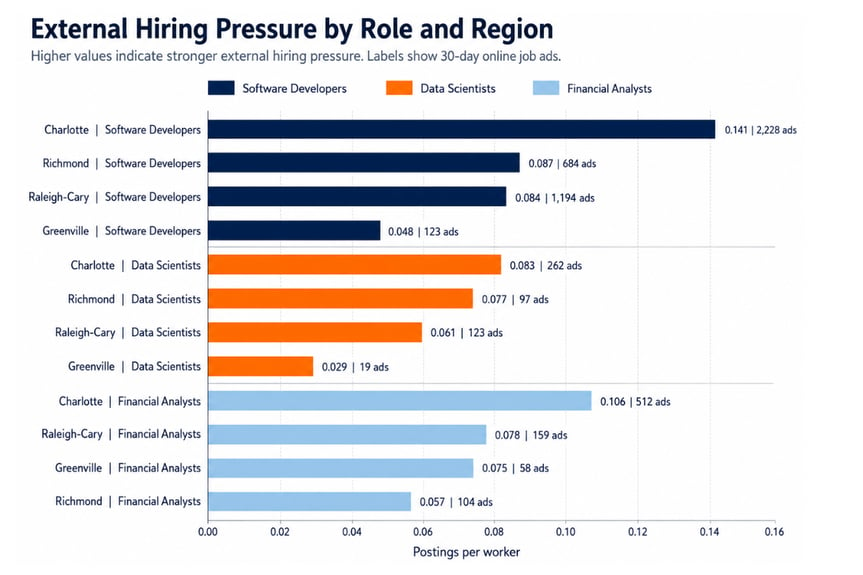
Retention pressure rises when a role has a large worker base, strong occupational concentration, and active employer hiring. Each measure answers a different question. Worker counts show market scale. Location quotient shows specialization, while job ads and postings per worker show current recruiting intensity.
The Chmura analysis illustrates the distinction. Raleigh-Cary had 14,148 software developers and a location quotient of 1.72, which indicates a strong regional concentration. Charlotte had a larger software developer base of 15,859 and much higher posting intensity. Both markets showed high external opportunity, but Charlotte carried the sharper immediate retention risk.
A national retention policy will miss that difference. Pay reviews, manager conversations, and career-path timing should reflect the employee's regional market. JobsEQ can support this work through hiring market comparisons that place worker supply, occupational concentration, and online postings in the same view. The output gives planners a defensible basis for deciding where action should happen first.
Role exposure determines where mobility planning should start
Mobility planning should start with roles where outside opportunity and internal business value overlap. A large occupation alone does not establish urgency. High posting intensity alone can also mislead. The strongest priority appears when employee replacement would be difficult, and nearby employers are actively recruiting the same talent.
|
Planning priority |
What the analysis indicates |
Practical response |
|
Software developers in Charlotte |
The highest posting intensity creates critical exposure. |
Review pay and shorten access to technical career paths. |
|
Data scientists in Charlotte |
Strong occupational concentration and active hiring create critical exposure. |
Protect key employees and prepare adjacent internal candidates. |
|
Software developers in Raleigh-Cary |
High concentration and strong job-ad activity raise retention pressure. |
Pair career discussions with a regional compensation check. |
|
Data scientists in Raleigh-Cary |
Specialized supply creates high risk despite fewer job ads than Charlotte. |
Identify internal successors before vacancies appear. |
This order gives the talent mobility program a defined starting point. It also prevents scarce training funds from being spread evenly across roles with very different exposure.
Skill adjacency defines realistic internal career pathways
A realistic pathway connects roles with overlapping work, skills, and learning requirements. Job-title similarity is only a starting signal. Planners must test the specific gap between the employee's current capability and the target role. The path becomes credible when that gap can be closed within a useful business timeframe.
Software developers offer a clear case. The supplied analysis identifies data scientists, database architects, and systems analysts as related pathways, with moderate upskilling and mobility feasibility. Those options give a planner several routes, but each requires a separate skills review. A developer with strong database and statistical experience will face a different path than one focused on application interfaces.
The same rule applies to financial analysts moving toward budget analysis, management analysis, or financial management. Their upskilling requirement was rated low to moderate, yet readiness still depends on the actual role. Internal mobility works when the pathway reflects verified skill overlap, manager evidence, and a clear learning plan.
External hiring pressure sets the pace for upskilling
Upskilling plans must move at a pace that matches outside hiring pressure. A pathway that closes a skill gap after the likely retention window has little protective value. Planners should compare training time with current job-ad activity, recruiting intensity, and the business cost of losing the employee.
A data scientist in Charlotte sits within a sizable market of 3,149 workers, but employers are actively recruiting from that pool. The region recorded 262 online job ads over 30 days, equal to 0.083 postings per worker, the highest rate for data scientists among the four regions analyzed. For employers, that means talent is available, but attracting and retaining it will require faster hiring, clear career paths, and close attention to pay.
External recruiting remains appropriate when certification, technical depth, or delivery timing places the target role beyond a reasonable internal path. The choice should follow a time comparison. Planners need the estimated months to prepare an internal candidate, the time to hire outside talent, and the operational risk attached to each route.
Program rules determine how internal moves happen
Program rules turn mobility from an informal manager privilege into a repeatable workforce process. Employees need clear eligibility, access, timing, and selection standards. Managers need defined responsibilities when a valued employee applies elsewhere inside the company. Planners need a record of each move and its result.
A workable talent mobility program should set five operating rules:
- Employees receive clear eligibility criteria before applying for internal roles.
- Managers cannot block qualified applications through informal approval practices.
- Skill gaps are assessed against the target role's actual work.
- Development plans include owners, milestones, and expected completion dates.
- Pay reviews reflect the target role and the employee's regional market.
These rules matter because a pathway fails when the process feels hidden or arbitrary. A software developer who qualifies for a systems analyst role should know the steps, the decision date, and the pay treatment. Clear rules also give planners consistent records for evaluating access and outcomes across teams.
Mobility analytics measure retention after internal career moves
Mobility analytics should show what happened after an employee entered a pathway or completed a move. Application counts reveal interest, but they do not prove program value. Planners need measures tied to movement, readiness, retention, performance, and vacancy coverage. Regional exposure should remain part of the interpretation.
A practical review can compare employees who completed an internal move with similar employees who stayed in place. Track retention at six and twelve months, time to productivity, compensation movement, and the share of priority vacancies filled internally. Results should also be separated by role and region because a single companywide rate will hide local pressure.
The supplied analysis also shows why missing fields must stay visible. Projected employment, annual openings, wage percentiles, employer concentration, detailed skills, and validated career-path similarity were unavailable. Planners should mark those limits rather than filling gaps with assumptions.
“A defensible mobility decision depends as much on honest boundaries as it does on available metrics.”
Regional opportunity shapes talent mobility priorities for 2026
Regional opportunity should determine where planners commit retention attention, development capacity, and recruiting support. The practical test is simple. Which roles face the strongest outside pull, which internal paths can close the gap soon enough, and which locations carry the greatest business exposure? Those answers should guide the sequence of work.
Raleigh-Cary and Charlotte deserve focused attention for the technical and financial roles covered in the analysis. Richmond and Greenville showed moderate pressure across the available role data, which supports a more measured response. Sales managers and industrial engineers require further validation because regional fields were unavailable. Treating those gaps as known facts would create false precision.
Good talent mobility depends on disciplined regional choices made before a resignation or vacancy forces action. Chmura helps teams connect internal workforce questions with regional labor evidence, so planners can support career paths, compensation reviews, hiring plans, and location choices with the same factual base. The lasting advantage comes from choosing where to act and carrying that choice through clear program rules.