See how a workforce-led site selection process uses labor sheds, hiring pressure, and wages to screen locations before comparing incentives.
Corporate

By Chmura Economics & Analytics
Published Jul 9, 2026
Key Takeaways
-
- Labor capacity belongs at the start of the site selection process because it determines which locations can support the hiring plan.
- Labor sheds, occupational depth, hiring pressure, and wages provide a more accurate site comparison than broad regional totals.
- Incentives are useful only after each finalist passes a consistent workforce test.
A credible site selection process screens locations for labor capacity before incentives enter the discussion. A tax package can improve project economics, but it cannot create qualified workers within a workable commute or remove hiring pressure from nearby employers.
Facility plans fail when leaders treat workforce supply as a late-stage validation step. The stronger sequence starts with the hiring plan, measures the reachable talent pool, tests wage and recruiting pressure, and keeps only the locations that can support the operation.
Workforce requirements should define the site selection process first
Workforce requirements should be the first filter because every location must support a specific hiring plan. Headcount alone is too broad. You need to define the roles, timing, shifts, pay assumptions, and experience levels that the facility will require before comparing places.
A practical workforce brief should state:
- Which occupations must be hired locally
- How many people are needed at launch
- When each hiring wave must begin
- Which shifts and schedules will be used
- What wage range the project can support
A 500-person operation needing 300 entry-level production workers faces a different test from a facility needing engineers, controls technicians, maintenance specialists, and supervisors. The same total headcount can produce completely different viable labor markets.
This step also keeps the site selection criteria tied to execution. A location should move forward only when the hiring plan fits the size, skills, wages, and commute patterns of the reachable workforce.
Labor sheds show the workforce each site can reach
- “Large regional totals can overstate access when workers live beyond a practical commute.”
A labor shed measures the workers a facility can reasonably reach from a specific address or site. Drive-time analysis makes that boundary practical because workers make commuting choices based on roads, congestion, shift times, and travel duration rather than county lines.
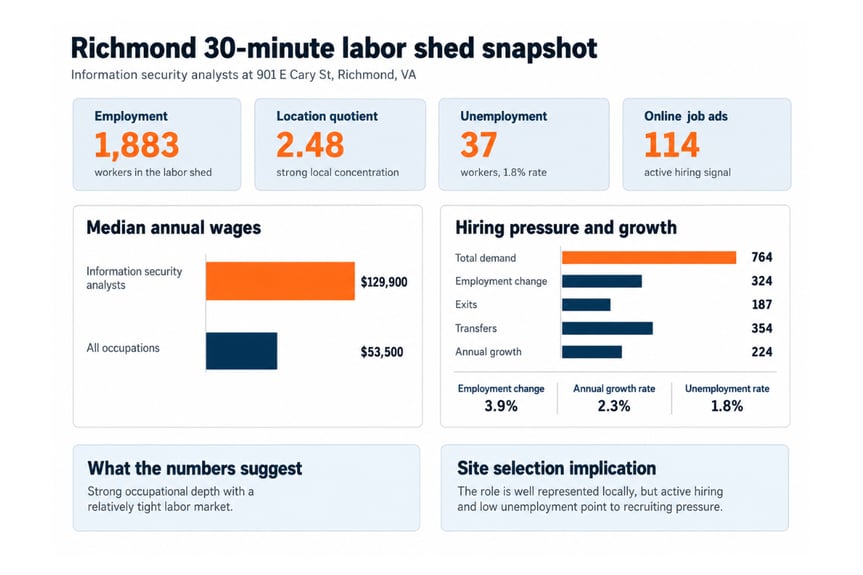
Chmura data for a 30-minute drive-time labor shed around 901 East Cary Street in Richmond reports 1,883 information security analysts and a location quotient of 2.48. A location quotient of 1.0 means an occupation has the same concentration locally as it does nationwide. Richmond’s 2.48 means information security analysts account for about 2.5 times the share of local employment that they account for nationally. Put another way, the occupation is 148% more concentrated in this labor shed than the national average. For a site selector, that signals meaningful occupational depth and a stronger local talent base for this role.
A metropolitan area, county, or fixed radius would produce a different result. Large regional totals can overstate access when workers live beyond a practical commuting distance. Use the same drive-time rule for every candidate so each comparison reflects the workforce the facility can reach.
Occupational depth must match the facility hiring plan
Occupational depth matters only when it matches the roles that will keep the facility running. A large labor force offers little comfort if the required technicians, operators, engineers, or supervisors are scarce within the commute area.
Data centers illustrate the issue. A location must support electricians, heating and cooling technicians, controls specialists, security staff, network workers, and managers. A site with strong technology employment can still fail if skilled trades are too thin for construction, maintenance, and round-the-clock operations.
Occupation-level analysis should also account for adjacent talent. A maintenance mechanic may transfer into an industrial technician role with limited training, while a general production worker may need a longer pathway.
The hiring model becomes more defensible when it distinguishes workers ready now from workers who need training. That distinction affects launch timing, recruiting cost, and the amount of support required from local education and workforce partners.
Hiring pressure reveals how much labor is truly available
A well-represented occupation can still be hard to hire when unemployment is low, job advertising is active, and other employers are recruiting from the same pool. Employment totals show how many people work in the occupation, but they do not show how many workers are readily available for a new employer.
The Richmond, VA labor-shed data reports 37 unemployed information security analysts and a 1.8% unemployment rate, alongside 114 online job ads. That means relatively few analysts are currently unemployed while employers are actively recruiting for the same talent. The data also shows annual hiring needs associated with 187 exits, 354 occupational transfers, and 224 workers tied to employment growth. Those figures indicate that employers are competing for a sizable local workforce, but only a small share is immediately available, while ongoing turnover and growth continue to create hiring needs.
A company planning to hire 100 analysts would need to recruit well beyond the 37 workers currently unemployed. The plan would likely require stronger pay, broader recruiting, training pathways, remote work options, or more hiring time.
Site comparisons should examine the same pressure measures for every critical occupation. That prevents a location with impressive employment totals from outranking a smaller market where qualified workers are easier to recruit.
Wage levels show the operating cost of each site
Wages show what a location will cost only when they are tied to the occupations and experience levels in the hiring plan. Regional averages can hide the pay required for scarce roles, night shifts, certifications, or supervisory experience.
The same Richmond analysis reports median annual wages of $129,900 for information security analysts, compared with $53,500 across all occupations in the labor shed. The difference does not mean the site is too expensive. It shows that this role carries a high local price and must be modeled separately from general payroll assumptions.
Compare expected wages for each priority role across every finalist. Test how much pay must rise to attract workers from established employers or the edge of the commute area.
Low wages can look favorable on a spreadsheet while creating hiring and retention problems. A realistic compensation benchmark gives finance and operations teams a clearer estimate of payroll, recruiting time, and turnover exposure.
Workforce capacity should narrow the shortlist before site tours
- “Workforce requirements should set the first filter because every location must support a specific hiring plan.”
Workforce capacity should reduce a long list of locations before leaders spend time on tours, negotiations, and incentive packages. The first screening does not choose the final site. It removes places where the hiring plan lacks credible support.
|
Site selection checkpoint |
What it tells you |
Shortlist effect |
|
Reachable workforce |
The labor shed shows how many relevant workers live within a practical commute. |
Keep sites with enough reachable talent for launch and ongoing hiring. |
|
Occupational concentration |
Location quotient shows how strongly the target role is represented locally. |
Favor sites with occupational depth that matches the hiring plan. |
|
Immediate availability |
Unemployment and worker counts show how much slack exists now. |
Flag sites that require an outsized share of available workers. |
|
Recruiting pressure |
Job ads and employer activity show the pressure around similar roles. |
Lower sites where hiring will take more time and money. |
|
Compensation fit |
Occupation-level wages show the payroll required to recruit and retain staff. |
Remove sites that exceed the project’s operating model. |
This sequence gives site tours a sharper purpose. Leaders can focus on infrastructure, real estate, community readiness, and project terms after workforce fit passes a consistent test.
Site selection consultants validate labor assumptions through field research
Site selection consultants should use field research to test the assumptions produced by workforce data. Interviews with employers, staffing firms, educators, workforce boards, and local officials can reveal recruiting practices, shift conflicts, training capacity, and upcoming projects that published measures cannot fully explain.
A labor shed may show enough industrial maintenance workers, while local interviews reveal that two major plants are planning expansions during the same hiring window. The reported pool still exists, but the project will face more recruiting pressure than the original count suggests.
Fieldwork also tests worker mobility. Staffing firms can explain night-shift commute limits, colleges can confirm likely completers, and employers can describe certification premiums.
The strongest process uses field research as validation after a consistent labor screen. Starting with interviews alone can favor the best sales presentation. Starting with comparable measures gives every location the same test before local claims are weighed.
Incentives should compare finalists after workforce fit is proven
Incentives belong near the end of the site selection process because they improve the economics of a viable location. They cannot fix a labor shed that is too small, a hiring schedule that is too aggressive, or wages that exceed the operating plan.
A $20 million package can look decisive until vacancies lead to overtime and offers above budget. A smaller package in a market with stronger workforce fit can produce the better operating result.
The right order is disciplined. Define the hiring plan, compare labor sheds, test occupational depth, measure hiring pressure, validate assumptions, and then weigh incentives among the remaining sites. Chmura’s labor-shed and drive-time analysis supports that front-end filter by grounding each location in the workforce it can reach.
A credible site decision rests on the workers who can make the operation function. Incentives can separate qualified finalists, but labor capacity determines which locations deserve to become finalists at all.