See what strategic workforce planning requires and get practical guidance on building a workforce planning process grounded in regional hiring conditions.
Corporate

By Chmura Economics & Analytics
Published Jun 16, 2026
Key Takeaways
-
- Workforce planning becomes credible when business goals are translated into occupation-level hiring requirements with clear timing and ownership.
- Regional labor evidence tests if planned hiring volume fits local worker availability, pay levels, employer activity, and operating constraints.
- Role-level risk should guide sourcing, compensation, training, location, and review priorities across the workforce planning process.
Headcount targets alone cannot show if qualified people are available, what pay will be required, or which roles could delay growth.
- “Strategic workforce planning connects a business objective to the people, occupations, timing, and locations required to deliver it.”
A four-market analysis of Raleigh-Cary, NC; Charlotte, NC; Richmond, VA; and Greenville, SC illustrates the point. Greenville received a favorable overall hiring feasibility result for five priority occupations, yet industrial engineers in that same market carried a critical shortage classification. The location looked workable at a broad level, while one essential role still posed a serious execution risk.
Strategic workforce planning links business goals to hiring requirements
Strategic workforce planning connects a business objective to the people, occupations, timing, and locations required to deliver it. A useful plan explains what work must be completed, which roles will perform it, when they are needed, and how local hiring conditions affect the commitment. That connection turns strategy into an operating plan tied to deadlines, budgets, and constraints.
Consider a company preparing to add a new product line within three years. A goal to add 300 employees gives recruiting teams little direction. A stronger plan identifies the required software developers, data scientists, financial analysts, sales managers, and industrial engineers, then assigns hiring dates and likely work locations. Leaders can test that plan against annual openings, pay levels, posting activity, and worker availability. Finance, operations, and talent teams then share one practical basis for budgets, recruiting priorities, and launch timing with greater confidence.
Business goals translate into specific occupation requirements
Business goals become usable workforce requirements when leaders break future work into occupations, staffing volumes, skill levels, and timing. This step should separate growth hiring from replacement hiring because both draw from the same labor pool. It should also connect each role to the business result it supports.
A software launch could require developers for product delivery, data scientists for model development, sales managers for revenue coverage, and financial analysts for pricing review. Treating those hires as one headcount figure hides the different labor pools, pay levels, and hiring cycles involved. It also obscures sequencing. Product roles might be needed 12 months before launch, while sales roles could ramp closer to release.
Replacement needs deserve equal attention. Our analysis notes that recurring backfill forms a major share of annual openings. A plan that counts only newly created jobs will understate the number of hires the organization must complete and the recruiting capacity required.
Current workforce capacity sets the planning baseline
A workforce plan needs a clear starting point before future hiring is added. The baseline should show current headcount, role distribution, expected exits, internal mobility, and available recruiting capacity. It should also identify which positions require local presence and which can draw from a wider labor pool.
Suppose a company needs 100 additional software developers but already has 40 open roles and expects 25 exits. The practical hiring requirement becomes 165 people before internal moves or productivity gains are considered. That total affects recruiter workload, interview capacity, onboarding schedules, and payroll timing. JobsEQ can place the internal requirement beside regional employment, annual openings, wages, and posting activity so leaders can test if the target fits the chosen market.
Data limits matter. Our analysis found that it lacks validated figures for 12-month postings, wage growth, underemployment, military exits, leading employers, requested skills, and explicit occupation gaps. Those fields should remain unfilled until verified.
Regional labor conditions test each hiring assumption
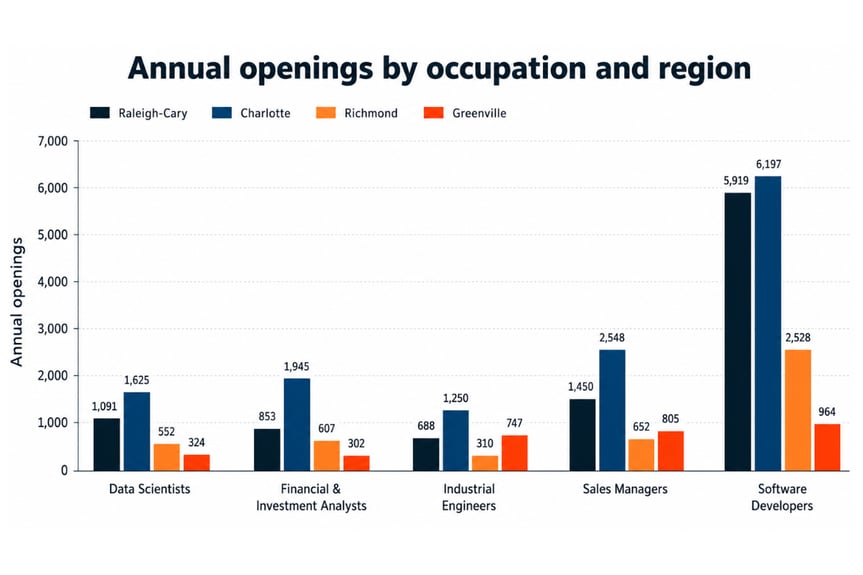
Regional evidence tests if a workforce target is feasible at the planned location, cost, and pace. Employment scale shows the size of the existing pool, annual openings indicate expected hiring activity, median pay supports budget planning, and current postings show near-term employer activity. No single measure should decide the result.
The four-market comparison shows why. Greenville had 2,558 software developers, 964 annual openings, a median salary of $126,600, and 123 postings over 30 days. Charlotte had 15,859 developers, 6,197 annual openings, a median salary of $139,800, and 2,228 postings. Charlotte offered more scale, while the higher posting volume and pay level signaled heavier recruiting pressure.
The right choice depends on the target. A firm seeking 30 developers could value Greenville’s lower pressure and lower median pay. A firm seeking several hundred could prefer Charlotte’s larger pool despite stronger employer activity. Location quality has to be judged against the size and timing of the actual hiring plan.
Role risk determines where planning should focus first
Role risk should set the order of workforce planning work. Positions with scarce workers, high projected need, strong posting activity, or pay pressure deserve early sourcing, budget review, and pipeline action. Roles with workable availability can receive routine monitoring and less executive attention.
|
Priority occupation |
Planning implication |
|
Data scientists |
Both markets show strong availability, but Charlotte has a much larger worker base and more active postings. |
|
Financial and investment analysts |
Charlotte’s large pool comes with high employer activity, so test pay and time-to-fill assumptions. |
|
Industrial engineers |
Greenville’s favorable broad result masks a critical shortage, requiring training or wider recruiting. |
|
Sales managers |
Greenville has moderate availability and growth risk, so phase hiring against sales plans. |
|
Software developers |
Raleigh-Cary and Charlotte face high future hiring volume and pay pressure, so test remote options. |
This checkpoint keeps a favorable market score from hiding a role-specific problem. Planning order should reflect labor risk and business dependency, since a scarce role on the critical path deserves immediate action.
Scenario planning tests geographic hiring options
Scenario planning compares how the same workforce target performs under different geographic choices. A useful test covers current sites, expansion markets, and remote or hybrid hiring. Each scenario should use the same role requirements so leaders can see how location alters availability, pay, timing, and operating constraints.
Current-site planning is direct, but it can preserve a weak assumption simply because the location already exists. Expansion analysis can reveal a stronger labor pool, although a smaller market might lack the scale required for a large hiring wave. Remote hiring broadens sourcing for software, data, and financial roles, while plant access, customer presence, or supervision can keep industrial and sales roles tied to a physical area.
A practical comparison could place 200 software hires across three scenarios. One assigns all roles to Charlotte, another splits the work between Charlotte and Greenville, and a third opens a remote pool for half the team. Leaders can compare time, pay, manager coverage, and recruiting exposure before selecting the operating model.
Workforce gaps shape practical hiring responses
A workforce gap should lead to a specific response tied to its cause. The response depends on why the gap exists. Low availability, high pay, limited scale, role location requirements, and a weak internal pipeline each call for a different action. A good plan assigns an owner and timing to every response:
- Start recruiting earlier for roles with limited or critical worker availability.
- Build college and workforce partnerships for occupations with recurring shortages.
- Adjust pay ranges when local salary levels or employer activity exceed the budget.
- Broaden the hiring area when one market cannot supply the required volume.
- Redesign work location rules when a role can be performed across a wider geography.
Industrial engineers in Greenville show the value of this approach. The critical shortage means local recruiting alone cannot carry the plan, even though the market scored favorably overall. Training partnerships, wider commuting areas, relocation support, or a different site assignment become business choices. Each option affects cost, timing, and operational risk, so the workforce plan must make those tradeoffs visible.
Regular review keeps workforce plans credible over time
A workforce plan remains credible when its assumptions are reviewed on a set schedule and tied to clear business triggers. Annual updates should refresh employment, projections, pay, posting activity, turnover, and business targets. Faster reviews are needed when a site plan, product schedule, hiring volume, or compensation budget shifts.
The review should ask a simple question: does the original hiring commitment still fit the labor conditions available to support it? A software developer plan could remain sound after a pay update, while an industrial engineering plan might require a new market or a longer pipeline. Discipline matters because stale assumptions can move directly into budgets, recruiter goals, and executive promises.
Chmura connects occupation and regional evidence to the workforce choices leaders must defend.
- “The strongest plan shows which hires are required, where they can be completed, what could block them, and which response will keep the business goal within reach.”