Strengthen succession planning with external workforce data on talent supply, wages, and hiring pressure. Get practical guidance for workforce risk management.
Corporate

By Chmura Economics & Analytics
Published Jun 18, 2026
Key Takeaways
-
- Internal readiness ratings become more useful when leaders compare them with regional talent supply, wages, and current hiring pressure.
- Critical role exposure should set development urgency, review frequency, and the strength of the external fallback plan.
- Employment counts alone cannot show replacement feasibility because occupational concentration, pay, and job-ad activity can point to different risks.
Strong succession plans connect internal readiness to the labor market that will supply, price, and compete for a replacement. Internal talent reviews show who could step into a critical role. External workforce data shows how hard that role will be to fill, what pay will be required, and how much time the organization can afford.
A plan built only on internal ratings can create false confidence. A named successor can leave, decline the role, or need more preparation than expected. Succession planning best practices become more useful when every readiness judgment is tested against regional talent supply, wages, hiring activity, and employer pressure.
Succession planning prepares critical roles before vacancies occur
Succession planning identifies roles whose vacancy would disrupt operations and prepares credible ways to cover them. The work starts before a resignation, retirement, promotion, or leave creates urgency. Your plan should name the role, possible successors, readiness level, development work, and an external hiring fallback.
Consider a software engineering director who owns release quality, staffing approvals, and architecture standards. Naming a senior manager as the successor is only the first step. The plan should also test how long that person needs to become ready, which responsibilities require temporary coverage, and how long an outside search would take if the internal move fails.
That structure keeps succession planning tied to operating risk. It also prevents the process from becoming a list of favored employees. Clear plans give leaders several workable paths before the vacancy occurs.
“The role carries the risk, while the person represents one possible response.”
Workforce risk management starts with critical role exposure
Critical role exposure measures the harm a vacancy could cause and the difficulty of restoring full capability. Titles alone do not determine exposure. A role becomes a priority when lost knowledge, scarce skills, limited coverage, long preparation time, or a difficult external search could interrupt important work.
Your review should test five points:
- The role controls work that cannot pause without material cost.
- Few employees can cover its responsibilities for more than a short period.
- Required knowledge is concentrated in one person or a small group.
- Internal candidates need substantial preparation before taking full ownership.
- External hiring will require a long search, higher pay, or a broader geography.
A plant manager with two ready supervisors presents less exposure than a payroll systems lead with no trained backup, even when the manager sits higher on the organization chart. This distinction helps leaders focus development funds and retention attention where a vacancy would create the greatest strain. It also gives workforce planning teams a clear reason for reviewing some roles each quarter and others once a year.
Succession analytics require consistent internal readiness standards
Succession analytics become useful when readiness labels mean the same thing across teams. “Ready now” should describe demonstrated ability to perform the role with limited transition support. “Ready soon” should include a defined preparation period, named experience gaps, and evidence that the employee can close them.
A finance team might rate a controller candidate as ready within one year. That rating should point to specific gaps, such as leading an audit, presenting to the board, or managing a larger team. Another candidate with the same label should face a comparable amount of preparation, even when the missing experiences differ.
Consistency also improves calibration between internal and external options. Leaders can compare the cost of a six-month development plan with the likely time and pay required for an outside hire. Weak labels hide that tradeoff. Clear standards create a common language for talent reviews, workforce plans, and executive discussions.
Regional talent supply determines replacement feasibility for critical roles
Regional talent supply sets the practical range of outside replacement options. Employment counts show scale, while location quotient shows how concentrated an occupation is compared with the nation. A location quotient above 1 signals a stronger local concentration. Job-ad volume adds a current view of recruiting pressure.
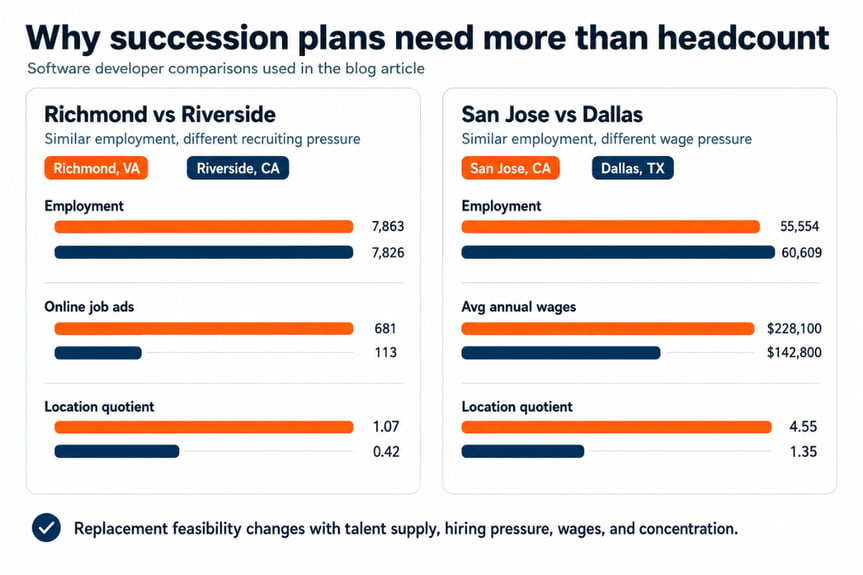
Chmura data shows why one number cannot carry the full judgment. The Richmond, Virginia, metropolitan area and the Riverside, California, metropolitan area each report about 7,800 software developers. Richmond has 681 active online job ads and a location quotient of 1.07, while Riverside has 113 ads and a location quotient of 0.42. Similar employment totals conceal very different levels of specialization and hiring activity.
A succession plan for a software leader in either market should reflect those differences. Richmond offers a more concentrated local base, but the heavier job-ad activity signals more employer competition. Riverside has lower current posting activity, yet its weaker concentration narrows the local pool. The replacement strategy should account for both availability and pressure.
Wage benchmarks expose hidden succession plan costs
Wage benchmarks show the financial exposure attached to an external replacement. Internal salary ranges can lag the local market, especially when a long-tenured employee holds a critical role. A succession plan that ignores current wages can understate hiring cost, retention risk, and the value of preparing an internal candidate.
Software developer data illustrates the size of that gap. San Jose reports average annual wages of $228,100 for 55,554 workers, while Dallas reports $142,800 for 60,609 workers. The employment bases are similar, but the average wage gap is $85,300. San Jose also has a location quotient of 4.55, compared with 1.35 in Dallas.
Those figures do not set a salary for a specific leadership role. They do show why national ranges or internal history provide an incomplete budget. Leaders should compare regional wages, role scope, internal equity, and the cost of delay before treating an external search as an easy fallback.
Hiring activity signals pressure on external replacement options
Hiring activity reveals how many employers are pursuing similar talent at the same time. Active job ads do not equal completed hires, and they do not measure every opening. They still provide a useful signal of recruiting pressure when paired with employment, wages, and occupational concentration.
The New York-Newark-Jersey City, New York-New Jersey metropolitan area reports 118,884 software developers and 10,660 active online job ads. The San Francisco-Oakland-Fremont, California metropolitan area reports 64,876 developers and 8,126 ads. The Seattle-Tacoma-Bellevue, Washington metropolitan area has a larger employed base than San Francisco at 80,271, yet it reports 2,608 ads. The figures cover ads active within the prior 30 days, so they show current recruiting activity rather than annual hiring totals.
A company with a critical software role in San Francisco should assume a crowded search and prepare for faster interview cycles, stronger pay pressure, and more candidate choice. A lower ad count elsewhere does not guarantee an easy hire. It should prompt a closer review of pool size, skills fit, and the number of employers targeting the same profile.
External hiring feasibility sets internal development urgency
External hiring feasibility should determine how quickly internal successors need experience and preparation. A thin or costly external market raises the value of a ready internal bench. A deep market offers flexibility, though continuity planning matters.
|
Market condition |
Planning implication |
|
A large pool also has heavy job-ad activity. |
Talent exists, but employer pressure supports internal preparation and market-aligned pay. |
|
A small pool has low occupational concentration. |
Local choices are limited, so development should start sooner and recruiting should cover more regions. |
|
Regional wages exceed internal assumptions. |
External replacements will cost more, so leaders should compare pay adjustments with internal development opportunities. |
|
Similar employment counts have different ad volumes. |
Headcount is incomplete, so several indicators should shape the coverage rating. |
|
External conditions stay stable across reviews. |
Leaders have more time, but the plan still needs owners and trigger points. |
A practical succession framework converts these signals into action dates. A role with no ready successor and weak external coverage needs immediate development work. A role with two credible candidates and broad coverage can follow a less urgent schedule. Exposure should set the pace.
Regular market reviews keep succession plans defensible
Succession plans stay credible when leaders revisit internal readiness and external labor conditions on a set schedule. Annual reviews are too slow for critical roles with rising pay, heavy hiring activity, or a shrinking local pool. Quarterly checks will support the highest-risk roles, while lower-risk positions can follow a longer cycle.
A disciplined review asks what has materially shifted since the last meeting. Has a successor gained the missing experience? Has pay moved outside the approved range? Has job-ad activity risen? Has a key employee signaled lower interest in the role? Each answer should lead to a named action, owner, and date.
“The strongest plan is the one leaders can explain before a vacancy tests it.”
Chmura can provide the external wage and labor market data that calibrates internal readiness against actual replacement conditions. That calibration gives succession planning a firmer standard, supports clearer workforce risk judgments, and helps leaders act while they still have options.