Build a skills taxonomy grounded in occupation data, job postings, and role evidence. Get practical guidance for skills gap analysis and workforce planning.
Corporate

By Chmura Economics & Analytics
Published Jun 25, 2026
Key Takeaways
-
- A skills taxonomy becomes operational when each capability is tied to an occupation, a defined proficiency level, and a suitable form of evidence.
- Current posting data helps prioritize employer requests, while local labor supply and hiring activity are required for a complete skills gap analysis.
- Shared durable skills can support broad learning and mobility, while technical requirements need occupation-specific assessments and training paths.
A defensible skills-based workforce strategy starts with occupation-level evidence because shared capabilities can span many roles while technical requirements stay highly specific. A skills taxonomy becomes useful only when it supports clear choices about hiring, training, internal mobility, and workforce planning.
An analysis of active U.S. job postings from July 1, 2024, through June 30, 2025, illustrates the pattern. Communication and teamwork appeared across all five occupations studied, while the leading technical skills differed sharply among registered nurses, software developers, accountants and auditors, industrial machinery mechanics, and machinists. That gap should shape the entire strategy.
“Occupation mapping connects a skill to the work where employers request it and keeps broad terms from carrying unsupported meaning.”
A skills-based organization links work to verified capabilities
A skills-based organization defines work through capabilities that can be observed, assessed, and tied to a specific role. Job titles remain useful, but they do not provide enough detail for screening, learning plans, or internal moves. Verified capabilities give managers a common basis for discussing ability and role requirements.
Consider a machinist role. Posting data identifies lathes, micrometers, blueprint reading, and Computerized Numerical Control software among the most requested technical skills. Communication, teamwork, attention to detail, and problem solving also appear often. A credible role profile will treat those groups differently because each requires distinct evidence.
A résumé keyword can signal exposure, but it cannot prove proficiency. Your process needs clear assessment methods, such as a work sample, structured interview question, credential check, or supervisor-validated performance record. Skills-first hiring gains value when every listed skill has a defined meaning and an appropriate test. That discipline keeps the taxonomy usable across teams.
Priority workforce decisions should define the taxonomy scope
A skills taxonomy should begin with the workforce decision your team needs to make. Scope becomes manageable when the taxonomy is built around a hiring plan, internal mobility path, training investment, or role redesign effort. Starting with every role creates maintenance work before the organization receives practical value.
A workforce planning team facing persistent software developer vacancies should begin with the roles that carry the greatest delivery risk. Programming, Python, Java, Amazon Web Services, and Agile were the leading technical skills in the supplied posting analysis. That evidence gives the team a focused starting point for profiles, screening, and learning priorities.
Clear boundaries also prevent false precision. Define the occupations, business units, worker groups, geographic areas, and time period before comparing gaps. Regional findings for Raleigh-Cary, North Carolina; Charlotte, North Carolina; Richmond, Virginia; and Greenville, South Carolina could not be produced in the supplied analysis because the metro definitions were not resolved to canonical regions. Geography must be settled before local workforce claims can support investment.
Occupation mapping gives each skill a usable context
Occupation mapping connects a skill to the work where employers request it and keeps broad terms from carrying unsupported meaning. Communication appears across many roles, yet effective communication for a nurse differs from effective communication for a software developer. The occupation supplies the context needed for interpretation.
National posting data for registered nurses makes that distinction clear. Across active U.S. job postings from July 1, 2024, through June 30, 2025, nursing appeared in 241,957 postings, Intensive Care Unit skills in 99,527, Epic Systems in 77,958, and critical care in 76,251. The same role also showed 847,479 references to a registered nurse license and 534,398 references to Basic Life Support. A general skill label cannot replace those role-specific requirements.
Chmura's occupation-to-skills mapping helps teams connect posting language to defined occupations before the information enters a taxonomy. That connection supports cleaner job architecture, focused assessments, and clearer training paths. It also reduces the risk of treating a commonly used phrase as proof that two jobs require the same capability at the same level.
Current posting data identifies skills employers request most
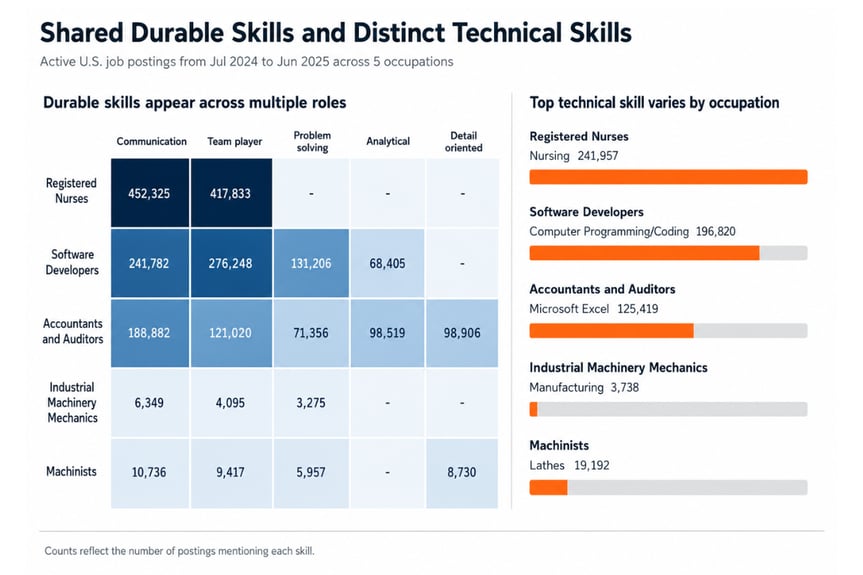
Current posting data shows which skills appear most often for a defined occupation and period. Frequency helps teams prioritize review, but it does not establish proficiency or business importance. Posting evidence works best as a market signal that is checked against the actual work.
The five occupations show why a single enterprise list will miss important distinctions. Accountants and auditors center on Microsoft Excel, accounting, Generally Accepted Accounting Principles (GAAP), and reconciliation. Industrial machinery mechanics center on manufacturing, welding, mechanical skills, and reading schematics. Shared durable skills sit beside technical requirements that remain tied to each occupation.
|
What posting evidence shows |
How the finding should shape the decision |
|
Registered nurse postings emphasize clinical systems and required licenses. |
Screening should verify clinical context and credentials. |
|
Software developer postings emphasize programming languages and cloud tools. |
Learning plans should follow technology used in priority roles. |
|
Accountant postings emphasize financial standards and spreadsheet work. |
Assessments should test accuracy within accounting tasks. |
|
Mechanic postings emphasize repair methods and industrial equipment. |
Hiring criteria should reflect the machinery present at each site. |
|
Machinist postings emphasize precision tools and production methods. |
Proficiency checks should use work samples tied to shop tasks. |
Skills gap analysis connects requirements to talent availability
A skills gap analysis compares required capabilities with the people who can supply them in the relevant labor pool. The result should identify a shortage, surplus, or verification problem. A list of popular skills is only the requirement side of the analysis and cannot show how difficult a hiring or training plan will be.
A regional expansion team assessing machinists needs more than posting frequency for lathes or blueprint reading. It also needs worker counts, hiring activity, commuting patterns, employer concentration, and adjacent occupations with transferable capabilities. Without that context, a high skill count can be mistaken for a large available talent pool.
A defensible review should answer five questions:
- Which capabilities are required for the target work?
- How often do employers request each capability?
- Which workers or adjacent occupations can supply it?
- What evidence proves the required proficiency level?
- Which gap calls for hiring, training, redesign, or relocation?
The missing regional results in the supplied analysis are an important limitation. Hiring competition, labor supply, local posting volume, and limited talent availability cannot be inferred from national occupation patterns. A responsible recommendation separates proven findings from questions that still require analysis.
Skills-based hiring requires evidence tied to role needs
“Skills-based hiring works when each requirement reflects an actual task and each assessment measures the right capability.”
Removing an education filter does not improve access when the replacement criteria remain vague. The strongest process identifies essential skills, credentials, and acceptable evidence before recruiters review candidates.
A software developer posting can separate Python proficiency from general programming knowledge and teamwork. A coding exercise can test technical application, while structured interview questions can examine collaboration and problem-solving. The data also shows that 229,243 postings referenced a bachelor's degree and 108,689 referenced experience without a specified length, giving employers reason to review broad filters.
Skills-first hiring still requires judgment. Some licenses and certifications protect safety or meet legal requirements, so they cannot be treated like optional preferences. Other qualifications can be assessed through work history, projects, work samples, or prior learning. The goal is a consistent evidence standard that matches the role rather than a longer checklist.
Workforce planning turns skill gaps into practical actions
Workforce planning converts a measured gap into a choice about hiring, training, internal mobility, job design, or location. The response should match the gap. A scarce technical capability calls for a different response than a common durable skill that lacks consistent assessment across the organization.
Communication and teamwork appeared across all five occupations in the supplied analysis, while problem solving appeared across four. Those recurring skills can support shared learning and internal mobility. Technical skills still need occupation-specific pathways, such as clinical systems for nurses, cloud tools for developers, or precision equipment for machinists.
A useful workforce plan assigns ownership, timing, cost, and a measure of progress to each response. Training should specify the target role and proficiency outcome. Internal mobility should identify the skills that transfer and the technical gaps that remain. Hiring plans should connect each screening rule to posting evidence and local talent availability, giving leaders a clearer basis for investment.
Governance keeps the skills strategy credible over time
Governance keeps a skills strategy usable by defining who approves terms, how evidence is reviewed, and when role requirements are refreshed. A taxonomy will lose credibility when similar skills carry different definitions or outdated requirements remain attached to jobs. Disciplined ownership protects consistency while preserving valid role differences.
Set a review cycle that reflects the pace of work and recruiting activity for each occupation. Software tools can shift within a shorter period than regulated clinical credentials, while durable skills need stable definitions and role-specific assessment guidance. Version history, source dates, occupation codes, proficiency levels, and approvals give leaders a clear path back to the evidence.
The most reliable skills-based organization treats the taxonomy as part of an operating process. Chmura supports that process when occupation mapping, posting evidence, regional workforce analysis, and expert review are used to connect a skill label to a defensible workforce choice. The lasting value comes from disciplined execution: each requirement has context, each gap has proof, and each action follows the evidence.