Build a future-ready talent acquisition strategy with regional workforce data, labor sheds, and the HR metrics that matter for better hiring plans.
Corporate

By Chmura Economics & Analytics
Published Jun 4, 2026
Key Takeaways
-
- Future-ready hiring plans begin with regional workforce analysis before roles open.
- Labor sheds, postings, wages, and worker availability must be assessed as connected measures.
- Geographic flexibility works best when each role has clear rules for location, pay, travel, and sourcing reach.
A future-ready talent acquisition strategy starts with choosing the right labor markets before opening a role. Hiring plans improve when teams test talent availability, recruiting pressure, pay, commuting reach, and role growth before setting headcount dates. Geographic flexibility turns those findings into options before hiring stalls.
National conditions alone cannot tell you where a specific role will be easier to fill. Each occupation has its own supply pattern, and nearby markets produce different results. The strongest plan treats location, compensation, work arrangement, and sourcing reach as connected choices that must be tested early.
Future-ready hiring starts before the requisition opens
Hiring strategy should begin during workforce planning, when leaders still have room to adjust location, timing, pay, and work design. Once a requisition is approved, many of those choices feel fixed. Early market analysis gives talent teams a chance to set realistic assumptions before recruiters inherit an avoidable problem.
A software team planning 40 hires should first define the occupations, skills, seniority, and regions tied to that goal. National projections support long-term planning, but they also show why occupation detail matters. Across the United States, software developer employment is projected to add 267,700 jobs from 2024 to 2034, while computer and mathematical occupations overall are projected to grow 10.1% over the same period.
Those figures indicate sustained hiring pressure, yet they do not identify the best recruiting market. Your planning process still needs local worker counts, recent postings, wage levels, commuting patterns, and expected openings. Starting there helps finance, operations, and talent acquisition agree on a plan that the local market can support.
Talent supply sets realistic targets for priority roles
Talent supply should determine hiring speed, sourcing reach, and role flexibility for every priority role. A large employed workforce is useful, but it does not equal an available candidate pool. Recruiters must separate total employment from workers they can realistically reach.
Data scientists provide a clear case. The Bureau of Labor Statistics projects 34% employment growth and about 23,400 openings per year from 2024 to 2034. Information security analysts are projected to grow 29%, with about 16,000 openings per year. Those national figures signal continued hiring pressure, while local data determines where the plan is workable.
For each priority role, record five measures before setting the hiring target:
- Workers employed in the occupation within the selected market
- Unemployed and underemployed workers with related experience
- Annual openings tied to growth and worker replacement
- Recent online postings from employers seeking similar skills
- Commuting reach for on-site or hybrid schedules
A target is credible when these measures support the timeline. Otherwise, adjust the market, work arrangement, pay range, or hiring sequence before opening the role.
Regional comparisons reveal stronger markets for scarce skills
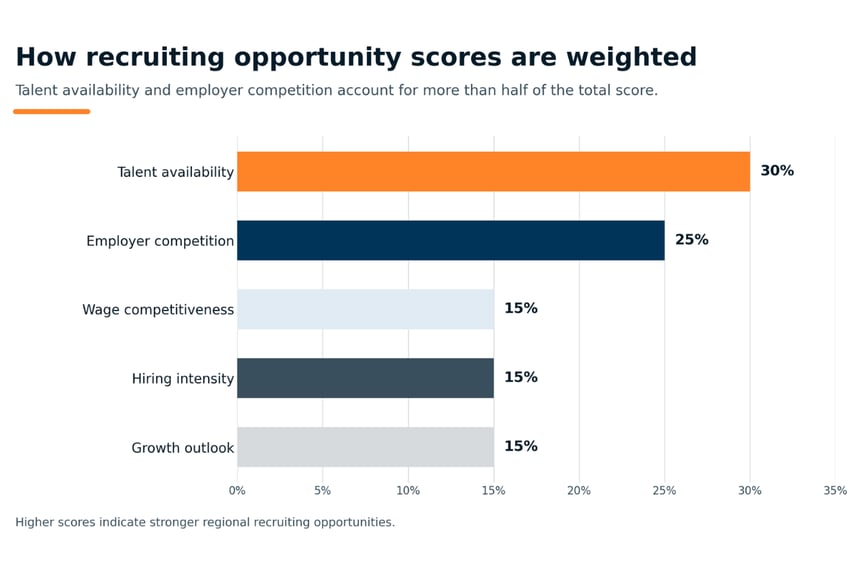
Regional comparison turns a broad talent problem into a choice among specific markets. It shows where qualified workers are more available relative to employer activity, pay pressure, and expected hiring. One market can have a larger workforce while another offers a more favorable recruiting balance.
Chmura’s analysis compares four technology occupations across Northern Virginia, Raleigh-Cary, Austin, Nashville, and Richmond using five recruiting factors. Talent availability carries the most weight at 30%, followed by employer competition at 25%. Wage position, hiring intensity, and growth outlook each account for 15%. The takeaway is that the strongest recruiting market is the one that offers the best balance across these conditions, rather than simply the largest talent pool or lowest wages.
|
Comparison factor |
What the measure should tell you |
|
Talent availability |
The market has enough reachable workers to support the planned hiring volume. |
|
Employer competition |
Active postings show how many employers are pursuing similar candidates. |
|
Wage position |
Local pay levels show the likely cost of attracting qualified workers. |
|
Hiring intensity |
Posting activity shows how strongly employers are recruiting right now. |
|
Growth outlook |
Projected openings show how much pressure the occupation will face over time. |
A lower-cost market can still be difficult when qualified workers are scarce or the practical commute area is too narrow. The regional score gives hiring teams a way to compare those tradeoffs before choosing where to recruit, how far to source, or how much flexibility a role will require.
Labor sheds define the true reach of each market
A labor shed shows where workers live and how far they travel to reach jobs in a selected area. This gives talent teams a more accurate recruiting boundary than a city limit or county line. The method is especially useful for on-site and hybrid roles because commuting patterns shape who can accept the job.
A data center expansion can require information security analysts, network administrators, electricians, and other skilled trades. Each occupation can draw from different communities, so one regional label can hide gaps in access.
The U.S. Census Bureau reported that 13.3% of workers worked from home in 2024, while the mean one-way commute reached 27.2 minutes. Those national figures do not set a local rule, but they show why work location and travel time belong in hiring analysis.
A well-built labor shed compares home locations, travel patterns, and nearby talent sources. It also shows when remote work, satellite space, shift design, or relocation support will expand the pool enough to justify the cost.
Posting pressure signals where recruiting difficulty will rise
Posting pressure shows how employer activity compares with the number of workers who could fill a role. A posting-to-worker ratio is useful because raw job ad counts can make a large market look easier than it is. A high ratio signals more recruiting activity for each available worker.
Employers reported 7.6 million job openings in May 2026, while the market had 1.0 unemployed person per opening. That ratio stayed between 0.9 and 1.1 from April 2024 through May 2026, which points to a broadly balanced national market with limited slack.
A regional cybersecurity search can still face far more pressure. If several employers post for the same certifications and experience level within one commuting area, the talent team will see longer searches and more offer pressure even when the regional unemployment rate looks normal.
Track postings monthly and compare them with worker counts, recent hires, and occupation growth. That cadence will flag pressure early enough to widen sourcing or revise the hiring sequence.
Local wage pressure should shape compensation before sourcing begins
Compensation should reflect the recruiting market, required skills, and employer activity around the role. These factors set the practical offer range. A national salary range supports budgeting, but it will not show the local premium for a scarce skill or difficult commute.
Consider an information security role that requires cloud security experience and on-call coverage. Two regions can have similar median wages while producing different recruiting outcomes. One could have more active postings, fewer available workers, and more employers advertising salaries above the median. That market will require a stronger offer or a wider recruiting area.
Wage analysis should compare average pay, median pay, wage growth, posted ranges, and nearby employer practices. It must also separate a broad occupation from the exact skill profile in the requisition.
Pay increases should follow evidence. When worker availability is solid, and posting pressure is modest, better sourcing or a broader labor shed can solve the problem without raising every offer.
Geographic flexibility expands access to qualified talent pools
Geographic flexibility gives talent teams more than one practical path to the hiring goal. Remote work, hybrid schedules, relocation support, satellite offices, and regional sourcing can each expand access, but the right option depends on the role and operating model.
A network administrator who must support physical systems will need a practical commute to the site. A data scientist can often work from a wider area if security, collaboration, and management practices support remote work. Treating both roles the same will either shrink the candidate pool or create an operating risk.
The supplied workforce framework recommends ranking markets by talent availability, employer competition, wage position, hiring intensity, and growth outlook. It also recommends identifying the best recruiting market, the lowest-pressure market, and the strongest geographic expansion option for each occupation.
Use that comparison to match each role with a sourcing radius and work arrangement.
- “Geographic flexibility works best when it is planned as part of workforce design, with clear rules for location, travel, pay, and team coverage.”
Talent intelligence software should turn metrics into hiring choices
Talent intelligence software earns its place when it helps leaders choose a market, set a hiring target, establish pay, and explain the recommendation. Dashboards alone do not create a sound plan. The system must connect worker supply, postings, wages, commuting reach, and projected openings to the choices a hiring team controls.
A useful operating rhythm keeps those choices current. Refresh posting comparisons monthly. Review employment, wages, and projections quarterly, with earlier checks for a major hiring plan, expansion, or compensation change.
The final output should state the recommended region, recruiting radius, pay position, work arrangement, expected pressure, and review date. Record the assumptions behind each choice so leaders can revise the plan when conditions move.
Chmura supports this workflow through regional analysis, labor-shed views, transparent measures, and expert review for high-stakes questions. The strongest strategy is the one your team can explain, execute, and update without rebuilding the analysis every time a new requisition appears.