A skills taxonomy organizes job-posting language but can't explain the labor market alone. See why occupation, industry and classification context matter.
JobsEQ
Analysis
Insights

By Patrick Clapp
Published Oct 21, 2026
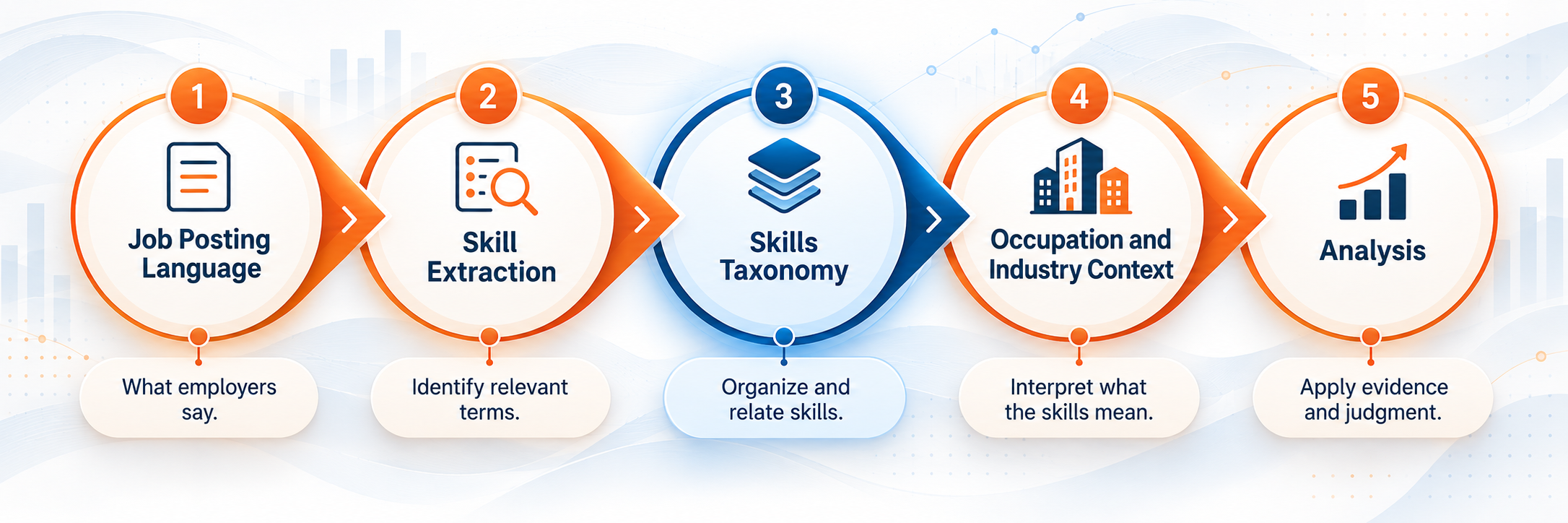
Skills taxonomies help organize the language of work. Evaluating one, however, requires looking beyond its size to the evidence, classifications, and context surrounding it.
“Data analysis” appears in job postings for software developers, financial analysts, health services managers, school administrators, construction managers, and logistics professionals.
But it does not necessarily describe the same work in each occupation.
For a construction manager, data analysis might involve estimating, scheduling, cost control, or project performance. In manufacturing, it could mean analyzing quality measurements or production processes. A healthcare employer might use the phrase in connection with clinical outcomes, operations, claims, or patient data.
A skills taxonomy attempts to organize this varied language into consistent, searchable concepts. That makes it an important part of a labor-market information system—but only one part.
When organizations compare workforce data tools, they are often encouraged to focus on the number of skills in a taxonomy or whether the taxonomy is proprietary. Those characteristics tell us something about the system but do not, by themselves, tell us whether its conclusions are accurate, transparent, or useful. A useful platform connects employer language with the occupational, industry, and regional context needed to answer workforce questions.
What is a skills taxonomy?
A skills taxonomy is a structured way of identifying, naming, and relating skills.
Its most basic function is normalization. Employers may use several expressions for the same or closely related capability. One posting may request “Microsoft Excel,” another “advanced spreadsheets,” and another “pivot tables and macros.” A taxonomy helps determine when those terms should be grouped and when their differences should be preserved.
More sophisticated taxonomies may also identify relationships among skills. They might group specific software tools under a broader technical domain, distinguish specialized skills from transferable ones, or connect a skill with the occupations in which it commonly appears.
This structure makes millions of lines of unstandardized job-posting language easier to search and analyze. Without some form of normalization, an analyst could miss relevant demand simply because employers describe similar needs differently.
A taxonomy therefore helps answer questions such as:
-
-
- Which skills are employers requesting?
- Which terms appear to describe the same or related capabilities?
- How does demand vary across occupations, industries, employers, or places?
- Which skills frequently appear together?
- Which requirements are becoming more or less common?
-
Answering these questions requires more than recognizing skill terms.
A taxonomy is a map, not the labor market
A map is valuable because it simplifies reality. Its usefulness also depends on what it leaves out.
A skills taxonomy faces the same tradeoff. If it treats every variation in employer language as a separate skill, the results may become noisy and difficult to interpret. If it combines terms too aggressively, it may erase distinctions that matter.
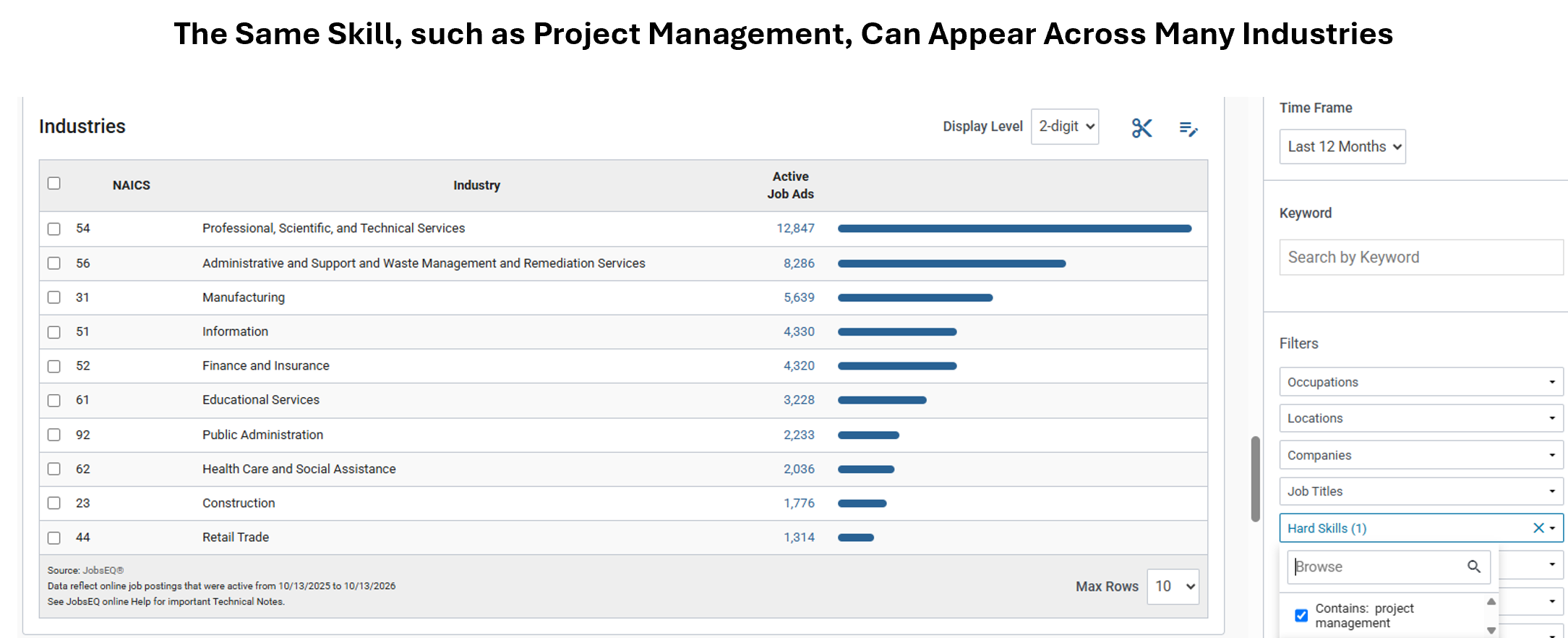
Consider “project management.” The phrase could describe formal project leadership, construction scheduling, software implementation, grant administration, or simply the ability to keep routine work organized. Counting every mention as equivalent could overstate the similarity among those jobs. Splitting the phrase into dozens of highly specific concepts could make it difficult to see a broader pattern.
There is no universally correct level of detail. The appropriate level depends on the question being asked.
A talent acquisition team searching for candidates may need highly specific tools and certifications. A community college reviewing an academic program may need broader skill families connected with occupations and curricula. An economic development organization may be more interested in skills shared across employers and industries.
Taxonomy size, therefore, is not a reliable shorthand for analytical quality. A system with more skill labels is not automatically more accurate or more useful. Coverage matters, but so does clarity, relevance, and the ability to trace a result back to evidence.
Context determines what a skill means
A skill should rarely be interpreted in isolation. At minimum, analysts should consider its relationship to:
- Occupation
- Industry
- Employer
- Job responsibilities
- Geography
- Experience or education requirements
- Other skills in the posting
- The original language used by the employer
Occupation is especially important. The federal Standard Occupational Classification system groups workers according to the work they perform, while O*NET provides more detailed information about occupational tasks, knowledge, abilities, skills, and work context. These public frameworks create a common foundation for comparing employment information across sources.
Neither framework eliminates the need for interpretation. In fact, the Bureau of Labor Statistics cautions that workers are classified according to job duties rather than job titles. Two people with the same title may belong to different occupations if their work differs.
The same principle applies to skills. A shared term does not necessarily represent an identical responsibility, level of expertise, or training need.
Classification errors can travel through an analysis
Skills are not the only concepts being classified in a job posting. Labor market information platforms also attempt to identify the employer, occupation, industry, location, education requirements, experience level, compensation, and employment arrangement.
An error in one layer can affect every layer that follows.
Imagine that a biological scientist position at a university is classified as a postsecondary teaching position simply because the employer is a university. The skills may be extracted correctly, but an occupation-level analysis would attribute them to the wrong kind of work. That error could then affect conclusions about demand, wages, education requirements, and program alignment.
Direct access to the underlying postings is particularly valuable here. It allows an analyst to test whether an apparent pattern reflects meaningful demand or is an artifact of language, classification, or a small number of employers.
How to evaluate a skills taxonomy
Organizations comparing labor-market tools should look beyond demonstrations built around a few successful searches. A useful evaluation includes the following questions.
1. Can users inspect the evidence?
Can they open the postings behind a chart, review employer wording, and determine why a skill was included?
2. Does the taxonomy preserve meaningful context?
Can skills be analyzed by occupation, industry, region, employer, experience, education, and related requirements?
3. How does the platform classify occupations and employers?
Does it use transparent public frameworks such as SOC, O*NET, and NAICS? Can results be reconciled with government statistics and planning requirements?
4. How does the taxonomy connect with other decisions?
Can users relate skills to employment, wages, projections, talent supply, educational programs, and completions—or does the analysis stop at posting counts?
5. How is quality maintained?
How are new terms added, classification errors investigated, and customer-reported anomalies resolved?
6. Is the level of detail appropriate?
Does the taxonomy provide usable signal, or does its size make the results fragmented, redundant, or difficult to explain?
What this means for JobsEQ users
JobsEQ uses a proprietary taxonomy to identify skills in job postings, but the analysis doesn’t stop at the skill label by itself. Users can examine skills by occupation, industry, employer, region, and other dimensions, then review the postings in which those skills appear.
JobsEQ also retains widely used classifications such as SOC, O*NET, and NAICS and connects postings with employment, wages, projections, and education programs.
That design reflects an important principle: a workforce data system should help an analyst investigate a claim, not simply present a classification as the answer.
Contact Chmura today to explore skills data in JobsEQ®.