See how much a hot dog costs in 2026 with the Chmura Hot Dog Index. Compare 4th of July food prices, grocery inflation, and regional cost differences.
Economic Trends
 By Nathanael Seife
Every Independence Day, millions of Americans gather for backyard cookouts, neighborhood block parties, and family celebrations. And while menus vary from region to region, one food remains nearly universal: the hot dog.
According to the National Hot Dog and Sausage Council, Americans eat approximately 150 million hot dogs on the Fourth of July alone [1]. To put that in perspective, that number of hot dogs could cross the Atlantic Ocean from New York City to London back and forth, twice. That makes the humble hot dog more than just a holiday tradition. It's also a surprisingly useful way to understand how everyday costs are changing.
The Chmura Hot Dog Index tracks the estimated cost of preparing a classic hot dog using retail grocery prices and inflation data. By following the price of a frankfurter, bun, ketchup, and mustard over time, we can measure how one of America's most recognizable meals has changed alongside broader economic trends.
For this year’s index, Chmura collected grocery prices from 5 locations—Washington D.C., California, Colorado, Ohio, and Texas—using major regional supermarket chains that reflect competitive local pricing.[i] The result is a simple, relatable snapshot of grocery inflation that shows not only how much a hot dog costs in different parts of the country, but also how quickly those costs continue to rise.
We began in Ohio at a local Cincinnati grocer, the headquarters of Kroger. Preparing a hot dog starts with the frankfurter. An 8-count Oscar Mayer Bun-Length Beef Frank at Kroger in Cincinnati costs $6.29, or $0.79 per frankfurter. Next, the bun. An 8-pack of Wonder Bread Classic Hot Dog Buns is listed at $2.49, or around $0.31 per bun. To purchase a 32-ounce Heinz Tomato Ketchup bottle, you could expect to pay $4.99 for 53 servings, or about 9 cents a serving. And finally, a 20-ounce bottle of French’s Classic Yellow Mustard costs $2.99 for 113 servings, or a little less than 3 cents per serving.
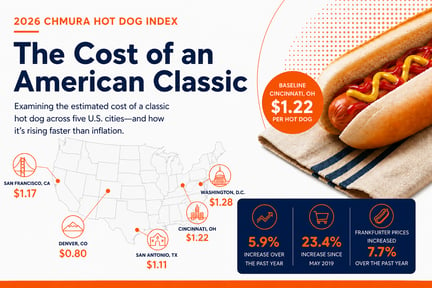
Based on these prices, the Chmura Hot Dog Index estimates that a classic hot dog costs $1.22 in 2026 in Cincinnati, consisting of one frankfurter, a hot dog bun, and a serving of ketchup and mustard.[1]
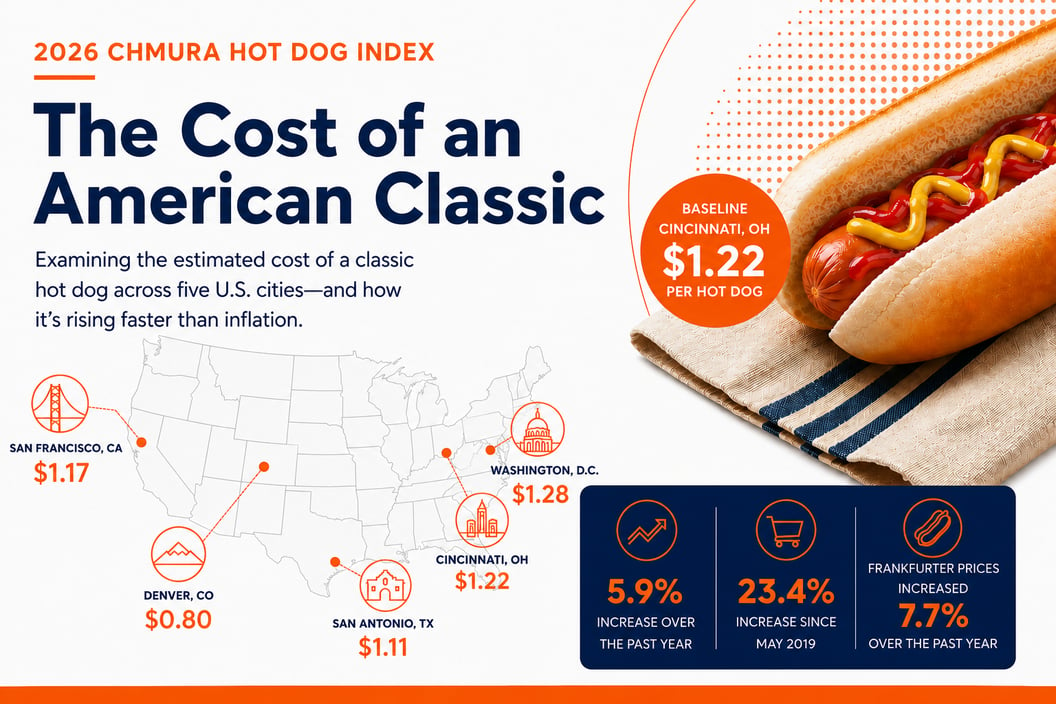
With the 2026 cost established at $1.22, we utilize the Bureau of Labor Statistics consumer price index (CPI) data to estimate its price compared with a year ago. To compute the specific price increase of hot dogs, each ingredient of a common hot dog is adjusted using the CPI category that most closely matches it: Frankfurters for the hot dog meat, Bread for the hot dog bun, and Sauces and Gravies for the Ketchup and Mustard. Using these CPI categories, the estimated cost of a hot dog increased approximately 6.2% in Cincinnati over the past year, and 24.7% since May 2019.
Frankfurter prices alone increased 7.7% over the past year, making it the largest contributor to the increase in the Chmura Hot Dog Index. The increase in the price of frankfurters and beef may be due to the large reduction in the U.S. cattle inventory, down to its lowest levels in 75 years. The shortage is caused by years of drought and, more recently, the screwworm outbreak, which not only causes fewer cattle to survive, but also requires more frequent inspections and quarantines, slowing down production and putting upward pressure on prices. Oscar Mayer passes these costs onto the consumer [2].
Chmura repeated this methodology for four other areas[i]—Washington D.C., San Francisco, Denver, and San Antonio—using major regional grocery retailers that reflect competitive local grocery pricing.
The Chmura Hot Dog Index reveals noticeable differences in the estimated cost of a classic hot dog across the five cities analyzed. Washington, D.C., recorded the highest estimated cost at $1.28 per hot dog, while Denver came in as the least expensive at $0.80. Cincinnati was estimated at $1.22, followed by San Francisco ($1.17) and San Antonio ($1.11).
Although prices varied considerably across cities, the estimated year-over-year increase was relatively consistent. The five markets experienced an estimated increase between 5.4% and 6.3%, suggesting that broad national inflation in grocery prices has affected markets nationwide.
While no single food can tell the entire inflation story, the Chmura Hot Dog Index offers an accessible way to see how national economic trends affect everyday purchases. A cookout staple that once seemed inexpensive now reflects the same pressures influencing grocery budgets across the country.
Although prices differ by market, the consistent year-over-year increases suggest that consumers nationwide continue to feel the effects of rising food costs. More notably, the cost of a classic hot dog has outpaced overall consumer inflation, increasing an average of 5.9% across the five cities compared with 4.2% for the Consumer Price Index.[2]
At Chmura, we believe data is most valuable when it helps explain the world in ways people immediately understand. Whether measuring labor markets, regional economies, or even the price of a Fourth of July cookout, turning complex data into meaningful insights helps people make more informed decisions.
[1] Toppings for hot dogs vary by region. In Cincinnati, you would be more likely to find an all-beef frankfurter topped with chili, mustard, white onions, and cheddar cheese. Chmura uses ketchup and mustard simply for comparability across cities.
[2] Average hot dog prices grew at an average of 3.0% annually between 2019 and 2026
[i] Kroger, Safeway, King Soopers, H-E-B, and Giant were used for Ohio, California, Colorado, Texas, and Washington, D.C., respectively.