The U.S. added 165,000 jobs in October. Chris Chmura examines whether hiring is rebounding and what it means for employers and workforce planning.
Workforce
Forecasting
Economy
Trends
Economic Trends

By Chris Chmura
Published Nov 11, 2026
October's employment report was stronger than expected, and upward revisions to August and September suggest the labor market has been healthier than previously reported. But stronger national hiring doesn't necessarily mean every industry, occupation, or region is experiencing the same improvement.
By Chris Chmura, Chief Economist, Chmura Economics & Analytics
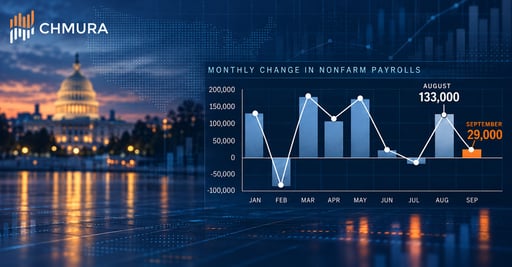
Just one month ago, the September employment report raised concerns that the U.S. labor market was losing momentum. Employers had reportedly added only 29,000 jobs, following an August increase of 133,000. The decline seemed significant, raising questions about whether businesses were entering a period of prolonged hiring weakness.
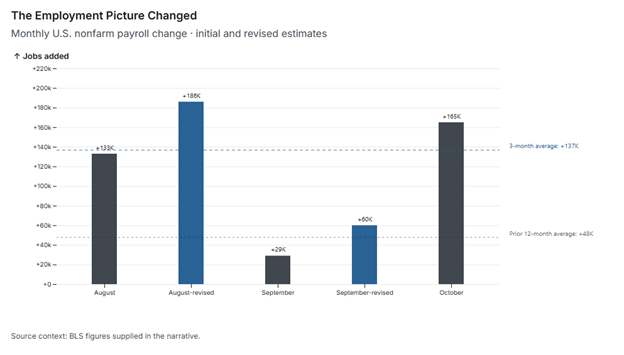
Now, the picture looks considerably different. According to the Bureau of Labor Statistics' October 2026 Employment Situation report, released November 6, the economy added 165,000 jobs in October, while the unemployment rate remained relatively stable at 4.1%. But October's stronger number isn't the only important development. The BLS also revised August's employment gain upward to 186,000 jobs and September's to 60,000. Together, those revisions added another 84,000 jobs to previously reported employment gains.
That changes our understanding of the labor market's performance over the past several months. In my earlier analysis, Why Did Job Growth Slow in September?, I cautioned against interpreting one weak month as evidence of a sudden deterioration in hiring. Monthly employment estimates are subject to revision, and unusual seasonal patterns can sometimes exaggerate changes in the headline numbers. The October report reinforces that caution.
So, are we seeing the beginning of a sustained labor market recovery, or simply a stronger month in an economy where employers remain cautious about their hiring decisions? My assessment is that the labor market is showing renewed momentum. But the underlying numbers suggest a more complicated story.
The Revisions May Be More Important Than the Headline
Economists generally avoid drawing broad conclusions from a single month's employment report. One reason is that payroll figures are preliminary estimates. As more information becomes available, the BLS revises its findings. Another is that employment growth can vary considerably from month to month, even when the underlying economic trend remains relatively stable.
Looking at the revised figures for August through October, the economy added an average of 137,000 jobs per month. That's considerably stronger than the average monthly increase of 48,000 during the preceding 12 months, as reported by the BLS. It's also a much different picture from the one we had just a few weeks ago.
August and October now represent two relatively strong months of employment growth, with a weaker September between them. That suggests hiring may have been more resilient than the initial reports indicated. Still, three months of stronger data don't establish a lasting trend. The next several reports will help determine whether hiring momentum can be sustained.
 Where Are the New Jobs Coming From?
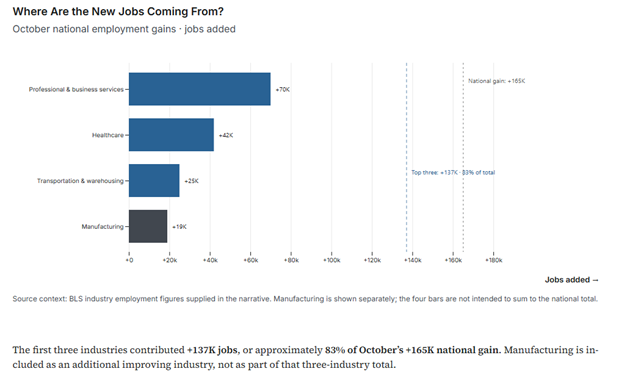
The composition of October's employment growth is particularly important. Three major industries accounted for approximately 137,000 of the 165,000 jobs added nationally—roughly 83% of the month's net employment gain. Professional and business services added 70,000 jobs, which was the largest contributor to October's growth.
According to the BLS industry employment breakdown, employment increased in professional, scientific, and technical services; administrative and support services; and management of companies and enterprises. Temporary-help services also showed improvement, adding approximately 18,600 jobs. Economists pay attention to temporary staffing because businesses sometimes use contingent workers when demand is improving but they remain uncertain about longer-term commitments. The increase is encouraging, although one month's improvement doesn't establish a sustained recovery in temporary employment.
Healthcare: 42,000 jobs added
Healthcare continued to be a significant contributor to national employment growth. The October BLS report showed that hospitals added 16,000 jobs, home health care services added 11,000, and outpatient care centers added another 5,000. Healthcare demand is influenced by long-term factors, including an aging population and changes in how medical services are delivered.
However, growth in healthcare employment doesn't tell us whether a particular hospital can easily recruit experienced nurses, medical technicians, or other specialized workers. Those conditions depend heavily on occupation and location.
Transportation and warehousing added 25,000 jobs. Transportation and warehousing also contributed significantly to October's gains. Couriers and messengers accounted for 17,000 additional jobs, while air transportation added another 4,000, according to the BLS Employment Situation.
The improvement provides another indication of demand for certain transportation services, but it shouldn't be interpreted as evidence that hiring is accelerating equally across every transportation occupation. A delivery driver, logistics analyst, warehouse supervisor, and aircraft mechanic face very different labor market conditions.
Manufacturing also improved with employment increasing by 19,000 jobs in October. Gains occurred in computer and electronic product manufacturing, machinery manufacturing, and primary metals. That's another encouraging development for the economy, particularly in regions with substantial manufacturing employment.
But many other major industries experienced relatively little change in October. The important takeaway is that job growth improved, but the improvement wasn't evenly distributed throughout the economy.
 A 4.1% Unemployment Rate Doesn't Tell the Entire Story
The unemployment rate edged down to 4.1% in October, remaining within the relatively narrow range observed over recent months. That's consistent with an economy that continues creating jobs without a significant increase in unemployment. But some indicators suggest employers and workers are still navigating challenges.
The BLS household survey showed that the number of people working part time for economic reasons increased by 339,000 to 4.8 million. These individuals would prefer full-time employment but were working fewer hours because of business conditions or an inability to find full-time work. Meanwhile, average hourly earnings for private-sector employees increased 3.1% over the preceding 12 months.
For employers, wage growth remains an important consideration when planning compensation and recruiting budgets. Yet a national wage average tells us relatively little about what a business must pay to recruit a particular occupation in a specific location. That's why national employment statistics should be considered a starting point, not the final answer to an employer's workforce questions.
Why a Stronger Labor Market Doesn't Mean Hiring Will Be Easier—or Harder—Everywhere
This may be the most important lesson for HR executives and corporate workforce planners. The national employment report tells us how many jobs the economy gained or lost. It doesn't tell an individual employer how difficult it will be to recruit the people it needs.
There's also a distinction between industries and occupations. The BLS payroll employment survey primarily measures employment by the industry of the employer. But businesses hire employees based on occupations, qualifications, and skills.
A hospital employs far more than healthcare practitioners. It also needs accountants, administrative employees, IT professionals, facilities workers, and many others. Likewise, a technology specialist may work for a bank, hospital, manufacturer, or consulting company.
Consequently, the competition for a particular type of worker often extends well beyond the industry in which a business operates. That's why evaluating occupational employment, wages, hiring activity, and projected demand within a specific region provides a much more useful view of recruiting conditions.
Where Is Hiring Actually Heating Up?
Consider three metropolitan markets: Richmond, Virginia; Columbus, Ohio; and Charlotte, North Carolina. Now consider three occupations associated with some of these industries' broader workforce needs:
- Computer systems analysts
- Registered nurses
- Light truck drivers
Each occupation can be examined across these regions using several labor market measures.
- How many workers are currently employed in the occupation?
- How much hiring activity is occurring?
- What wages are employers paying?
- How has job posting demand changed over the past several months?
- And what does the longer-term employment outlook suggest?
An employer comparing these markets might discover that a region with a large occupational workforce also has substantial hiring competition. Another region might have fewer workers but less recruiting activity. A third might offer attractive wage conditions but a limited pool of experienced workers. These differences can affect recruiting costs, hiring timelines, compensation strategies, and expansion decisions.
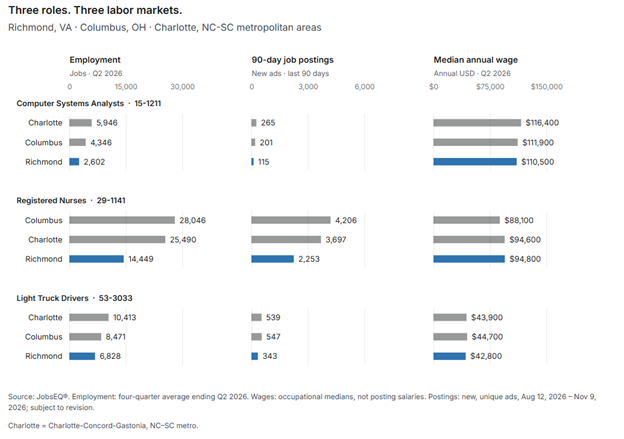
National employment growth provides useful economic context. But decisions about where to recruit, what to pay, and how to prepare for future workforce needs require more specific information.
What Employers Should Be Watching
For organizations developing their 2027 workforce plans, October's employment report provides a reason to revisit earlier assumptions. But I wouldn't recommend changing a hiring strategy simply because the economy added 165,000 jobs in one month. Instead, I would focus on several questions.
- Which occupations are most important to your organization's growth?
- Is hiring activity for those occupations increasing in your recruiting markets?
- How much competition exists from other employers?
- Are wage expectations changing?
- And does the region have the workforce capacity to support your future operations?
Understanding these conditions will help employers distinguish broad economic improvements from the hiring challenges affecting their own businesses.
The Bottom Line: Encouraging News, but the Story Isn't Finished
October's employment report was good news. The addition of 165,000 jobs, combined with meaningful upward revisions to August and September, suggests that the labor market has been more resilient than previously reported. But stronger national employment growth doesn't necessarily mean hiring conditions are improving for every occupation or region. And it certainly doesn't mean businesses have stopped evaluating costs, productivity, technology investments, or future staffing requirements. Those decisions can continue even during periods of economic expansion.
That brings us to an apparent contradiction—and the subject of Part 2. If employers are adding jobs again, why does a new LHH survey reported by HR Dive show that roughly two-thirds of HR leaders expect workforce reductions over the coming year? Are we looking at two conflicting economic signals? Or is something more fundamental happening to the types of workers businesses need?
In the next article, I'll explain why companies can be hiring and preparing for layoffs at the same time—and why understanding that distinction may be one of the most important workforce planning challenges for 2027.
See What October's Hiring Trends Mean for Your Labor Market
JobsEQ by Chmura helps employers move beyond national employment statistics to analyze occupational employment, wages, regional hiring activity, and forecasts. With JobsEQ Canvas, organizations can organize this information into customized workforce planning reports.
Explore JobsEQ and schedule a workforce intelligence session
Sources
Employment figures are preliminary and subject to revision.