See how hiring competition analysis connects compa ratio, workforce assessment, and employee retention strategy to active employer postings.
Workforce

By Chmura Economics & Analytics
Published Jul 31, 2026
Key Takeaways
-
- True hiring rivals share occupations, qualifications, and commute areas, regardless of sector.
- Posting volume needs occupation and experience context before it can guide sourcing or pay decisions.
- Compa ratios and workforce assessment turn external hiring pressure into role-specific retention priorities.
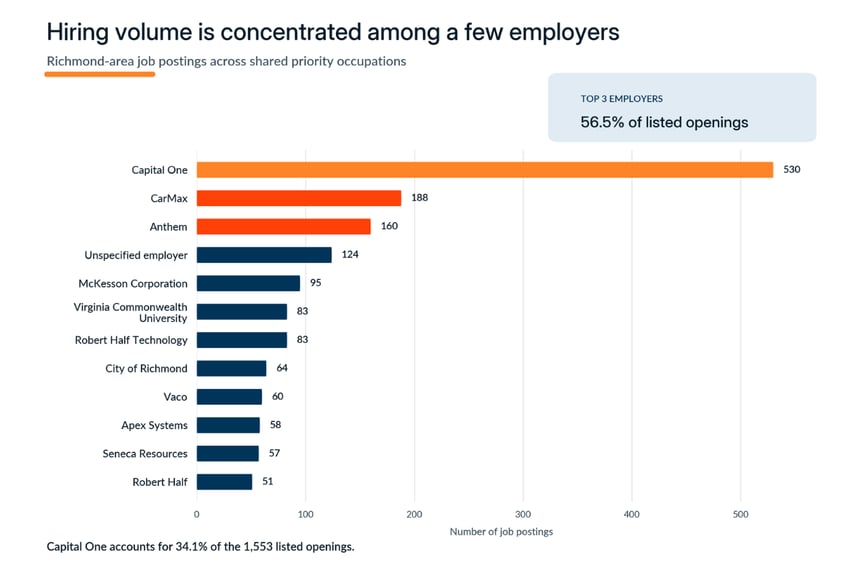
Hiring competition analysis works best when corporate HR identifies the employers pursuing the same workers, skills, and experience levels, regardless of industry. A Richmond-area review counted 1,553 postings across 12 leading employers. Capital One, CarMax, and Anthem accounted for 878 openings, or 56.5% of the total, while recruiting across many of the same technical, business, engineering, and customer-facing roles.
That concentration matters because a bank, an automotive retailer, and a health insurer can all pull from the same local candidate pool. A peer list limited to companies in your own sector will overlook much of the hiring pressure affecting your roles. Corporate HR should compare active postings, shared occupations, qualifications, and employer volume, then use that evidence to guide recruiting, compa ratios, workforce assessment, and employee retention strategy.
The talent market defines your true hiring competitors
“Your true hiring competitors are the employers pursuing the same workers across sectors.”
Candidate overlap provides the stronger test. HR needs a view centered on occupations, qualifications, and geography. This view reflects actual candidate choices.
Richmond data makes that clear. Capital One, CarMax, and Anthem all posted for software developers, data scientists, financial analysts, and human resources specialists. A bank, a retailer, and a health insurer can pull from the same candidate pool.
Ask which employers can offer the same worker a credible alternative. That answer shapes sourcing, pay reviews, interview speed, and retention priorities.
|
Signal to review |
What it reveals |
Decision it supports |
|
Shared occupations |
Shared roles reach the same candidates. |
Set a rival list for each role. |
|
Posting volume |
Larger totals indicate stronger hiring pressure. |
Allocate sourcing effort. |
|
Experience requirements |
Similar tenure expectations narrow the pool. |
Adjust role design. |
|
Education requirements |
Credentials reveal shared screens. |
Reconsider restrictive filters. |
|
Work location |
Nearby roles draw from one commute area. |
Refine market comparisons. |
Job postings reveal which employers are hiring against you
Job postings show who is actively pursuing talent now. They also reveal role mix, required experience, education, skills, and location. That evidence gives HR a current and direct view of employer behavior. It replaces assumptions with a repeatable hiring competition analysis.
A useful review starts with five checks:
- Rank employers by active posting volume for each priority occupation.
- Measure occupation overlap across employers in the hiring market.
- Compare required experience with your own openings.
- Review education filters that define the reachable candidate pool.
- Track where postings sit within the relevant commute area.
Talent acquisition teams hiring data scientists can use JobsEQ to identify employers posting for that occupation, then compare volume and candidate requirements. The result is a role-specific hiring market comparison. Recruiters can decide where to source and which employers to watch.
Posting data still requires judgment. Repeated ads, staffing listings, and unnamed employers can affect interpretation, so consistent employer and occupation records matter.
Shared occupations expose talent competitors outside your industry
Occupation overlap is the clearest sign that two employers are reaching for the same talent. Sector boundaries matter less when roles, qualifications, and work locations align. HR should build rival groups for each occupation instead of relying on one companywide list. That produces a more accurate view of candidate alternatives.
The Richmond findings show software developers and data scientists appearing across financial services, automotive retail, health insurance, higher education, local government, health care distribution, and staffing firms. Financial analysts and human resources specialists also appeared across several employers. A direct-industry peer review would overlook much of that pressure.
Role-specific lists prevent overreaction. A university can be a serious rival for software developers while posing little pressure for industrial engineers. A staffing firm can matter for technical roles despite a smaller total.
Recruiters can then study the employers that matter for each role. Compensation teams also gain a clearer basis for deciding which external pay signals deserve attention.
Hiring volume shows where recruiting pressure is concentrated
Hiring volume helps HR separate occasional recruiting from sustained employer activity. A large posting total suggests repeated contact with the same candidate pool. Smaller totals still matter when they focus on a hard-to-fill occupation. Volume should guide attention without becoming the only ranking factor.
Capital One posted 530 openings in the Richmond analysis, 342 more than CarMax and 370 more than Anthem. The top three employers accounted for 878 of the 1,553 listed postings. When a few employers recruit heavily across several shared occupations, candidates encounter their job titles, pay ranges, experience requirements, benefits, and work arrangements more often. That repeated exposure can establish expectations for what a strong offer should include, even among candidates who never apply to those employers.
Occupation context remains essential. An employer with 60 postings concentrated in financial analysis and data science could matter more to those teams than a larger employer posting mainly for unrelated roles. HR should compare total volume with role-level volume.
Monthly tracking shows if pressure persists. That pattern helps recruiters set sourcing effort, compensation teams time pay reviews, and leaders explain faster approvals.
Experience requirements define the true candidate overlap
Experience requirements show which employers are targeting the same career stage. Two companies can post for the same occupation while pursuing different workers. A role seeking one to three years of experience will overlap less with a role requiring five to ten years. HR should treat experience as a core filter.
Several leading Richmond employers sought candidates with about three to five years of experience. Capital One and CarMax listed five years as typical, while McKesson listed four to five years. Seneca Resources reached higher with five to ten years, and the City of Richmond listed one to three years.
The strongest pressure sits around established professionals who can contribute quickly without executive tenure. Recruiters face more direct overlap when their own requirements use the same band. Hiring managers should review if every requested year reflects a genuine job need.
Broader ranges increase candidate access while affecting training, pay, and role scope. Narrow requirements produce a smaller pool and stronger offer pressure.
Compa ratios need hiring market context to guide pay
A compa ratio compares an employee's salary with the midpoint of the assigned pay range. A ratio of 0.90 means the employee earns 90% of that midpoint. The measure shows internal pay position, while external hiring activity shows where low ratios create greater exposure. HR needs both views.
Consider two financial analysts at a 0.90 compa ratio. One works in a market with limited active hiring, while the other faces several employers posting for the same role and experience level. Their internal position matches, but their external risk differs. The second case deserves faster review.
A single compa ratio threshold cannot provide the full answer. Tenure, performance, skill depth, range design, location, and current employer activity all affect interpretation. A low ratio can reflect a recent hire or a developing employee.
A stronger compensation benchmark connects range position with posting volume, shared employers, and experience. That combination directs reviews toward roles with the clearest exposure.
Workforce assessment should shape your employee retention strategy
“A useful employee retention strategy starts with the roles that face the strongest external hiring pressure and the greatest internal exposure.”
Workforce assessment connects market activity with turnover, tenure, pay position, skill coverage, and succession depth. The result is a focused plan tied to specific roles.
A finance team might find that several analysts sit below their range midpoints, have three to five years of experience, and match profiles sought by multiple local employers. That cluster deserves attention before a companywide retention campaign begins. HR can review pay, manager support, career paths, workload, and internal mobility for that group.
The same assessment can show where urgent action is unnecessary. A role with modest employer activity, low turnover, and strong internal coverage requires less immediate intervention. Resources can move toward occupations where replacement time and business disruption are higher.
HR can explain why one role needs a compensation review while another needs clearer career progression. Retention becomes role-level choices supported by evidence.
Employer tracking keeps hiring plans current over time
Employer tracking turns a one-time analysis into a working management process. Posting volume, role mix, and candidate requirements shift with budgets, projects, and staffing needs. HR should refresh priority employer lists on a set schedule and record material changes. Consistency matters more than constant checking.
A monthly review fits high-volume occupations, while a quarterly review can support steadier roles. Teams should compare new postings, recurring roles, experience bands, education filters, and location patterns. The purpose is to adjust sourcing, pay, or workforce plans while evidence remains useful.
Chmura's job posting and employer-of-record data gives teams a consistent basis for this review, while human judgment keeps the findings tied to business needs. A short hiring market comparison should serve recruiters, compensation leaders, and workforce planners without repeated interpretation.
Hiring competition analysis earns trust when it stays specific. The employer list must match the role, and the numbers must reflect current activity. Each response must connect to a clear workforce choice. Disciplined tracking keeps those choices grounded.