Review pay transparency law requirements, salary band design, and pay equity analysis steps to get practical guidance for defensible ranges.
Workforce

By Chmura Economics & Analytics
Published Jul 20, 2026
Key Takeaways
- Jurisdiction mapping must happen before a role reaches any public or internal posting channel.
- A defensible salary band connects job architecture, regional evidence, approved budgets, and documented placement rules.
- Pay equity review, manager training, and scheduled range checks turn disclosure into a repeatable compensation practice.
Pay transparency compliance now depends on publishing salary ranges you can explain, reproduce, and apply consistently across hiring and internal pay. Legal wording matters, but a compliant posting begins with sound compensation work: clear job levels, defined range placement rules, regional evidence, and an equity review before publication.
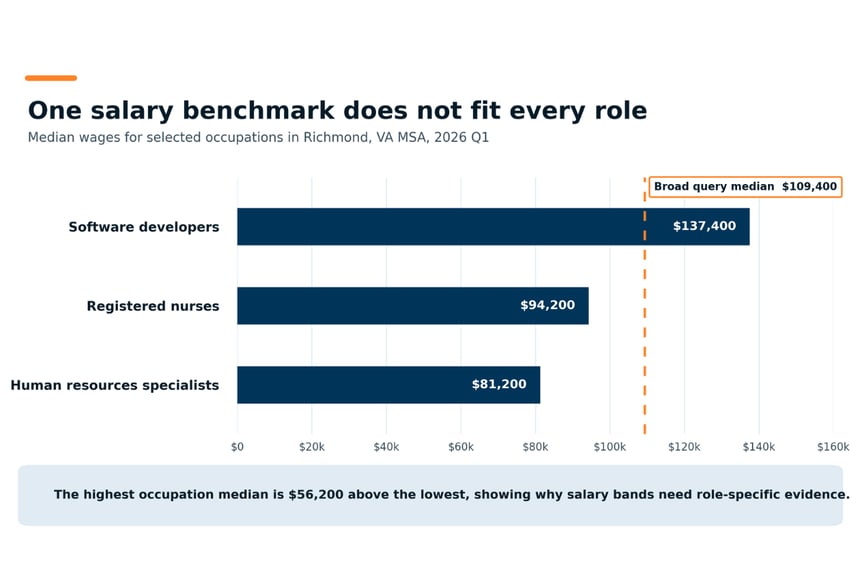
A July 2026 compensation analysis of 7,599 postings across 157 metros returned a P50 salary, or median salary, of $109,400. This means half of the salaries in the analysis fell below $109,400, and half fell above it. The broad query covered several occupations, and Richmond medians ranged from $81,200 for human resources specialists to $137,400 for software developers. That $56,200 difference shows why a single overall median cannot support every salary band.
Pay transparency compliance starts with jurisdiction coverage
Compliance starts with every law tied to the employer, worker, worksite, and posting channel. Remote roles can trigger requirements in other states, while internal transfers can carry separate obligations. Your compliance matrix should record employer thresholds, geographic tests, required disclosures, employee request rights, notices, and record retention periods. As of July 22, 2026, no federal law required private-sector employers nationwide to include pay ranges in job postings.
|
Jurisdiction |
Coverage checkpoint |
Posting requirement |
|
Virginia |
Public and internal roles are covered. |
Post the wage, salary, or good-faith range; breadth affects good faith. |
|
Maine |
Employers with 10 or more employees are covered July 29, 2026. |
Post the anticipated range and retain pay records for three years after separation. |
|
Illinois |
Employers with 15 or more employees cover specified Illinois work. |
Internal and external postings require pay scale and benefits. |
|
Massachusetts |
Employers with 25 or more Massachusetts employees are covered. |
Specific postings require the range expected in good faith. |
|
New Jersey |
Employers with 10 or more employees over 20 weeks can be covered. |
Job and transfer postings require pay, benefits, and other compensation. |
|
California |
Employers with 15 or more employees cover roles fillable in California. |
Post the good-faith salary or hourly range expected upon hire. |
Disclosure content must match each applicable law
The safest process uses the highest applicable disclosure standard for each role. Compensation teams should define required fields before recruiters publish. A national template can work when it captures every applicable element and reflects the relevant work location. Legal review should approve the template and its exceptions.
Each posting record should contain exactly what the role requires:
- State the base salary or hourly range with a clear minimum and maximum.
- Describe benefits when the governing rule requires that information.
- Identify bonuses, commissions, equity, or other eligible compensation separately.
- Apply the correct range to remote, hybrid, internal, and transfer postings.
- Save the approved posting, publication date, source data, and range owner.
A New Jersey posting needs pay, benefits, and other compensation programs, while California generally requires the salary or hourly range. Illinois adds benefits and can require internal notice after an external posting. One shortened field across every channel can omit a required element even when the range is accurate.
Published ranges need a documented good faith basis
A good-faith range reflects what the employer genuinely expects to pay when the posting goes live. The supporting record needs to capture the job level, location, approved budget, market reference, incumbent pay, range width, and approval date. This gives compensation and legal teams a consistent explanation when candidates, employees, or regulators ask how the range was set.
Range width matters because an unusually broad spread can weaken that explanation. Virginia now considers breadth when assessing good faith, while California defines the pay scale as the range an employer reasonably expects to pay upon hire. A role posted at $70,000 to $200,000 would be difficult to support if the approved budget stops at $125,000. A more credible range stays within likely offer limits, reflects the regional market, and documents what would place a hire near the minimum, midpoint, or maximum.
“Good faith becomes visible through the process itself.”
Salary band design starts with consistent job architecture
Salary band design starts with consistent definitions for job family, level, scope, and location. The same title can represent different responsibilities. Compensation teams need a role profile stating expected work, required skills, experience, reporting scope, and authority before selecting a market reference.
A broad compensation query can hide this problem. The supplied July 2026 analysis grouped several occupations and returned one P50 of $109,400. Yet Richmond medians were $81,200 for human resources specialists, $94,200 for registered nurses, and $137,400 for software developers. One midpoint would misstate at least two of those roles.
A practical architecture separates those jobs into distinct families and levels, then maps each role to a salary band. A senior software engineer and a registered nurse can share a posting system while using different references and placement rules. Consistency comes from applying the same method to comparable work.
Regional pay benchmarks support defensible range placement
Regional pay benchmarks show where a salary band should sit for the actual hiring market. A useful comparison matches occupation, level, geography, and time period. Compensation teams should review percentiles, current postings, incumbent pay, and budget limits before selecting a midpoint. Each input answers a different pay question.
The July 2026 compensation output placed the broad query at a $109,400 median, with P10 at $75,600, P25 at $86,400, P75 at $123,300, and P90 at $147,300. An average range setting around the median produced $93,000 to $125,900. The output is useful as a diagnostic illustration. A final band requires narrower filters for role and market.
Chmura regional compensation benchmarks help teams test a narrower range against current postings and government wage data while keeping occupation and region visible. A team can then explain why a Denver role uses one midpoint while a Richmond role uses another. Comparable work receives comparable treatment within the market selected for that job.
Pay equity analysis comes before public disclosure
Complete a pay equity analysis before a range appears in any posting. Compare employees performing substantially similar work and test documented factors such as level, experience, tenure, performance, location, and specialized skill. Any difference that remains unexplained needs attention before candidates or employees see the new range.
Consider a team where current analysts earn $72,000 to $90,000 while a new posting lists $85,000 to $110,000 for the same level and location. The posting can meet disclosure rules and still reveal pay compression, inconsistent placement, or an outdated internal band. Compensation leaders then need to address incumbent pay, revise the posting, or document a valid reason for the difference before recruiting begins. California’s equal pay rules offer a useful operating standard because they require legitimate factors to account for the full pay difference and prevent prior salary from justifying a disparity for substantially similar work. The same range logic needs to apply to applicants and current employees.
Managers need clear rules for explaining pay placement
Managers need a short explanation for how an employee or candidate lands within the published range. The answer should refer to approved factors, never negotiation style or prior salary. Clear rules reduce ad hoc promises and help managers respond calmly when employees compare their pay with a new posting.
A manager might explain that the lower portion fits someone building proficiency, the midpoint reflects full performance in the role, and the upper portion is reserved for sustained advanced scope or scarce expertise. The same framework should apply during hiring, promotion, and annual pay reviews. Specific criteria make the range useful instead of symbolic.
Training should cover questions managers must send to compensation or legal staff. A manager should pause when job scope differs from the approved profile, a candidate requests pay above the maximum, or an employee raises an equity concern. Employees will accept difficult answers more readily when the explanation is specific, documented, and consistent.
Regular range reviews keep published pay information credible
Regular reviews keep published ranges aligned with hiring budgets, internal pay, and current regional evidence. A strong cadence combines scheduled reviews with triggers such as a new location, revised level, repeated offers near the maximum, or a material gap between incumbent pay and posted ranges. Every update should leave a dated record.
A quarterly review can compare accepted offers, offer declines, range penetration, incumbent placement, and fresh market references for priority roles. A role that repeatedly hires above the midpoint needs a closer look at level definition, range position, or sourcing market. A role with no hires near the top can support a narrower range the next time it is posted.
“Credibility comes from discipline rather than range width.”
Chmura can support that discipline with regional benchmarks that keep occupation, geography, and source timing clear, while compensation and legal teams own the final range. A number becomes defensible when the same evidence supports the posting, offer, employee explanation, and next review.