Review data center site selection criteria for labor sheds, skilled trades, wages, and training capacity, and get practical guidance for site comparisons.
Workforce
By Chmura Economics & Analytics
Published Jul 17, 2026
Key Takeaways
-
- Workforce feasibility should be tested before a data center site reaches the final shortlist because labor access shapes construction timing and operating stability.
- Construction and operating roles require separate labor-pool analysis because each phase relies on different occupations, hiring dates, and staffing levels.
- Labor sheds, hiring pressure, pay, and training capacity create a stronger location case than statewide worker totals.
A data center site is viable only when its workforce can support construction and ongoing operations alongside power and land requirements. A 2026 JobsEQ analysis found 8,835 electricians in the selected region, a location quotient of 1.47, and 9.6% annual employment growth. The figures show a substantial trade base under active hiring pressure.
Power can place a market on the shortlist, but workforce feasibility determines how reliably the project moves from permitting to operation. Site teams must test skilled trades, operating talent, commuting reach, wages, hiring pressure, and training capacity as one workforce case. A low-cost parcel loses value when contractors cannot staff the build or operators face chronic vacancies.
Data center site selection starts with workforce feasibility
Workforce feasibility should be tested before a site reaches the final round. The question is simple: can the surrounding labor shed supply enough qualified people at a workable cost and within the project schedule? A statewide worker count will rarely answer that question because actual recruiting reach follows commuting patterns and occupation fit.
Consider two sites with equal power access and similar tax terms. One sits within a 45-minute labor shed containing electricians, cooling technicians, and facilities workers, while the other depends on workers who live well beyond a practical commute. The first site gives contractors and operators more staffing options. The second will require higher pay, relocation support, travel crews, or a longer ramp period, each of which changes the business case.
Data center jobs require distinct labor pools by phase
Data center workforce planning must separate construction hiring from steady-state operations. The build phase needs a large, time-sensitive trade workforce, while the operating phase needs a smaller group with specialized facilities, technical, security, and engineering skills. Combining both phases into one worker count hides the points where staffing risk will appear.
A useful occupation map should cover five distinct groups:
- Electricians and electrical supervisors who install and maintain power systems.
- Heating, ventilation, and air conditioning technicians who support cooling systems.
- Construction managers and skilled trades workers who keep the build on schedule.
- Data center technicians and facilities staff who operate the site after opening.
- Network, security, and engineering specialists who support uptime and site access.
A site can score well for operating technicians and still struggle during construction. Another market can offer a deep construction pool but too few experienced facilities workers for continuous operations. Phase-specific analysis keeps those risks visible and ties each occupation group to a hiring date, staffing target, and budget.
Skilled trades supply sets construction capacity at each site
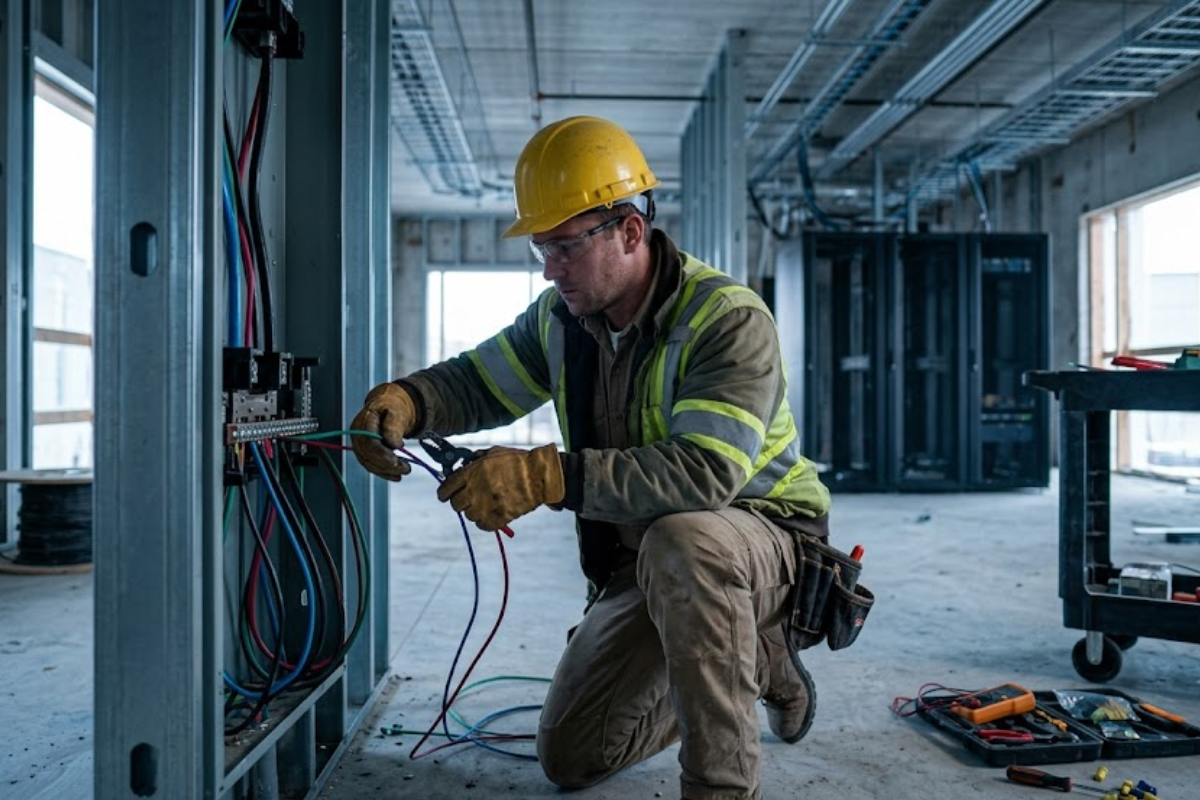
Construction speed depends on the skilled trades workers a project can actually secure within its hiring window. Electricians deserve close attention because data centers require extensive electrical installation, testing, backup power work, and ongoing maintenance. A regional employment total offers a starting point, but concentration, unemployment, active recruiting, and contractor availability determine how much capacity exists for another major project.
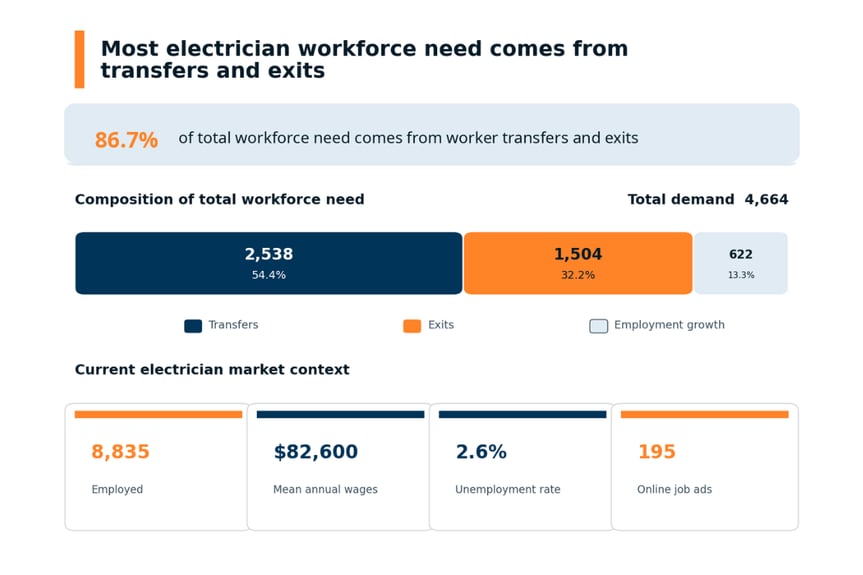
According to the 2026 JobsEQ analysis, the selected region has 8,835 employed electricians, yet only 177 are unemployed, producing a 2.6% unemployment rate. Another 195 active online job ads show that local employers are already trying to fill electrical roles. Mean annual pay of $82,600 provides a useful baseline, though a large construction project will likely need to account for overtime, contractor rates, and wage pressure during peak hiring. A contractor seeking several hundred electricians cannot treat the full employed population as a recruiting pool. Many workers are committed to current employers, union assignments, active construction projects, or established commute patterns. Site teams should confirm how many crews contractors can add, how quickly they can add them, and what compensation will be required before locking the construction schedule.
Labor sheds show the talent each location can reach
A labor shed measures where workers live and how far they travel to reach jobs, making it more useful than county or state borders for data center site selection. It shows the practical recruiting area around a site and exposes the places where drive times, road access, and competing job centers will narrow the reachable talent pool.
Picture a proposed facility near three counties. County totals can make the pool appear large, yet commuting flows may show most electricians travel toward a major employment center in the opposite direction. A labor-shed view may reveal a smaller nearby community whose workers already use the proposed route. That community could be a better hiring source than the largest county.
Commuting behavior affects pay, recruiting messages, shift design, and transportation planning for corporate relocation and new business locations. A 30-minute and a 60-minute labor shed can produce different staffing conclusions. Site teams should compare both and explain which threshold fits the roles being filled.
Local hiring pressure changes the value of worker counts
A large labor pool can look reassuring until you ask how many workers are actually available. Low unemployment, active job ads, employer concentration, recent employment gains, and expected worker exits all affect how difficult hiring will be. A site with thousands of electricians can still face tight recruiting conditions when those workers are already employed or moving between established projects.
The electrician analysis makes that pressure clear. Total workforce need reaches 4,664 positions, including 1,504 exits, 2,538 transfers, and 622 positions tied to employment growth. Most hiring activity comes from replacing or moving existing workers, so a new data center enters an active hiring market rather than drawing from an unused pool. Site teams should compare the employers already recruiting these workers, the wages attached to major projects, contractor capacity, and practical commute access. A smaller market can offer a stronger hiring path when fewer employers are competing for the same trades and local contractors have room to add crews.
“A new data center will enter that hiring flow rather than recruit from an untouched pool.”
Wage trends reveal location costs before construction begins
Wage analysis should estimate the pay required to attract and retain workers at each phase, rather than simply compare regional averages. Current wages provide a baseline, while recent wage movement, job-ad pay, union terms, overtime practices, and contractor rates reveal the actual cost of entering the market. That cost should be modeled before incentives are treated as savings.
Suppose one site shows electrician pay near $82,600 and another shows a lower average. The lower figure will not guarantee a lower staffing bill if qualified workers are scarce, commute distances are longer, or employers are raising offers. A credible compensation benchmark tests the expected offer range for each occupation and the premium required during peak construction.
Wage pressure also affects operating continuity. Facilities technicians and electrical specialists support systems that cannot tolerate prolonged vacancies. Underpricing those roles can create turnover, overtime, and contractor reliance after the facility opens, shifting costs from the construction budget into operations.
Training pipelines shape long-term staffing resilience
Training capacity shows how a market will replace workers and support expansion after the first hiring cycle. Site teams should examine apprenticeship completions, technical programs, instructor capacity, employer partnerships, and the time required for new workers to reach full proficiency. A program name alone does not prove that enough graduates enter the relevant occupations.
A community college might offer electrical technology and heating, ventilation, and air conditioning programs, yet completions may cover only a small share of regional hiring needs. An apprenticeship can offer stronger trade alignment, though cohort size and employer sponsorship will limit near-term output. Site teams should compare completions with exits, transfers, and growth-related needs to measure the gap.
Training partnerships work best when tied to named roles and start dates. A data center operator can coordinate curriculum, equipment, internships, and instructor support with local providers. A clear staffing plan should show which roles the pipeline will fill, when graduates will be ready, and how many hires it can supply.
Workforce comparisons support the final site recommendation
A final recommendation should test every site against the same workforce questions and state the tradeoffs clearly. Power, land, incentives, and permitting still matter, but the workforce case shapes schedule confidence and operating stability. The strongest location will show accessible talent, credible pay assumptions, and a practical replenishment path.
|
Workforce question |
What the answer means for the site |
|
Can nearby skilled trades staff the build? |
A strong pool supports the schedule and limits reliance on travel crews. |
|
Can the market fill ongoing operating roles? |
A balanced pool supports staffing after construction ends. |
|
How much hiring pressure exists for priority occupations? |
Lower pressure gives recruiters more room to fill roles at planned pay. |
|
Do pay assumptions match current local conditions? |
Credible ranges protect the budget from late revisions and vacancies. |
|
Can training providers support replacement and expansion? |
A sufficient pipeline creates a repeatable source of qualified workers. |
Good site selection comes from disciplined comparison rather than a single attractive metric. Chmura’s labor-shed and skilled-trades analysis connects workforce reach, availability, cost, and timing to the location choice. A site earns confidence when its workforce case can withstand the same scrutiny as its power plan.